A young woman of low birth falls in love with a nobleman’s son. They marry in secret. He leaves for the capital promising to return. A cruel official arrives and demands she become his concubine; she refuses, and is imprisoned and beaten for it. Then, at the last possible moment, a stranger reveals his true identity and everything changes. If that sounds like the plot of a K-drama you’ve seen, that’s because Korean screenwriters have been reworking this story for decades. The Tale of Chunhyang is roughly 250 years old, and it may be the single most influential love story in Korean culture.
What Is The Tale of Chunhyang?
Chunhyangjeon (춘향전) is Korea’s best-loved folk romance. Nobody knows who wrote it or exactly when; the version we know took shape somewhere between the late 17th and early 19th centuries, passed along and polished by performers rather than composed by a single author.
That’s because it didn’t begin as a book at all. It began as pansori — a form of Korean musical storytelling — under the title Chunhyangga, “The Song of Chunhyang.” Of the twelve pansori works that once existed, only five survive, and Chunhyangga is the most famous of them all. The prose novel came later, written down from what audiences had been hearing for generations.
The heroine’s name sets the tone: Chunhyang means “scent of spring.”
The Story
A meeting at the pavilion
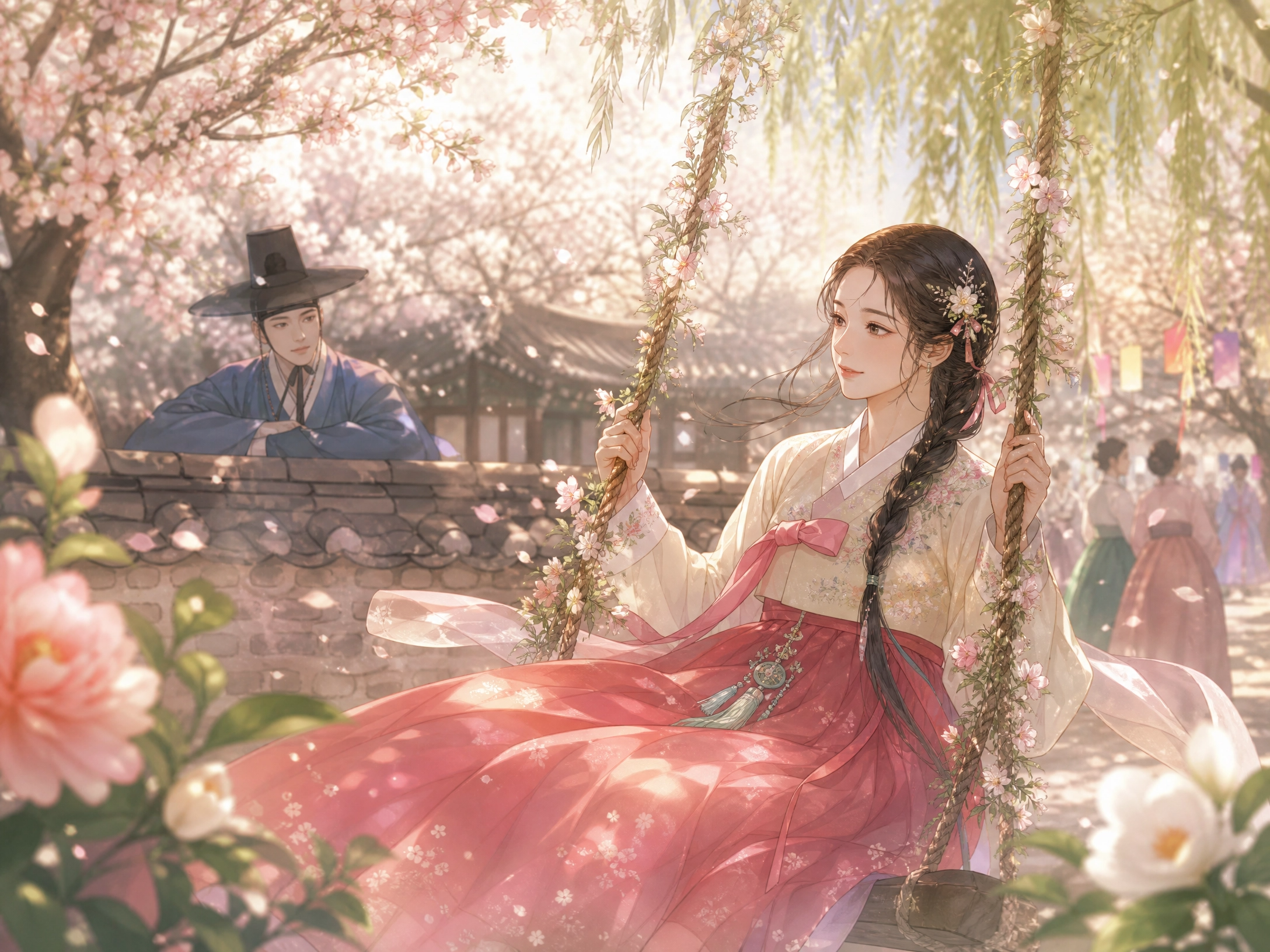
Chunhyang is the daughter of Wolmae, a former gisaeng — a class of female entertainers who were often cultured and accomplished but socially looked down upon. One spring day in the town of Namwon, Yi Mongryong, son of the local magistrate, is out walking when he sees a girl on a swing among the blossoms. He is instantly transfixed. They meet at Gwanghallu Pavilion, and despite the gulf in their social standing, they fall in love and pledge themselves to each other in a private ceremony.
The separation
Mongryong’s father is promoted to a post in the capital, and the family must move. Because of Chunhyang’s birth, Mongryong cannot bring her. He leaves to study for the civil service examination, promising to return for her once he has passed.
The ordeal
A new magistrate, Byeon Hakdo, arrives in Namwon — corrupt, arrogant, and used to taking what he wants. He summons Chunhyang and orders her to serve him as his concubine. She refuses, insisting she is already a married woman. Enraged that a girl of her status would defy him, he has her beaten, chained, and thrown into prison to await execution.
The return
Meanwhile, Mongryong passes the examination at the top of his class and is appointed a secret royal inspector — a real Joseon institution, an undercover official who traveled in disguise to investigate corrupt local officials and could remove them on the spot. He returns to Namwon dressed as a beggar. He visits Chunhyang in prison, still concealing who he is, and she remains loyal even believing he has nothing.
Then, at Byeon Hakdo’s lavish birthday banquet, Mongryong reveals his badge. The magistrate is arrested, Chunhyang is freed, and the lovers are reunited. It is one of the great crowd-pleasing endings in world folk literature — and Korean audiences have been cheering it for two centuries.
Why It’s More Than a Romance
On the surface it’s a love story. Underneath, it’s about power.
Chunhyang’s defiance is remarkable precisely because of who she is. A gisaeng’s daughter in Joseon Korea had almost no standing to refuse a magistrate anything. Her refusal isn’t just romantic fidelity — it’s an ordinary person asserting that she has the right to say no to someone who outranks her completely. The story’s villain isn’t a rival lover; it’s the abuse of official power, and the climax is quite literally the arrival of justice from above.
That’s why the tale flourished among common audiences. Pansori was performed in open air for ordinary people, and here was a story where a powerless woman held her ground against a corrupt official and won. Whether Chunhyang is best read as a Confucian model of wifely virtue or as an early portrait of personal dignity is a debate that continues among scholars — and the fact that it works both ways is part of why it has lasted.
Pansori: The Art Form Behind the Story
To really understand Chunhyang, it helps to know how it was originally delivered. A pansori performance needs only two people: a singer and a drummer. The singer performs every character and narrates, alternating between song and spoken passages, stretching or compressing rhythm and melody to match the emotion of the moment. A full performance of Chunhyangga can run for hours.
Once dismissed by the elite as entertainment for commoners, pansori was gradually recognized as a sophisticated art. In 2003, UNESCO designated it a Masterpiece of the Oral and Intangible Heritage of Humanity. If you ever get the chance to hear even ten minutes of it live, take it — the raspy, wrenching vocal style is unlike anything else.
Chunhyang in Modern Korean Culture
The story never really left. It has been adapted into films repeatedly across the decades, and into television, comics, and stage productions. One of the most enjoyable modern versions is the 2005 drama Sassy Girl, Chun-hyang, which transplanted the tale into a contemporary high school and mixed pansori into its soundtrack alongside modern pop — the first series written by the celebrated Hong sisters.
Its DNA runs even deeper than direct adaptations. The class-crossed couple, the scheming powerful antagonist, the hero who conceals his true identity until the perfect dramatic moment: these are the load-bearing beams of countless Korean dramas. Watch enough of them and you start seeing Chunhyang everywhere.
Visiting Chunhyang’s Hometown
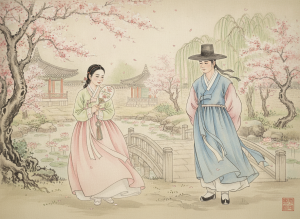
Namwon, in North Jeolla Province, has fully embraced its most famous fictional resident. You can visit Gwanghallu Garden, the setting of the lovers’ first meeting, which contains a shrine dedicated to Chunhyang, along with a Chunhyang-themed park nearby. The city holds an annual Chunhyang Festival in spring. It’s a rare chance to stand in the actual place a story you’ve just read is set — even if the story is fiction.
How to Read It in English
Chunhyang has been translated into English many times, going back to the late 19th century, and different versions emphasize different things — some the romance, some the Confucian virtue, some the social critique. Because there’s no single definitive edition, the practical approach is to look for it in anthologies of classic Korean fiction, where it frequently appears alongside other Joseon-era works. The translation by Richard Rutt, published in a collection of traditional Korean fiction, is among the more widely read.
Alternatively, seek out a filmed version or a recorded pansori performance. Given that this story spent most of its life being sung rather than read, hearing it may be closer to the original experience than any book.
Keep Exploring Korean Books
Enjoying Korea’s classics? Meet Hong Gildong, Korea’s Robin Hood and its most famous folk hero, or The Nine Cloud Dream, the Buddhist masterpiece often called Korea’s greatest classic novel. For something more modern and heartbreaking, try Sonagi, the short story every Korean reads in school.
For another Korean tale where the English version tends to stop early, see Heungbu and Nolbu.