Most visitors to Korea never think of Incheon as anything but the airport. But if you follow the subway a few stops inland, you arrive at a neighborhood that hosted one of the most euphoric nights in Korean sporting history — and that, on an ordinary evening, turns into one of the loveliest quiet corners in the city. This is the area around Munhak Stadium and Seonhak, where a World Cup landmark, a working baseball park, a community garden hill, and a riverside cycling path all sit within walking distance of each other. As someone who lives here in Incheon, this is a walk I’d genuinely recommend.
Munhak Stadium: Where Korea Reached the Round of 16
Incheon Munhak Stadium opened in late 2001 and became one of the ten venues for the 2002 FIFA World Cup, co-hosted by Korea and Japan. For Koreans of a certain age, one match here is unforgettable: in June 2002, Korea beat Portugal 1–0 on a spectacular goal from Park Ji-sung, securing a place in the Round of 16 for the first time in the nation’s history. The whole country erupted. If you have ever seen footage of red-shirted crowds flooding Korean streets that summer, this stadium is part of the reason why.
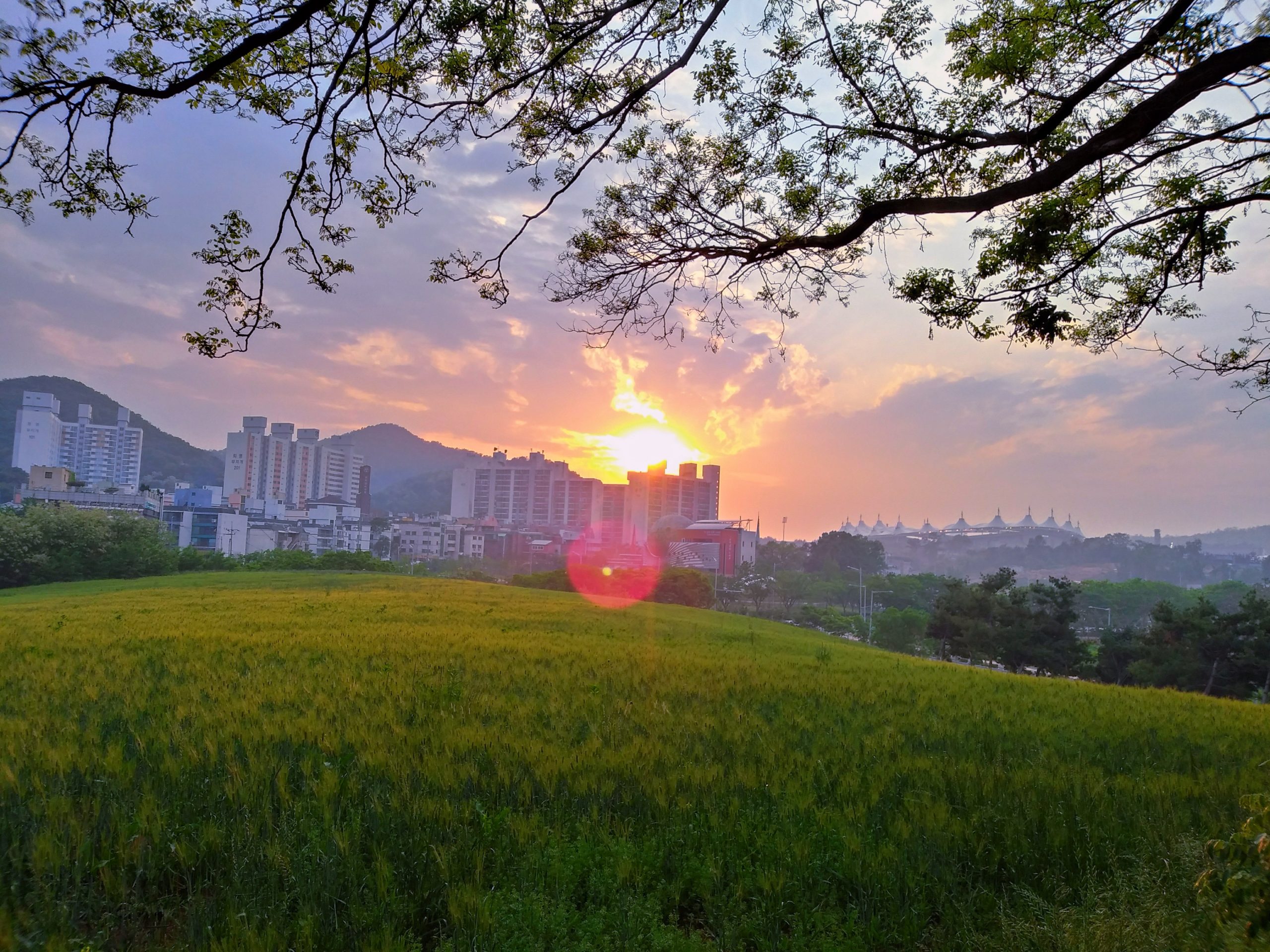
The main stadium seats around 50,000, and its most striking feature is the roof — a vast membrane canopy held up by 24 pillars, one of the largest structures of its kind in the world. You can spot that distinctive white, tent-like silhouette from surprisingly far away. In my second photo, taken from a park hillside on the other side of the neighborhood, those pale peaks on the horizon are the stadium roof catching the last of the sunset.
The Baseball Park Next Door
Right beside the football stadium sits Incheon SSG Landers Field, home of the SSG Landers of the KBO League — Korean professional baseball. With roughly 23,000 seats, it has a reputation as one of the better-appointed ballparks in the country, and it has been steadily renovated over the years.
If you have never been to a Korean baseball game, it is worth planning your visit around one. Korean baseball crowds are famous for organized cheering: every player has a personal chant, fans sing continuously, and the atmosphere feels closer to a music festival than a sporting event. Even people who don’t follow baseball tend to leave grinning. The complex also includes an indoor swimming pool named after Olympic swimmer Park Tae-hwan, plus futsal courts and a climbing wall.
Seonhak: An Asian Games Venue Turned Ice Rink
Walk about five minutes from Munhak and you cross into a different district — Yeonsu-gu — and reach the Seonhak sports complex. The two are so close you’d never notice the boundary, which follows a ridge of Cheonghaksan and the expressway running alongside it.
Seonhak was built for the 2014 Asian Games, which Incheon hosted, and staged handball and hockey events. What makes it interesting is what happened afterward. Rather than being left to rot the way so many Asian Games venues around the world have, the handball arena was converted into the Seonhak International Ice Rink, which opened in 2015 and runs year-round. Before the 2018 PyeongChang Winter Olympics, foreign teams came here to train. Today it’s a public rink where you can rent skates and go around in circles like everyone else, alongside a gymnasium, a hockey arena, park golf, and an inline skating track.
Hanmaeum Park: The Local Secret
Here’s the part no guidebook will tell you. Just beside the Seonhak complex sits Hanmaeum Neighborhood Park, a small green hill that functions as the area’s living room.
It isn’t a manicured tourist park. It’s a natural rise with walking paths, shade trees, and — the detail I like most — plots of community vegetable gardens where local residents grow their own crops. On a spring or early summer evening you’ll find retirees tending rows of greens, families out for a stroll, and kids running loose in the grass. It’s the kind of unhurried, ordinary scene that tells you more about how Koreans actually live than any palace tour.
It’s also the best vantage point around. From the top of the hill, the view opens west across the neighborhood toward Munhak, and when the sun drops behind the hills, the whole sky over the stadium turns orange and violet. My photos here were taken on exactly one of those evenings, and I’d put that sunset up against anything in Seoul.
The Seunggicheon Cycling Path to Songdo
Running right past Seonhak is the Seunggicheon, a stream with a paved path along its banks — and this is the area’s hidden superpower. The path is part of Incheon’s cycling network and links this old inland neighborhood all the way down to Songdo, the futuristic waterfront district of glass towers and wide boulevards built on reclaimed land.
That contrast is what makes the ride special. You start among low-rise apartments, garden plots, and a World Cup stadium from 2002, follow a quiet stream lined with reeds and herons, and finish among the skyscrapers of one of the most ambitious planned cities in Asia. It’s a short, flat, traffic-free ride that packs in about forty years of Korean urban history. Rental bikes are available around the city, and the route is well paved and easy for casual riders.
How to Visit
- Getting there: Take Incheon Subway Line 1 to Munhak Stadium Station or Seonhak Station — both put you within walking distance of everything mentioned here.
- Best time to go: Late afternoon into sunset. Come in the early evening and you can walk the park hill, catch the sunset, then head out for dinner.
- Check the schedule: If you want the full experience, look up the SSG Landers’ home fixtures before you come. The neighborhood transforms on game days.
- Bring a bike, or rent one: The Seunggicheon path toward Songdo is the highlight for anyone who cycles.
- Wear comfortable shoes: The park is a real hill, not a flat lawn.
Why This Corner of Incheon Is Worth Your Time
What I love about this neighborhood is how casually it carries its history. A stadium that once held the hopes of an entire nation now sits between vegetable plots and a stream path, used by ordinary people on ordinary evenings. There’s no ticket booth for the view, no queue for the sunset. You just walk up the hill with everyone else who lives here.
For travelers who have already done the palaces and the shopping streets and want to see how Koreans actually spend a Tuesday evening, an afternoon around Munhak and Seonhak is far more rewarding than another crowded tourist district.
Keep Exploring Hidden Incheon
Want more of the real Incheon? See our local’s guide to Juan Station, with its food alley and sprawling underground arcade, or the greener side of the city at Juan-dong’s Citizens Park. And for one of Korea’s most beautiful hidden getaways further afield, don’t miss Okjeong Lake.
If you are already out this way, Bupyeong Station and its underground arcade are a short ride on Incheon Subway Line 1.