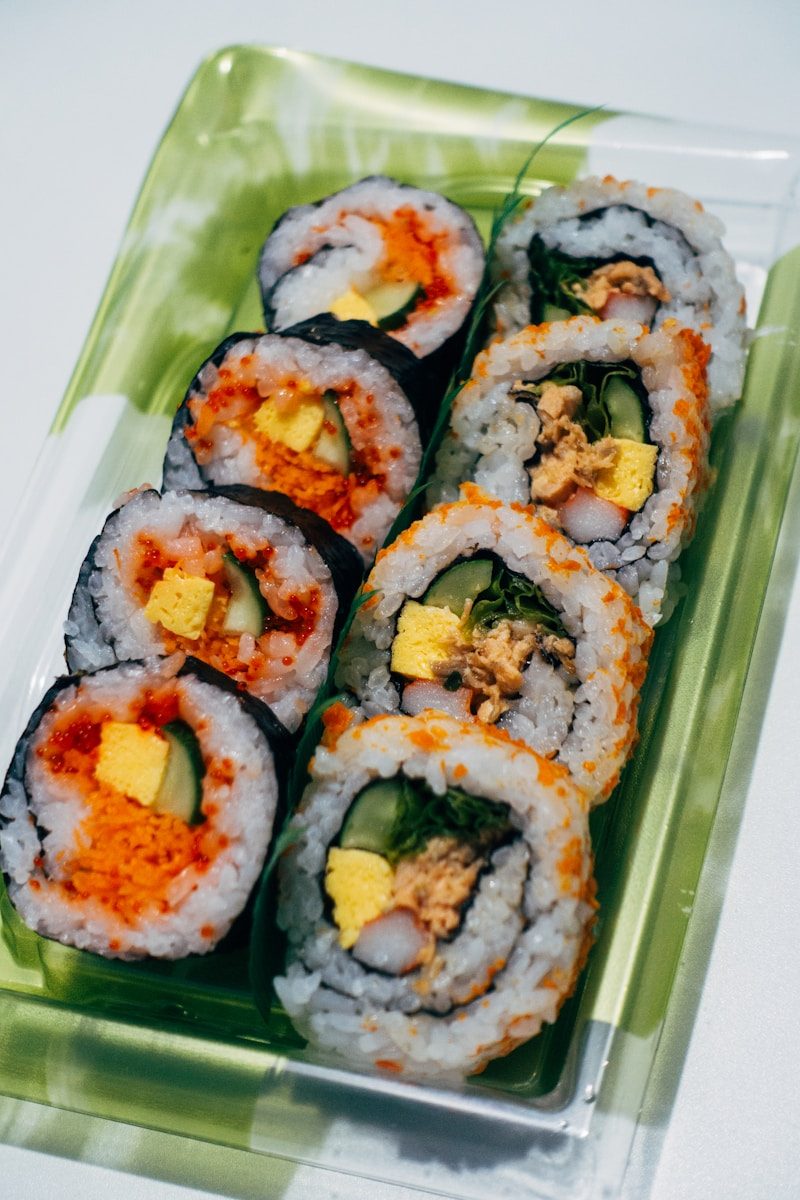
What is kimbap? Rice and fillings rolled in seaweed, sliced into rounds. Structurally it resembles sushi, and that comparison is where most English explanations stop.
It is not a useful place to stop. Sushi is a restaurant tradition built on raw fish and a chef’s precision. Kimbap is something a mother made at five in the morning so her child would have something to eat on a school trip.
That difference is the whole subject.
The morning before a school picnic
Through the 1980s and 90s, kimbap was not everyday food in an ordinary household. It appeared for occasions — a celebration, and above all the sopung (소풍), the school outing.
The work started before dawn, because the fillings had to be prepared individually and each one cut into long strips the length of the roll.
- Carrot, cut long and cooked
- Cucumber, cut long, seasoned
- Burdock root, simmered until dark and sweet
- Ham, cut into matching strips
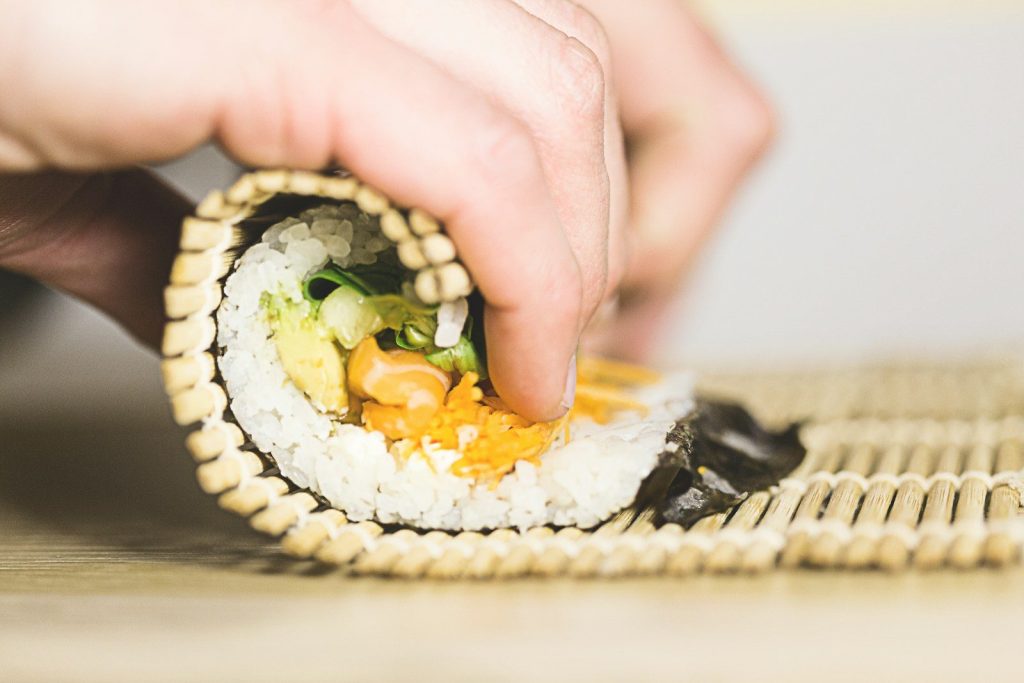
Then plain white rice, then rolling — by hand, without tools. Mothers across the neighborhood were doing the same thing at the same hour, and the child woke up to a lunchbox that had taken most of a morning to build.
Rolling by hand is harder than it sounds. Too loose and the roll collapses when it is cut; too tight and the rice compacts into something dense and unpleasant. The rice has to be spread thin enough to see the seaweed through it, the fillings have to sit in a straight line, and the whole thing has to be closed in one continuous motion. There is no correcting a roll halfway through.
White rice mattered too. Korean households of that era did not always eat pure white rice — barley or other grains were often mixed in to stretch it. A lunchbox of plain white rice was itself a small statement, food prepared to a standard the family would not normally apply to an ordinary Tuesday.
And the timing was unforgiving. Kimbap does not survive being made the night before; the rice hardens and the seaweed turns limp. Which is why mothers were awake at five rather than at nine the evening prior. The early hour was not devotion for its own sake. It was the only window the food allowed.
You could read a family’s situation in it
Ham was not a given. Households with more room in the budget included it as a matter of course; others worked around it.
The clearest marker was the outside of the roll. A brush of sesame oil and a scatter of sesame seeds — glossy, fragrant, unmistakable when the lunchbox opened. It cost almost nothing and it was not something every family did.
Korean children of that generation knew this without anyone explaining it. The lunchbox was visible to everyone sitting on the same picnic mat.
None of this was cruel, and mostly it was not even remarked on. Children shared. Lunchboxes got opened together on a mat, pieces travelled between them, and a roll made without ham was eaten as readily as one made with it. But the information was there, and everyone absorbed it without discussion.
What is striking looking back is how much labor sat behind a food that was, in the end, a snack. A morning of cutting and cooking and rolling, for something eaten in fifteen minutes on a hillside. Korean adults who describe their mothers’ kimbap are rarely talking about flavor. They are talking about someone getting up in the dark.
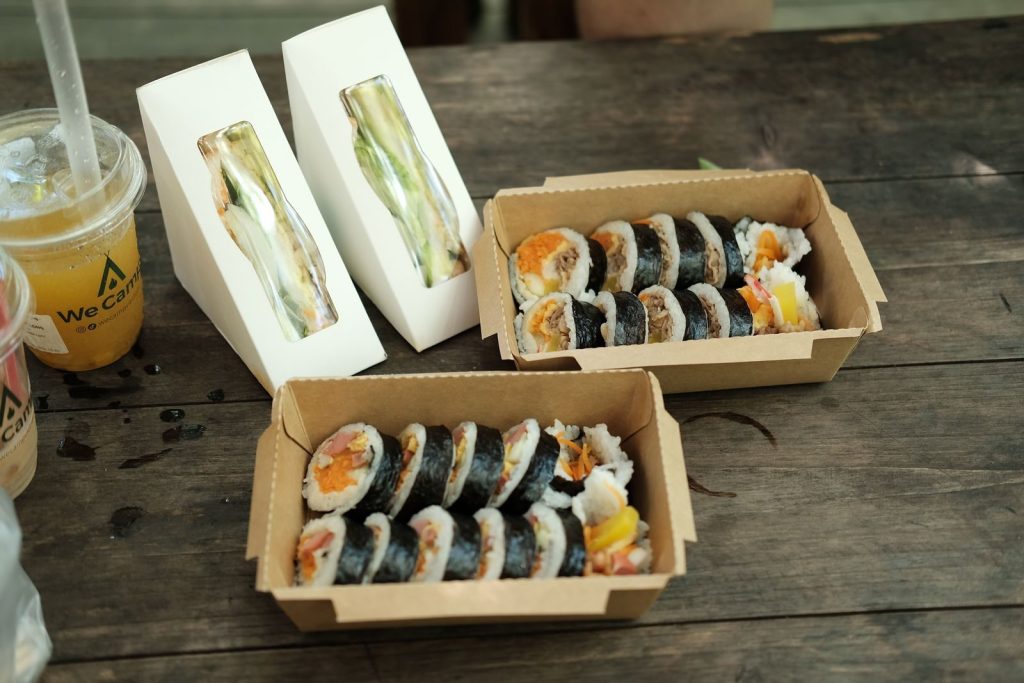
For many Koreans, gimbap is the taste of sopung, the school picnic day. In Incheon, one of the classic picnic spots was Incheon Grand Park, where classmates traded slices on the grass after the treasure hunt.
What changed
Kimbap is now ordinary. You can buy it at a dedicated kimbap shop on nearly any commercial street, and the menu will run to a dozen or more versions — tuna, cheese, spicy pork, vegetables only, rolls made without rice.
At home it is easier too. Rolling mats and simple tools took away the part that required practiced hands, which was the part that used to take the time.
Something is gained and something is lost in that, and Koreans of a certain age will tell you both at once. Kimbap is available whenever you want it now. It also no longer means what it meant when it only arrived on the morning of a school trip.
The shops themselves changed the economics. A roll from a kimbap shop costs little enough that making one at home is no longer obviously cheaper, only different. For a working household, buying is the rational choice, and most people make it most of the time.
Home rolling has not disappeared, though. It reappears for the same reasons it always existed — a family outing, a long train journey, a child’s school event. The occasion still pulls the mat and the ingredients out, even in houses where nobody has rolled one in months.
One thing did not change at all. Kimbap is still portable food that needs no reheating, no utensils, and no table. Every version on a shop menu today, however elaborate, is built on that same premise: something you can hand to someone who is about to leave the house.
How Koreans actually eat it
It is finger food, eaten at room temperature, not a dish you sit down to with utensils. That is exactly why it worked for outings, and why it still turns up on trains, at sports fields, and at the desk of someone eating quickly.
Kimbap shops are fast and cheap, and they usually sell tteokbokki alongside — dipping kimbap into the spicy sauce is a standard move rather than an improvisation.
Two things worth knowing. It is not refrigerated before eating, because cold hardens the rice. And it is eaten the same day, ideally within hours — this is food built around freshness, not storage.
That last point is a genuine safety matter in summer, not just a preference. Kimbap sits at room temperature with cooked fillings inside, and Korean households treat leftover rolls with real caution when the weather is warm. If you buy some, eat them that day.
The rice is seasoned, which is where the sushi comparison breaks down most clearly. Sushi rice is dressed with vinegar; kimbap rice is dressed with sesame oil and salt. That single difference sets the entire flavor in another direction — nutty and savory rather than sharp — and it explains why soy sauce and wasabi never enter the picture. There is nothing to dip. The seasoning is already inside.
Ordering and pronunciation
Say it gim-bap, two syllables, flat. Gim is the seaweed sheet, bap is cooked rice. You will see it spelled both kimbap and gimbap; both are the same word.
Prices are low by restaurant standards, and one roll is a light meal rather than a full one. Ordering two, or a roll plus something hot, is normal. Our guide to Korean restaurant etiquette covers how ordering works more broadly.
Why it is worth understanding
Call kimbap Korean sushi and you get the shape right and the meaning wrong.
It is domestic food. It came out of home kitchens, it was tied to a specific kind of day, and for one generation it carried quiet information about how a family was doing. The version sold from a shop window today is the same object with a completely different life around it.