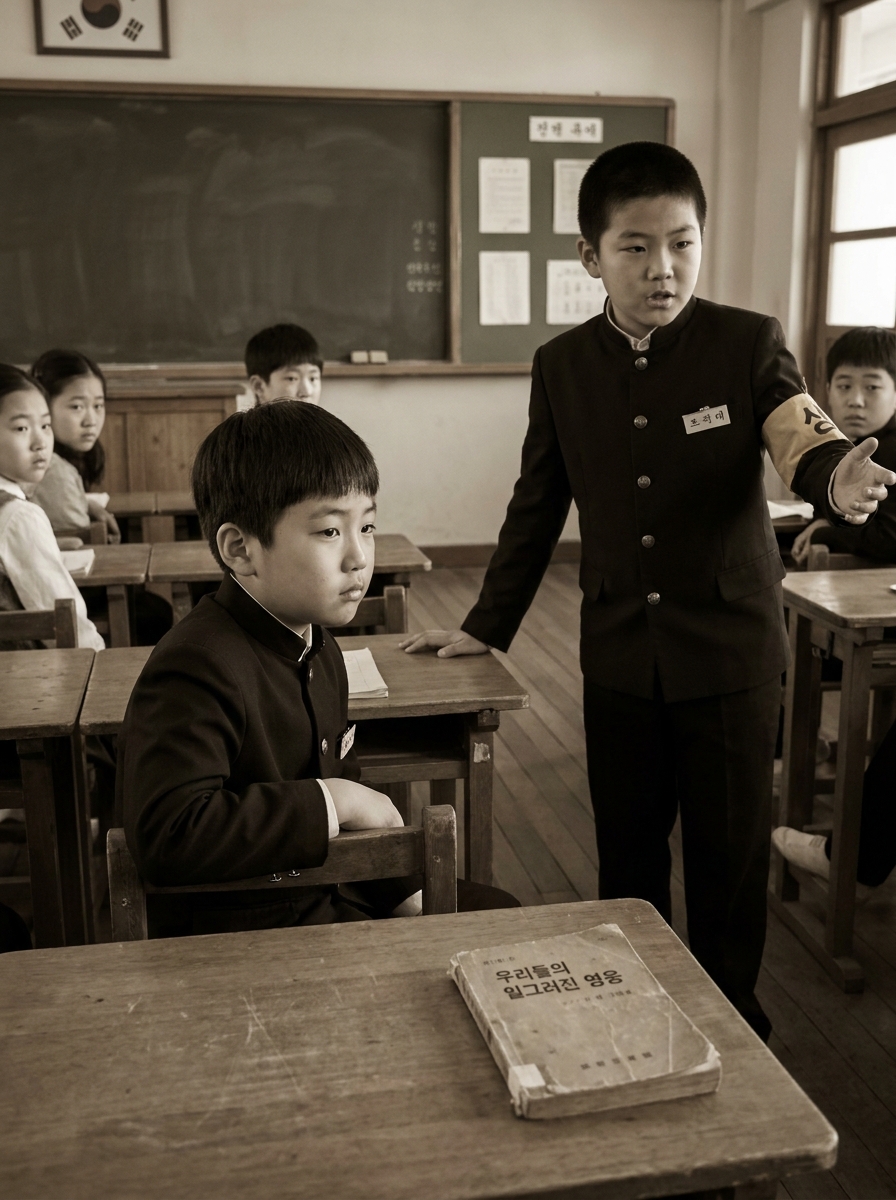
Imagine a single elementary school classroom in a small Korean town. One boy runs it — not the teacher, but a twelve-year-old class monitor who has quietly turned forty children into his subjects. He collects tribute, rewards loyalty, punishes dissent, and rigs the system so completely that the adults never notice. Then a new student arrives from Seoul and decides to fight back.
That’s the setup of Our Twisted Hero (우리들의 일그러진 영웅), a short novel by Yi Munyol that is one of the most widely read works of modern Korean literature — and one of the few that translates almost effortlessly for readers anywhere in the world. On the surface it’s a story about a schoolyard bully. Underneath, it’s a razor-sharp allegory about how dictatorships take and lose power.
What Is Our Twisted Hero?
Our Twisted Hero is a novella first published in 1987. It won Yi Munyol the Yi Sang Literary Award, one of Korea’s most prestigious fiction prizes, the same year. It later became the first of Yi’s books to be published in North America, appearing in English in the early 1990s in a translation by Kevin O’Rourke.
The book is short — closer to a long short story than a full novel — which is part of why it works so well as an introduction to Korean literature. It moves fast, the premise is instantly clear, and you don’t need any background in Korean history to feel the tension. But if you do know the history, a second layer opens up underneath the first.
The Story
The narrator, Han Pyongt’ae, is twelve when his family moves from Seoul to a small provincial town and he transfers into the local school. He arrives confident — a big-city kid who assumes he’ll naturally rise to the top of his new class.
Instead he finds the class already ruled, absolutely, by the class monitor Om Sokdae. Sokdae isn’t a crude bully who throws punches. He’s something more unsettling: a genuine leader, clever and charismatic, who has built a whole order of loyalty and fear. Classmates hand over their possessions, write his assignments, and cover for his cheating — and they do it willingly, because Sokdae also protects them and makes the class run smoothly.
Han refuses to bow. He fights Sokdae’s rule for months, expecting the other children to rally behind him once they see the injustice. They don’t. Instead Han is isolated, harassed, and worn down until he finally gives in — and then discovers something worse about himself. Once he accepts Sokdae’s power, he’s rewarded with privilege, and he comes to enjoy it. He stops being the rebel and becomes the right-hand man.
Then a new teacher arrives, and the entire structure that seemed so permanent collapses with startling speed. What happens to Sokdae afterward — and how the class reacts — is where the book delivers its final, uncomfortable punch. (No spoilers here.)
The Allegory: A Classroom as a Country
This is the layer that makes the book famous. Our Twisted Hero was written in 1987 — the exact year South Korea was convulsing through mass protests that ended decades of military dictatorship. Read in that light, the classroom stops being a classroom.
Sokdae is the strongman ruler: not simply evil, but effective, offering order and stability in exchange for freedom. The compliant classmates are a population that trades liberty for a quiet life, telling themselves the arrangement isn’t so bad. Han is the intellectual dissident who resists, breaks, collaborates, and has to live with that. And the new teacher who topples Sokdae raises the book’s hardest question — whether freedom handed down from above by a new authority is the same thing as freedom won by the people themselves.
Yi Munyol refuses to make it comfortable. The story doesn’t end with a clean triumph of good over evil. It ends by asking what the “liberated” classmates actually learned, and whether they’d do it all again under the next Sokdae. That refusal to flatter the reader is exactly why the book has lasted.
Why It Travels So Well
Plenty of great Korean novels lean heavily on cultural context that outside readers have to work to reach. Our Twisted Hero doesn’t. Almost everyone, in any country, has been inside a group ruled by one dominant personality — a classroom, an office, a team — and has watched people rationalize going along with it. The bullying story is universal, and the political allegory maps onto far more than just Korea.
Reviewers in the West picked up on this immediately. Salman Rushdie compared it to Günter Grass, and critics reached for Lord of the Flies — another deceptively simple story of children that’s really about how power works among adults. If you liked the idea behind that book, this is its sharp, compact Korean cousin.
Should You Read It?
Yes — especially if you’re looking for a first step into modern Korean literature that won’t overwhelm you.
- Length: very short. You can finish it in a single sitting.
- Difficulty: easy to read, but it rewards thinking afterward.
- Best for: readers who like allegory, political fiction, or coming-of-age stories with a dark edge.
- Pairs well with: George Orwell’s Animal Farm or William Golding’s Lord of the Flies, both of which use a small closed world to say something large about power.
Look for the English edition translated by Kevin O’Rourke. It’s widely available secondhand and through libraries, and it also appears in some collections of Yi Munyol’s shorter fiction.
About the Author
Yi Munyol (born 1948) is one of South Korea’s most acclaimed and widely read novelists, the author of dozens of novels and novellas that have sold in the millions at home. His own life was shaped by the divisions the book quietly circles: his father defected to North Korea during the Korean War, and Yi grew up amid the hardship and suspicion that followed. That background — a childhood marked by political fracture — runs beneath much of his work, and it’s part of why his stories about power feel so lived-in rather than abstract.
Keep Exploring
Our Twisted Hero is a modern entry point, but Korean literature runs deep into the past too. For an earlier tale of resistance against unjust power, read about The Story of Hong Gildong, Korea’s Robin Hood. For a modern short story every Korean reads in school, see Sonagi (The Shower). And for a classic of love and class defiance, try The Tale of Chunhyang.