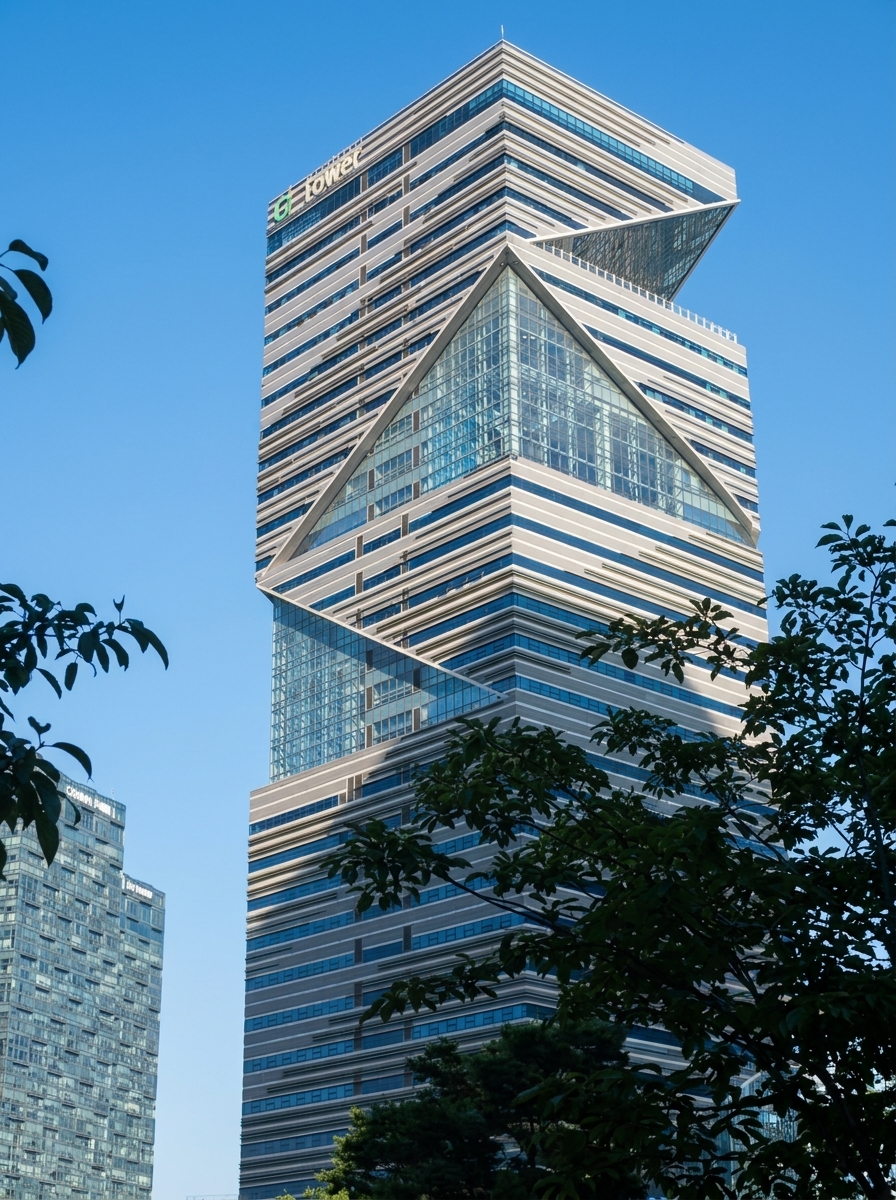
Most visitors to Songdo never look up. They come for Central Park, ride the paddle boats, take a few photos of the skyline, and leave. But one of the best free views in the entire Incheon area sits on the 33rd floor of an office building most tourists walk right past — the twisted, notch-cut tower on the north edge of the park.
That building is G-Tower (G타워), and its top-floor observatory is open to the public at no charge. No ticket, no reservation, no drone required. This is where locals go when they want the Songdo skyline from above without paying for it, and almost nobody outside Incheon knows it’s there.
What Is G-Tower?
G-Tower is a 33-story government and office building in Songdo, the planned “smart city” district built on reclaimed land in Incheon’s Yeonsu-gu. At 145.8 meters it isn’t Songdo’s tallest tower, but it’s easily its most recognizable — the facade is cut with deep diagonal notches that make the whole thing look carved rather than built.
The building opened in February 2013 under the name I-Tower. Later that year the Green Climate Fund (GCF) — a United Nations climate finance body, one of the largest of its kind in the world — established its permanent headquarters here, and the building was renamed G-Tower after it. Several other UN-affiliated agencies share the address, along with the Incheon Free Economic Zone (IFEZ), the authority that runs Songdo, Yeongjong, and Cheongna.
None of that sounds like a tourist attraction, and officially it isn’t. The observatory exists because IFEZ runs a public promotion hall on the top floor — and that promotion hall happens to sit behind a 360-degree wall of glass.
The Free Observatory on the 33rd Floor
The 33rd floor is officially the IFEZ Promotion Hall, an exhibition space about how Songdo and the surrounding economic zone were built. There are touchscreens, scale models of the district, and media displays about the reclaimed-land project that turned tidal flats into a city. Interesting for ten minutes — but that’s not why you go up.
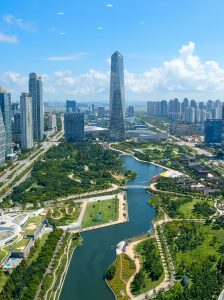
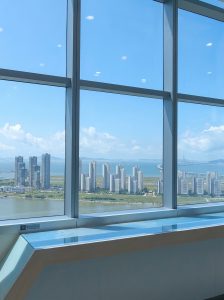
You go up for the windows. The hall wraps the full floor in glass, giving you an uninterrupted panorama in every direction. On a clear day you can trace the entire shape of Songdo: the green sprawl of Central Park directly below, the skyline of the international business district, the reclaimed coastline, and on the best days the long line of the Incheon Bridge stretching out over the Yellow Sea toward the airport.
It’s the view people usually pay for at commercial observation decks in Seoul, except here it’s free, and Songdo’s layout — wide, low, and green in the middle — actually photographs better from a mid-height tower than a super-tall one would. You’re high enough to see everything and low enough to still make out the paths, the water, and the people in the park below.
What It Actually Feels Like Up There
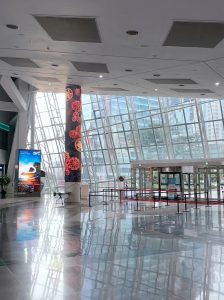
The lobby sets the tone before you even reach the elevator. It’s cavernous and quiet, with a giant world map made of national flags on one wall — a nod to Songdo’s “international city” branding and its cluster of UN offices. During my visit there was a digital art column glowing in the middle of the hall, the kind of thing that makes the space feel more like a museum entrance than an office building.
Because this is a working government building and not a tourist site, the atmosphere upstairs is calm to the point of being sleepy. On weekdays you may share the whole floor with only a handful of other people. Bring a camera, take your time at each window, and don’t expect a gift shop or a café — this is a viewpoint, not an attraction built to sell you things. Food and drinks aren’t allowed in the hall.
Why Tourists Don’t Know About It
Two reasons. First, it’s not marketed as a tourist attraction — it’s an economic-zone promotion hall, buried under a name that means nothing to a foreign visitor. Nothing about “IFEZ Promotion Hall” says “great free view.” Second, Songdo itself is off most tourist routes. It’s a business and residential district, not a sightseeing zone, so unless you already have a reason to be in the neighborhood, you’d never stumble onto it. That’s exactly what makes it worth the detour.
What Else Is Nearby
G-Tower works best as one stop on a half-day in Songdo rather than a destination on its own.
- Songdo Central Park (송도 센트럴파크): right below the tower. A long saltwater canal with paddle boats and kayaks, walking paths, and a small traditional-style garden at the far end. Do the observatory first, then walk the park you just saw from above.
- Tri-bowl (트라이볼): a distinctive curved concert and exhibition hall in the park, worth a look even from outside.
- Incheon Urban History Museum: a short trip away, with detailed scale models of the city — a good companion to the IFEZ hall if you’re into how Songdo was planned.
- Songdo outlet malls: large shopping complexes within a short drive for anyone wanting to combine the view with a meal or shopping.
How to Get There
G-Tower is at 175 Art center-daero, Yeonsu-gu, Incheon. The easiest way in is the Incheon Subway Line 1: get off at Central Park Station (센트럴파크역) and it’s roughly a five-minute walk to the tower on the north side of the park.
Coming from Seoul, take a train to Incheon and transfer to Incheon Subway Line 1, or ride an express bus toward Songdo. From Incheon International Airport it’s one of the closer parts of the mainland — a taxi or airport bus can reach Songdo without going through central Incheon. If you drive, the building has an underground parking garage; parking has been free but the operator has signaled it may become paid, so confirm before you go.
A note on hours: the observatory is free, but opening times have changed more than once — it was renovated and reopened recently, and weekday and weekend hours differ, with Mondays and major holidays typically closed. Because the schedule keeps shifting, check the current hours before making a special trip. Late afternoon is the sweet spot: you catch the city in daylight, then the sunset and the start of the night view from the same window.
Where to Stay Nearby
Songdo is a good base if you want a modern, quiet, spacious side of Korea rather than the crush of central Seoul — and it’s close to the airport, which makes it convenient for a first or last night in the country.
Most accommodation clusters within walking or short-taxi distance of Central Park, so staying near the park usually puts you close to G-Tower as well. You’ll find a mix of international-brand business hotels aimed at the convention center crowd, plus mid-range hotels and serviced residences scattered through the district. For budget travelers, there are smaller guesthouses and motels toward the older parts of Incheon, though those trade the Songdo polish for a lower price. Whatever the tier, check current rates and reviews before booking, since Songdo’s hotel scene skews toward business travelers and prices swing with convention schedules.
If your trip is mainly about Seoul and Songdo is a one-day detour, you don’t need to stay here at all — the Central Park Station subway connection makes it an easy in-and-out from the city.
Is It Worth It?
For a free, no-reservation, five-minutes-from-the-subway viewpoint, absolutely. G-Tower won’t fill a whole day, but it’s the best way to understand Songdo — a city built from nothing on reclaimed sea — by seeing the whole strange, green, planned grid of it laid out at once. Pair it with a walk in the park below and you’ve got a genuinely local half-day that most visitors to Korea never even hear about.
Keep Exploring
G-Tower is one piece of a bigger picture of Incheon that tourists rarely see. For more of the city beyond the airport, read about Cheongna, a district built on the sea, or Munhak Stadium and the 2002 World Cup neighborhood. And for a more everyday, lived-in slice of the city, see our guide to Juan-dong and its underground arcade.