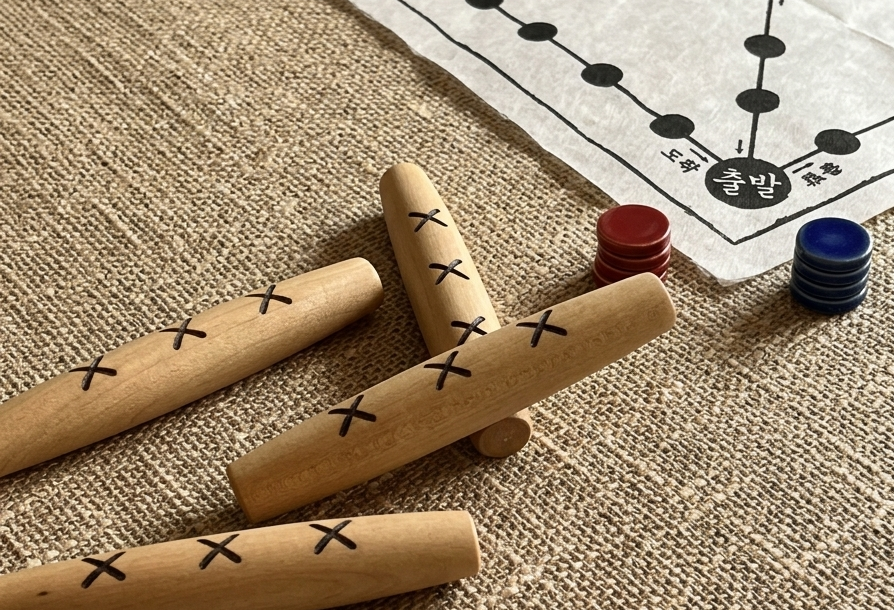
Every guide that explains how to play yutnori gets the rules right and the game wrong. The rules take about four minutes to learn. Four wooden sticks, a board of twenty-nine stations, four pieces per side, first side to bring all four home wins. That is genuinely all of it.
What the rules do not tell you is that yutnori is the only Korean traditional game that still gets played every year by millions of people — and that it survives for a reason that has nothing to do with the rules. It survives because it is the one game that works better the more relatives are crammed into the room.
I grew up playing it in Incheon in the 1980s and 90s, in the version that matters: an extended family gathered at a relative’s house for Seollal or Chuseok, two dozen people, the board drawn on whatever paper was lying around, and small amounts of money on the floor.
What You Need
A yutnori set is almost nothing.
- Four yut sticks. Each is a short length of wood, rounded on one side and flat on the other. The flat face counts as “up.”
- A board (yutpan, 윷판). Twenty-nine stations arranged in a circle with two diagonals crossing the middle.
- Four pieces per team (mal, 말). Anything works. Coins, bottle caps, torn paper, different-colored buttons.
In my family we bought a set. It came with the sticks and usually a printed paper board. Sets like this were sold everywhere before the holidays, and the good ones were not expensive.
How to Play Yutnori: The Rules
Throwing
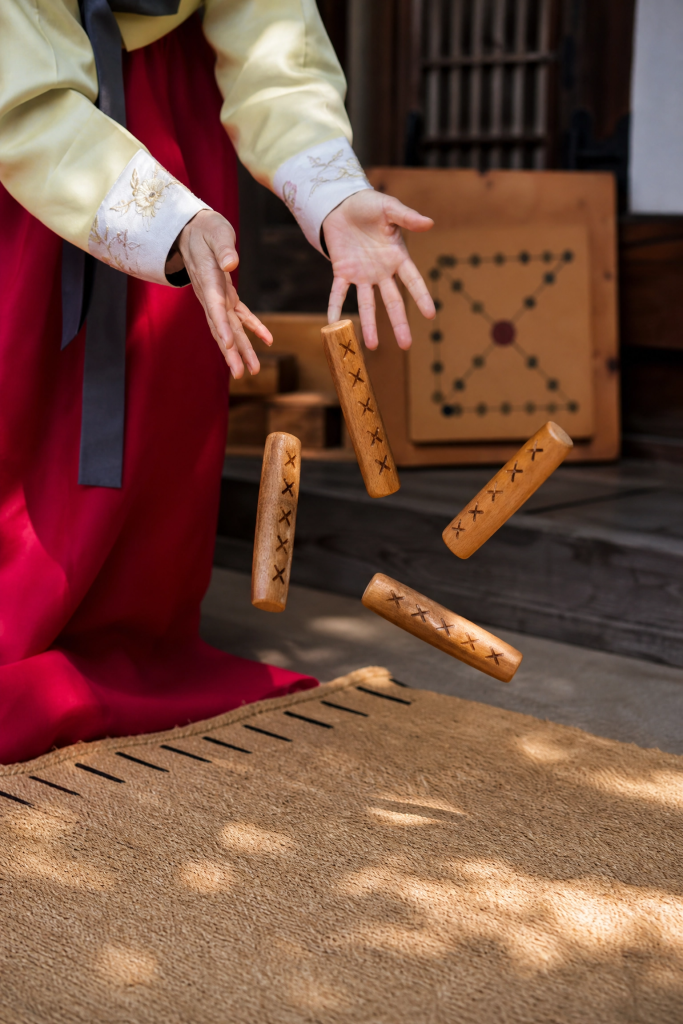
You throw all four sticks at once. The result depends on how many land flat side up.
- Do (도) — one flat face up. Move 1.
- Gae (개) — two flat faces up. Move 2.
- Geol (걸) — three flat faces up. Move 3.
- Yut (윷) — all four flat faces up. Move 4, and throw again.
- Mo (모) — no flat faces up. Move 5, and throw again.
Moving
Pieces enter at the starting station and travel around the outer ring. The clever part is the diagonals: if a piece lands exactly on a corner station, it can turn inward and cut across the middle, which saves a large number of moves. The whole strategic tension of yutnori lives in those shortcuts.
Capturing
Land on a station occupied by the other side and their piece is sent back to the start. You also get another throw. A single capture late in a game can undo ten minutes of progress, which is why yutnori produces more shouting per minute than any other Korean game.
Stacking
Two of your own pieces on one station may be carried together from then on, moving as a unit. It doubles your speed, and it doubles your exposure — if that stack gets captured, both pieces go back at once.
House rules
Almost every family plays with at least one rule that appears in no official description. The most widespread is baekdo (백도), a backward do — one stick in the set is marked, and when that marked stick shows the only flat face, the piece moves one station backward instead of forward. It is cruel and it is very popular, partly because a piece pushed backward off the entry station leaves the board entirely.
Other common variations cover whether a stick that lands leaning against something counts at all, whether a piece sitting exactly on a corner must take the shortcut or may decline it, and how many consecutive bonus throws a lucky streak is allowed. None of this is settled nationally. Agree on your version before the first throw, or you will be arguing about it at minute twenty.
Winning
Bring all four pieces around the board and out past the final station. First team out wins.
The Names Are Animals
The five throw names are usually explained as domestic animals, ordered by how fast they move: pig, dog, sheep, cow, horse. Pig is one step, horse is five. Once you hear that, the sequence stops being arbitrary and becomes easy to remember.
Where those names actually come from is less settled than the popular explanation suggests. One well-known theory links them to the official titles of the ancient state of Buyeo, whose ranks were named after animals — with the pig, dog, cow and horse ranks matching four of the five throws, and the third one left unexplained. It is a compelling idea, and it is a theory, not a documented fact.
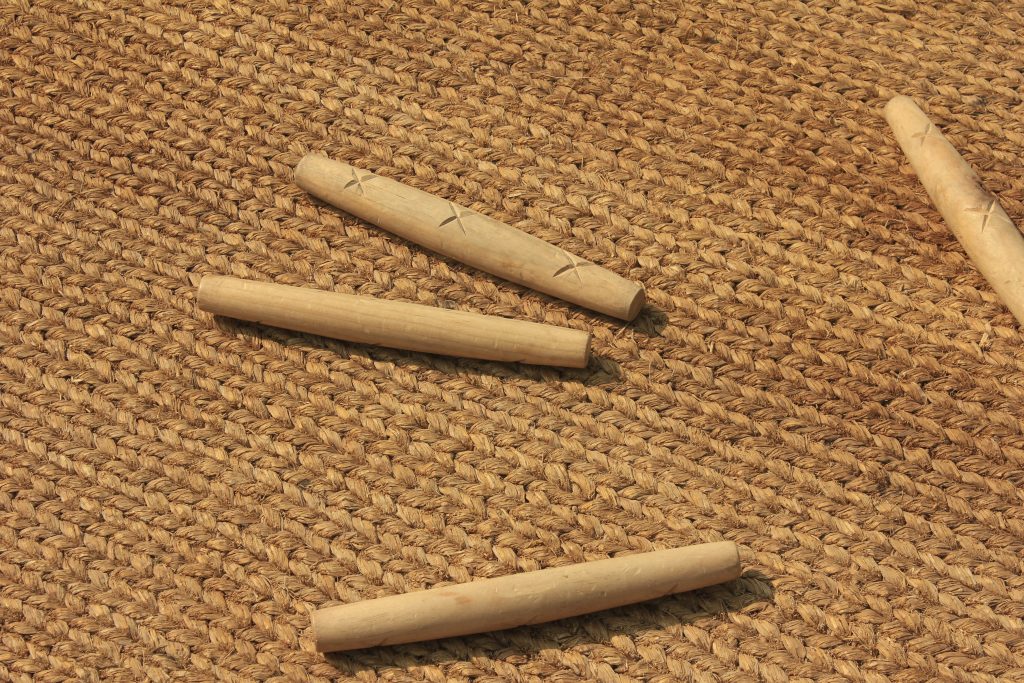
Photo source 한국저작권위원회 김상범
Why the Wood Matters
This is the part I would not want left out.
Yut sticks are wood. In my experience they were always wood — I do not recall plastic sets at all, and I would have noticed, because the material is most of the experience.
Wooden sticks have weight. You feel them leave your hand, and there is a specific dry clatter when four of them hit the floor and scatter. Everyone in the room turns toward that sound before anyone can see the result. In a crowded room, the noise is the announcement.
People also throw with intent, which only works with weight. Some players toss gently to nurse a small number. Others slam the sticks down hard when the family needs a mo, and everyone leans in to watch them tumble. A light plastic stick would take all of that away. The game would still function. It would stop being satisfying.
The Board Was Whatever Paper Was Around
Bought sets came with a printed board, but half the time we did not use it.
Someone would grab a sheet of paper — the back of a calendar page, a used envelope, a page torn from a notebook — and draw the twenty-nine circles freehand with a pen. It takes about a minute. Nobody measured anything, and the circles were never even.
That is worth sitting with, because it explains the game’s survival better than any cultural policy. Yutnori needs four sticks and a pen. Lose the board and you redraw it. Lose a piece and a coin replaces it. There is almost nothing to maintain, and almost nothing that can go missing permanently.
The Game Needed a Full House
Korea in the 1980s and 90s still ran on extended families. On Seollal and Chuseok, relatives converged on one house — grandparents, several sets of aunts and uncles, cousins of every age. Twenty people in an apartment was normal.
Yutnori is built for exactly that situation, and this is the part foreign readers most often miss.
Team sizes are flexible. You can split thirty people into two teams and everyone plays. Skill barely matters, so an eight-year-old and a seventy-year-old are equally likely to throw a mo, which means nobody has to be carried and nobody dominates. Turns are fast, so people can wander off to the kitchen and come back without breaking anything. And the whole game is loud by design, which suits a room where three conversations are already running.
Most traditional games need matched opponents or open space. Yutnori needs a crowd and a floor. That is why it outlived nearly all of the others.
Money and Forfeits
Yutnori is played for stakes far more often than English sources mention.
In my family, small amounts of money went on the floor. Nothing that hurt anyone — holiday-sized amounts, the sort of thing that makes people pay attention without making anyone unhappy. Losing teams also took forfeits, which varied by household and by who was in the room.
The stakes are the engine. Without them, yutnori is a pleasant way to pass twenty minutes. With a little money on it, an entire extended family will argue about whether a stick landed flat.
Worth saying plainly: in some circles the game does slide into real gambling, with serious sums. That is a genuine part of the picture. The family version and the gambling version use the same four sticks and are not remotely the same activity.
Where Yutnori Came From
The game is old, although how old depends on which scholar you follow.
The Korean word for the sticks derives from a character meaning, roughly, “four pieces of wood” — the object named after its own materials. Chinese historical texts record a stick-throwing game among the ancient Korean kingdoms, which is generally taken as evidence that something close to yutnori existed well before the unified dynasties. A famous Joseon-era scholar, writing much later, described it instead as a custom inherited from the Goryeo period.
Both can be partly true. What is clear is that a four-stick throwing game with a marked board has been played on the Korean peninsula for a very long time, and that it was already tied to the new year when it first shows up in the written record.
Variants exist too. Larger sticks, smaller nut-sized ones shaken in a bowl, and — when no sticks were available at all — split beans thrown in place of wood. The game adapts to whatever is at hand, which is the same quality that keeps it alive now.
Is Yutnori Still Played?
Yes. It is the clear survivor.
Unlike almost every other game of my childhood, yutnori is still played by ordinary families at the holidays, not just demonstrated at cultural events. Sets still appear in shops before Seollal. Schools and community centers run tournaments. It remains the default answer when a Korean family has an hour to fill after a holiday meal.
But the conditions are narrowing. Households are smaller, more families travel or stay home instead of converging on one house, and the twenty-person gathering that yutnori was made for is no longer the standard holiday. The game has not weakened. The room it was built for has.
That makes it the opposite case from the games I have written about elsewhere on this site. Jwibulnori lost the land it needed. Paengi chigi lost the alleys and the shops that supplied it. Yutnori kept its equipment and its occasion, and it is only the size of the family that has changed.
Try It Yourself
Yutnori is easily the most practical traditional Korean game to try outside Korea.
- Getting a set: inexpensive sets are sold online and in Korean grocery stores, especially ahead of the lunar new year. Wooden sticks are worth insisting on.
- Improvising: four identical sticks with one side flattened will do. Halved wooden dowels work. Draw the board by hand.
- Group size: works with two players, comes alive with eight or more split into teams.
- House rules: settle stacking, edge landings and bonus throws before you start, because every Korean family has its own answers.
- Stakes: put something small on it. The game is noticeably better.
One Last Thing
What I remember about yutnori is not a single game. It is the sound — four pieces of wood hitting the floor of a packed room, and twenty people reacting at once before anyone has counted anything.
That is what the rules cannot give you. You can learn how to play yutnori in four minutes. Getting the room full enough for it to mean anything is the hard part now.
Not every childhood game aged well — malttukbakgi is one Korean schools were right to leave behind.