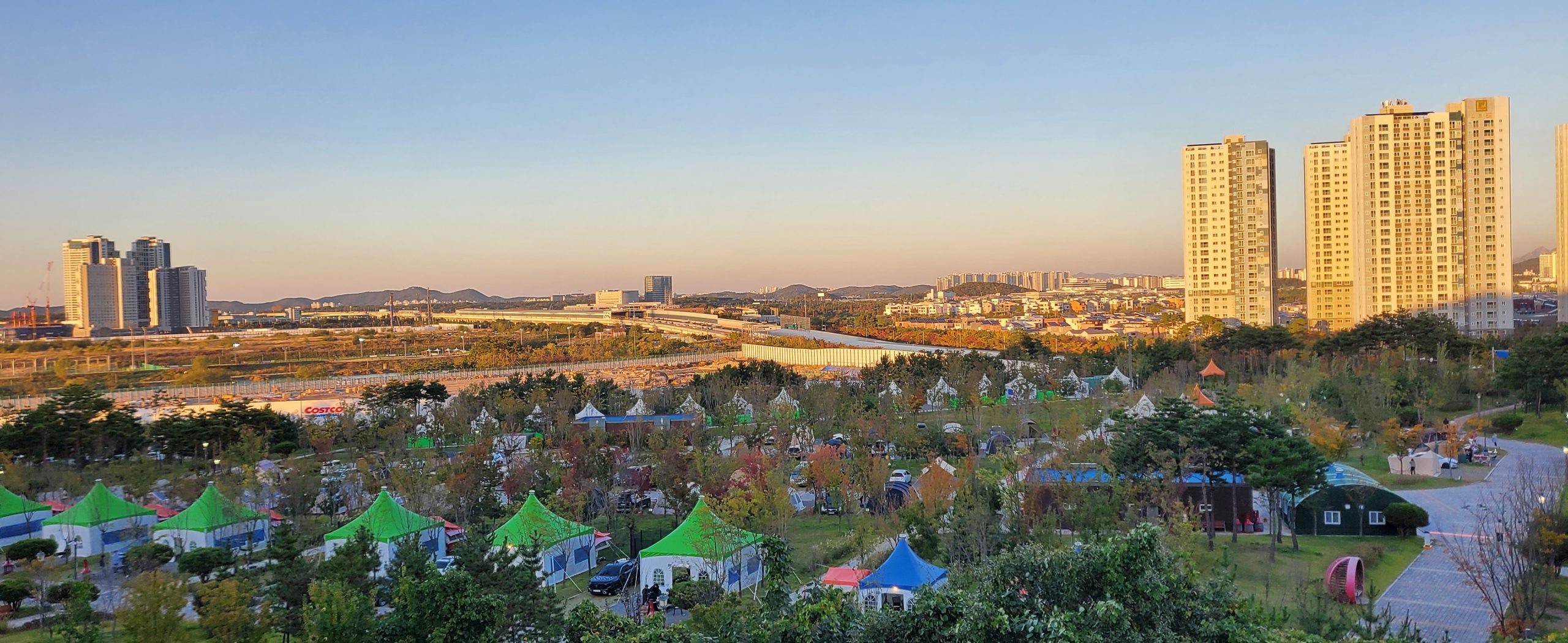
Stand on the low hill above Cheongna Camping Park at sunset and you’ll see something that shouldn’t quite make sense: rows of family tents glowing in the evening light, a Costco sign, an elevated highway, and a wall of gleaming apartment towers on the horizon — all at once. It looks like a campsite that wandered into the middle of a city. What makes it stranger still is that none of this existed a lifetime ago. Every bit of ground in this photo used to be the sea.
A City Built on the Sea
Cheongna International City sits in Seo-gu, on the western edge of Incheon, and its origin story is remarkable. Until the 1980s this was tidal flats and open water, dotted with a handful of small islands — one of which was called Cheongna-do, and almost nobody had heard of it.
Between 1979 and 1989, a major construction company carried out a decade-long land reclamation project here, originally intended to create farmland. For years afterward locals didn’t call it Cheongna at all; they called it “the Dong-ah reclamation” or “the Gimpo landfill,” named after the company and the neighboring district. Only later was the land rezoned for housing and commerce, and eventually designated part of the Incheon Free Economic Zone alongside Songdo and Yeongjong.
So when you look out from that hill, you’re looking at a city that is, in the most literal sense, newer than most of the people living in it. That’s a strange and specific feeling, and it’s why I keep coming back.
Cheongna Camping Park: Camping Without Leaving the City
The camping park is the most surprising thing here. Korea has plenty of campsites tucked into mountains and river valleys, hours from anywhere. This one is in the middle of a planned international city, minutes from a superstore and a highway interchange.
Pitched across a landscaped park, you’ll find everything from small family tents to elaborate setups with awnings and camp kitchens. On an autumn weekend the place fills up completely: kids running between the sites, the smell of grilling meat drifting over the trees, the low murmur of dozens of families settling in for the evening.
The appeal is obvious once you see it. You get the whole ritual of Korean camping — the tent, the fire, the outdoor dinner — without a three-hour drive. For city families with small children, that’s an enormous difference. And because the ground here is flat reclaimed land, the sites are level and easy, which is not something you can say about most Korean campsites.
If you plan to camp, book ahead. Weekend spots at Korean campsites of this quality tend to be reserved well in advance, especially in spring and autumn.
The View From the Hill
The photos here were taken from a small rise overlooking the camping area, late on an October afternoon. It’s not a designated viewpoint and there’s no sign pointing to it — just a bit of higher ground that happens to line up perfectly.
From up there the layers of Cheongna stack neatly on top of each other: tents in the foreground, then trees, then the retail and logistics zone, then the highway, and finally the apartment towers catching the last gold of the sun. On a clear evening the hills of the mainland show up faintly behind everything. It’s the whole story of the district in one frame — nature, commerce, infrastructure, and housing, all built at once on ground that didn’t exist fifty years ago.
Go about an hour before sunset. The light comes in low from the west, off the sea that used to be here, and everything turns amber.
Cheongna Lake Park: The District’s Centerpiece
A short distance from the campground lies Cheongna Lake Park, the showpiece of the whole development and worth a visit on its own.
The park is built around a large artificial lake fed by nearby streams, with a walking loop of roughly 4.3 kilometers circling the water. It’s divided into themed zones — ecological, traditional, leisure, and arts — with a traditional pavilion overlooking the lake, an outdoor performance stage, gardens, and playgrounds spread along the route. Canal waterways extend from the lake through the commercial center of the district.
The main attraction is the musical fountain, which shoots water as high as 75 meters and performs in the evenings during the warmer months, roughly late spring through early autumn. Come at dusk, walk part of the loop, and stay for the show.
What I find interesting is the design intent: the planners built the lake and canals to echo the water that was here before, threading it back through a city that replaced it.
What Else Is Around
- Cheongna Ecological Park — a quieter green space nearby, good for a slow walk away from the crowds.
- Noeul Park — a city park whose name means “sunset,” which tells you what it’s for.
- The commercial district — large retail including a Costco, plus the restaurants and cafés that fill the ground floors of the residential towers.
- Wide, flat streets — Cheongna was planned from scratch, so it’s unusually easy to cycle or walk around compared to Korea’s older, denser neighborhoods.
How to Visit
- Getting there: Take the Airport Railroad (AREX) to Cheongna International City Station. From there, local buses and taxis reach the lake park and camping area. Coming from Incheon Airport takes roughly an hour; from central Seoul, allow around 80 to 100 minutes.
- Best time to go: Late afternoon into sunset, especially in spring and autumn. Summer evenings are good for the fountain.
- If you’re camping: Reserve in advance and bring your own gear, or look into the glamping-style setups available in the area.
- Getting around: The district is spread out and built for cars. Walking between the lake and the campground is possible but takes a while — a bike or a short taxi ride helps.
- Coming soon: A subway extension to Cheongna is planned, which will make the district considerably easier to reach without a car.
Why Cheongna Is Worth Seeing
Cheongna won’t appear on any list of must-see Korean destinations, and that’s exactly the point. It isn’t a historic site or a scenic wonder. It’s something rarer for a visitor: a chance to watch a Korean city in the act of becoming itself.
Half of Cheongna still feels unfinished — empty lots waiting for towers, roads leading to construction fences. The other half is thoroughly lived in, full of families camping on a Saturday and joggers circling a lake. Seeing both at the same time tells you more about how modern Korea actually gets built than any museum could.
And if you want to understand the range of a single city, spend one day here and another in the old neighborhoods across town. Incheon contains both, twenty kilometers apart.
Where Is Cheongna Camping Park?
Cheongna is in Seo-gu, on Incheon’s western edge, closer to the airport than to Seoul. The camping park, ecological park, and lake park are all within the same district, as shown on the map below.
Keep Exploring Hidden Incheon
Want to see the older side of the same city? Visit Juan Station with its food alley and underground arcade, or Munhak Stadium, the 2002 World Cup landmark surrounded by ordinary neighborhood life. And for a hidden getaway well beyond Incheon, see Okjeong Lake.