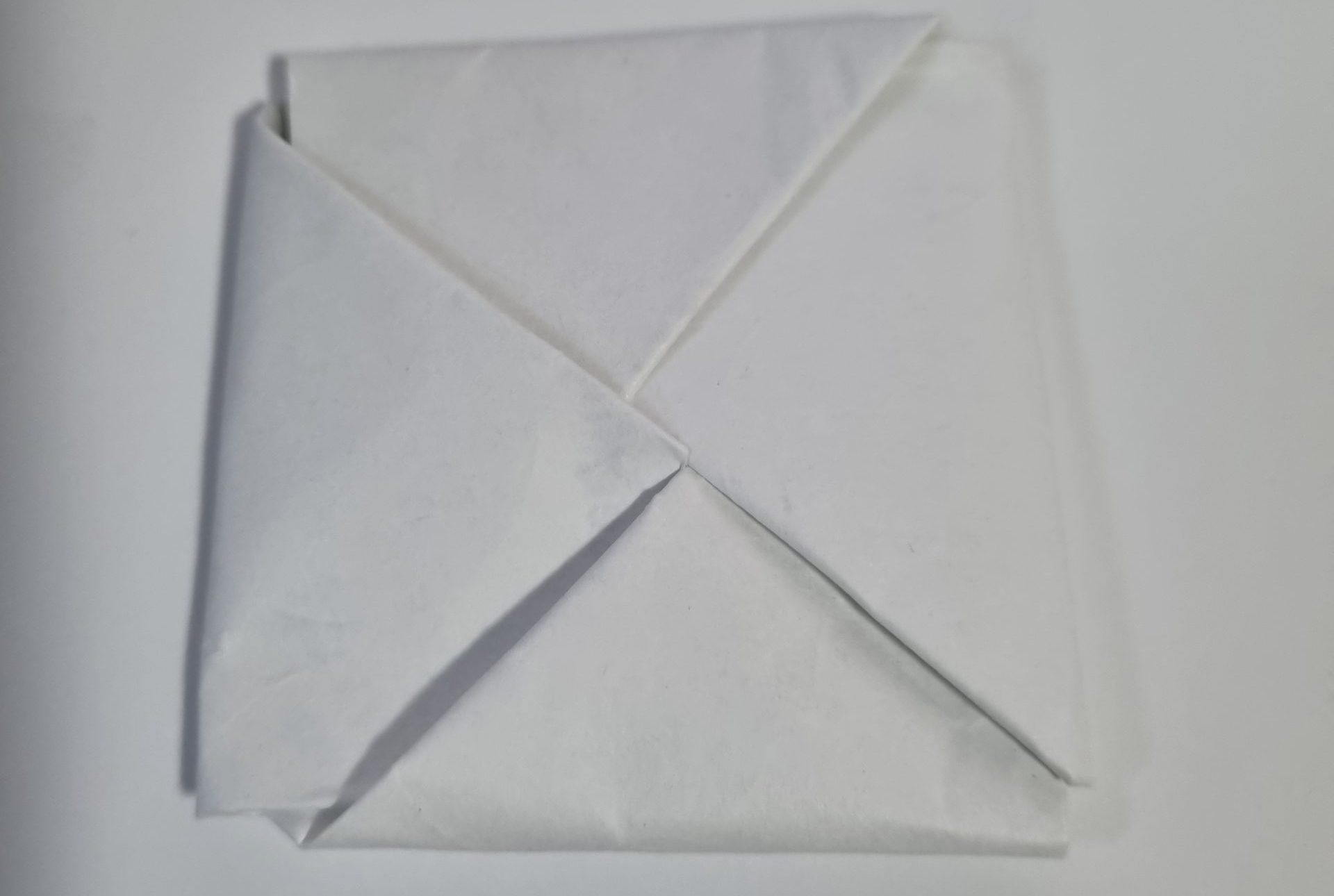
Learning how to play ddakji takes about two minutes. Getting good at it takes a whole childhood. Ddakji (딱지) is the Korean paper tile game where you slam your own folded tile onto the ground and try to flip your opponent’s tile over. Most people outside Korea met it in the opening episode of Squid Game, but for kids of my generation in Incheon it was simply what you did after school on any flat patch of ground.
This guide covers everything you need to actually play: how to fold a tile from two sheets of paper, the basic rules, the techniques that win, and the house rules that changed from one lane to the next. The folding photos below are my own. I folded a fresh pair for this post, decades after the last time, and the steps came back quickly.
What Is Ddakji?
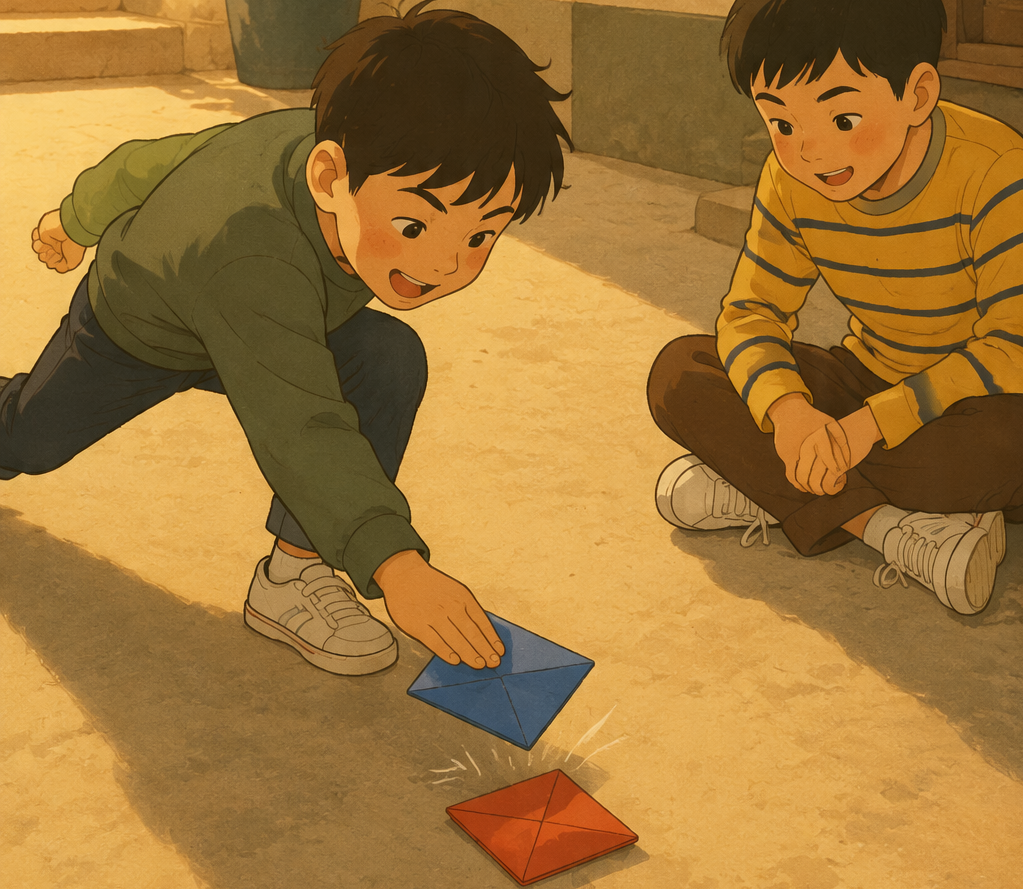
Ddakji is a two-player game played with square tiles folded from paper. One player puts a tile on the ground. The other throws their own tile down hard, right next to it or onto its edge. If the impact and the burst of air flip the tile on the ground face down, the thrower wins. In the traditional version played for keeps, the winner takes the flipped tile home.
The name is often said to come from the sharp “ddak” sound a tile makes when it smacks the ground, and if you have ever heard a good hit, the explanation feels right. You will also see it spelled ttakji in English, and the activity itself is called ddakji-chigi (딱지치기), “hitting ddakji.”
Korea also had printed round cardboard ddakji sold at stationery shops, which were played differently. This post is about the folded square kind, the one made from paper at home, which is the version most people mean today.
What You Need
Two sheets of paper for each tile. That is the whole equipment list. But the paper you choose decides how well your tile plays, and every kid in my neighborhood knew the ranking by heart.
Thick, stiff paper wins. Old wall calendars were the best material by far, because their heavy coated pages made a tile that hit hard and refused to flip. Notebook pages were acceptable. Old textbooks were good. Newspaper was the weakest choice, light and floppy and easy to beat. I wrote about that paper hierarchy, and what it said about each family’s household, in where Korean kids got their toys in the 1980s.
If you are trying this today, here is a modern version of the same ranking:
- Best: thin cardstock, old calendar pages, or cereal box card for a heavy “boss” tile
- Good: two sheets of standard A4 or letter printer paper
- Fun but weak: colored origami paper, which looks great but flips easily
- Avoid: newspaper and tissue-thin paper
Using two different colors makes the folding easier to follow, and it makes a finished tile look like the classic red and blue pair from Squid Game.
How to Fold a Ddakji, Step by Step
You fold each sheet into a long strip, cross the two strips, and lock the corners together. It sounds harder than it is. Take your time on the first one, and by the third you will fold one in under a minute.
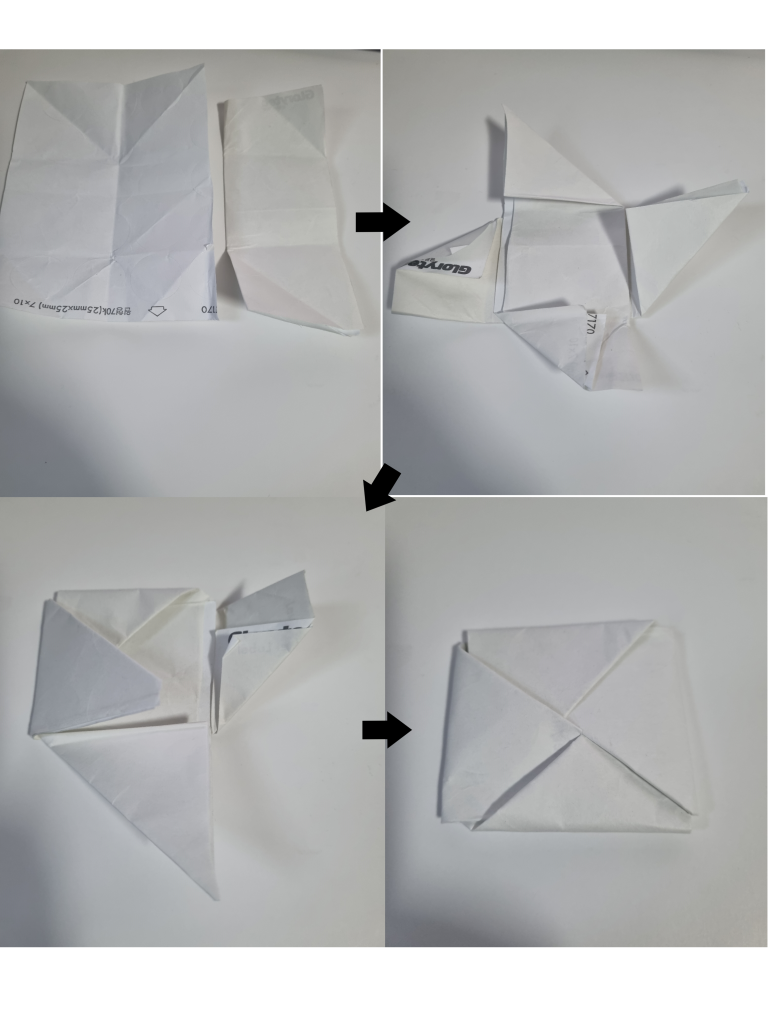
Step 1: Prepare Two Sheets
Start with two square sheets of the same size. If you only have rectangular printer paper, fold one corner down to the opposite edge to make a triangle, cut off the leftover strip, and unfold. You now have a square.
Step 2: Make a Center Crease
Fold the first sheet in half and press the crease firmly, then open it again. This line is your guide for the next step, so make it sharp.
Step 3: Fold Into a Long Strip
Fold both long edges in to meet at the center crease, then fold the whole thing in half along the crease. You now have a long, thick strip several layers deep. Repeat Steps 2 and 3 with the second sheet. The more layers, the heavier your tile, so press every fold flat.
Step 4: Angle the Ends
Take the first strip and fold the left end down at a 45-degree angle and the right end up at a 45-degree angle, so the strip looks like a flattened Z. Do the same with the second strip, but in the mirror direction. This is the step most beginners get wrong. If both strips are angled the same way, the corners will not lock.
Step 5: Cross the Strips
Lay one strip vertically. Lay the second strip horizontally across its middle, so they form a plus sign with the angled ends pointing outward like the arms of a pinwheel.
Step 6: Fold and Lock the Corners
Fold each of the four triangular flaps into the center, one after another, working around the square. The last flap gets tucked under the first one, which locks the whole tile together. Press it firmly from both sides. One side of the finished tile shows a neat X pattern, and the other side shows a flat square.
Before you play, flatten the tile on a hard surface. A tile that curls up at the edges is much easier for your opponent to flip.
How to Play Ddakji: The Basic Rules
The rules fit on a sticky note, which is exactly why the game spread so easily.
- Decide who goes first. In Korea, this is settled with rock-paper-scissors (gawi-bawi-bo).
- The defender places a tile. The player going second puts their tile flat on the ground.
- The attacker throws. The first player slams their own tile down near or onto the edge of the defender’s tile.
- Check the result. If the defender’s tile flips over, the attacker wins it. If it does not flip, the players switch roles.
- Keep going. Play continues until someone runs out of tiles, or until it gets dark and someone’s mother calls them home.
Playing for Keeps or for Fun
In the traditional version, you keep every tile you flip. That is what gave the game its tension. A kid with a tall stack of won tiles walked home a little taller, and a kid who lost his best calendar-paper tile walked home quiet.
For family play, classrooms, or parties, it is kinder to play for points instead. Each flip scores a point, everyone keeps their own tiles, and the first to reach five wins. You lose a bit of the drama, but nobody leaves in tears.
Techniques That Actually Flip Tiles
Ddakji looks like pure strength, but strength alone loses to technique. Here is what experienced players do.
Aim for the Edge, Not the Center
Hitting the middle of the defender’s tile only pins it to the ground. You want your tile to land just beside it, or to clip its edge, so the air pushed out by the impact gets underneath and lifts it. Think of it as making a gust of wind, not a punch.
Swing From the Side
Many players throw with a sideways, slightly sweeping motion rather than straight down, so their tile hits the ground at an angle and drives air under the target. Watch a skilled player and you will see the arm come across the body, almost like skipping a stone.
Use the Whole Arm
Throwing with just the wrist produces a soft tap. Real hits come from the shoulder, with the whole arm swinging through. That is also why the sound changes: a weak throw slaps, while a strong one cracks.
Read the Ground
Surface matters more than people expect. Smooth concrete lets air spread under a tile easily, which helps the attacker. Rough dirt traps air and makes flipping harder. That is why where the tile gets placed can become an argument, and a clever defender looks for the bumpiest spot available.
Defense: Making Your Tile Hard to Beat
When you are the defender, you have only one decision, and that is which tile to put down. Choose well.
- Heavy and stiff beats light and soft. This is where the calendar paper earned its reputation.
- Flat beats curled. Press your tile flat before every round. A raised corner is an invitation.
- Tight folds beat loose ones. Gaps in the folds let air inside and make the tile easier to lift.
- Keep your best tile for big moments. Many players had one favorite tile they rarely risked.
House Rules: Every Neighborhood Was Different
No official rulebook existed. The rules of ddakji were negotiated by whoever was playing that afternoon, and they changed from one lane to the next.
Some of the questions players had to settle:
- Could you re-fold a tile that got damaged in the middle of a game?
- Did a tile that flipped halfway and landed on its edge count?
- Could a defender choose where their tile was placed, or did it have to go on a spot both agreed on?
- Was a hit valid if your tile landed on top of the other tile?
When a new kid arrived from a few streets away, the first few minutes were spent working out whose version applied. That flexibility was part of the charm, and it is something a rulebook can never quite capture. If you play with friends, agree on these points before the first throw and you will avoid most arguments.
Ddakji in Squid Game
In 2021, Netflix’s Squid Game turned this humble schoolyard game into a global image. In the first episode, a well-dressed recruiter in a subway station challenges the main character to ddakji, with a red tile and a blue tile. Every time he wins, he gets money. Every time he loses, he gets slapped across the face.
The scene worked because it took something every Korean viewer associated with childhood and attached adult stakes to it. Overnight, people around the world were searching for how to fold the tiles, and ddakji challenges spread across social media. The recruiter and his tiles returned when the series came back for its second season.
If you want the full list of childhood games used in the show, including Red Light, Green Light and the dalgona candy challenge, see my guide to the Korean games in Squid Game.
One honest note from someone who grew up with the real thing: nobody slapped anyone. In my neighborhood, the cost of losing was simply losing your tile, and that felt painful enough.
Where to Play Ddakji Today
The empty lots where we played are mostly gone, but the game still works almost anywhere with a hard floor.
- Classrooms: Teachers in Korea and abroad use ddakji to introduce Korean culture, because the only supplies are paper and the folding itself is a craft lesson.
- Parties: A pile of pre-folded tiles in two colors makes an easy tournament for a Squid Game themed gathering.
- Family visits: Folding together is a good way to get grandparents and grandchildren at the same table. Many Korean grandparents can still fold one from memory.
A simple safety tip for younger players: play on a floor or smooth pavement, not on gravel, and keep faces out of the throwing area. Excited kids swing hard.
Quick Answers
How many players can play ddakji?
The core game is one on one. With more players, people usually take turns in a circle, or run a small knockout tournament.
Is ddakji hard to learn?
Folding takes a few tries. The rules take a minute. Consistently flipping tiles takes practice, which is why it kept kids busy for hours.
Can I use regular printer paper?
Yes. Two sheets of A4 or letter paper make a perfectly playable tile. For a stronger one, fold an extra sheet into each strip or use thin cardstock.
Is ddakji still played in Korea?
Less than before, but it never disappeared. It shows up in schools, at folk festivals, and in families, and Squid Game gave it a second life among young people.
Final Thoughts
Ddakji asks for almost nothing: two sheets of paper and a patch of ground. In return it gives you everything a good game needs, which is skill, strategy, a little luck, and something to lose. That combination kept a generation of Korean kids outside until dark.
So find two sheets of paper, fold a pair, and challenge someone. Aim for the edge, swing from the side, and keep your best tile for the final round. If you want to explore more of the games we played, start with my overview of traditional Korean games.