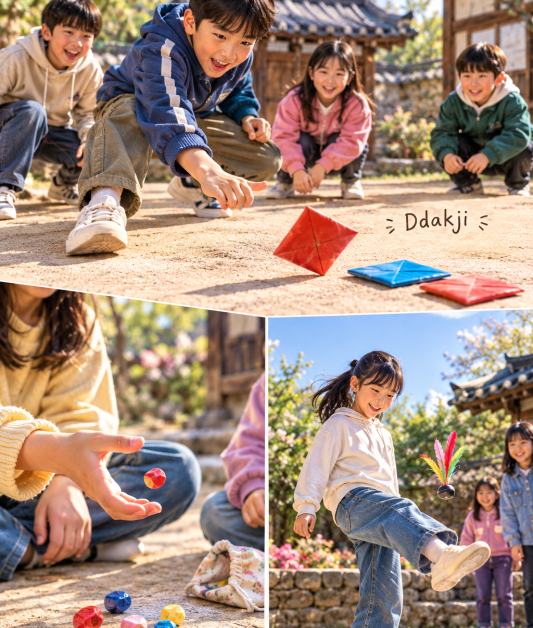
Most articles about Korean childhood games list the games. This one is about where the equipment came from, because that turns out to explain more.
I grew up in Incheon in the 1980s and 90s. Looking back at what we played, the games sort cleanly into three groups — and the sorting has nothing to do with the rules. It depends entirely on where you got the thing you played with.
Some games used paper from the house. Some used a stone you picked up outside. Some required a trip to the stationery shop near the school. Those three supply lines shaped which games we played, who could join in, and which ones survived into the present.
Group One: Made From Paper at Home
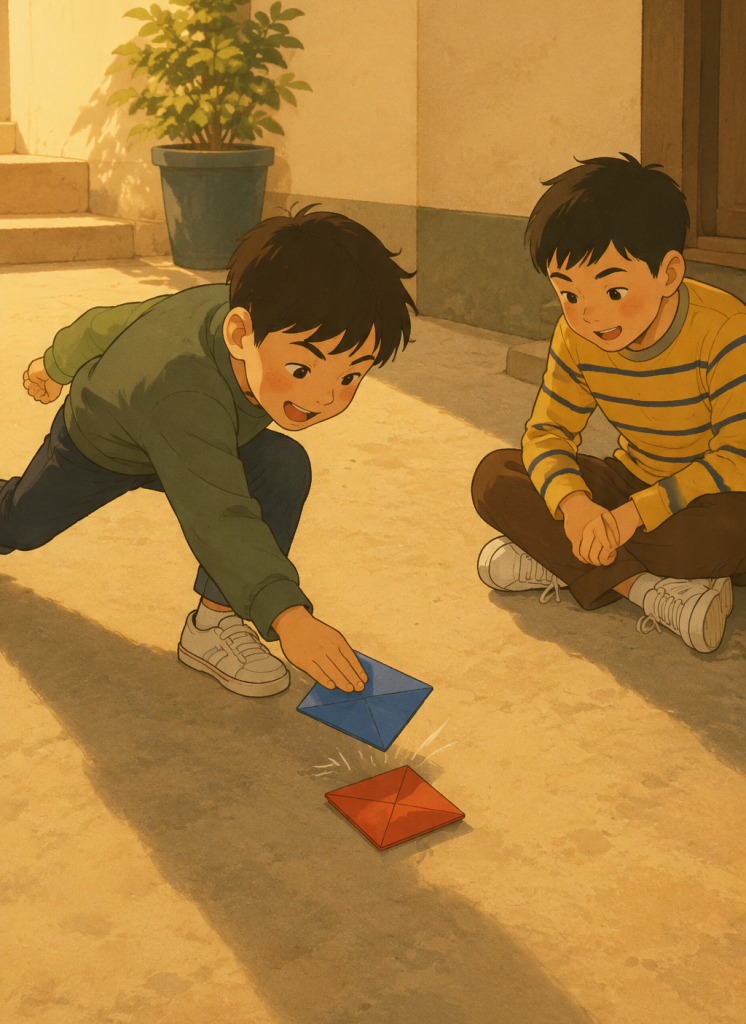
The clearest example is ddakji (딱지), the folded paper tile game. Two players take turns slamming their tile down beside the other player’s tile on the ground, trying to flip it over with the air pressure and impact. Flip it, you win it.
Nobody bought these. You folded your own, and what you folded it from mattered enormously.
Calendar paper was the best material by a wide margin. Old wall calendars used thick, stiff, coated stock, and a tile folded from calendar paper was heavy and rigid — it hit hard and it resisted flipping. Having a spent calendar at home was a genuine advantage, and everyone knew it.
Below that came a rough hierarchy. Pages from a notebook worked. A textbook you no longer needed was good, and using a current textbook was a decision with consequences at home. Newspaper was at the bottom — thin, floppy, and easy for an opponent to flip.
So a child’s supply of ddakji tiles was a direct readout of what paper their household had lying around. No money changed hands, but the game was not entirely equal either.
As for storage, there was none. Everyone kept their own tiles however they wanted, and there was no shared box or hiding place. You looked after your own stack.
There was also a social layer to the paper supply. A kid with a thick stack of calendar-paper tiles was in a position to lend one out, and lending was how newcomers got started. The tiles circulated — won, lost, borrowed, returned — so a single good calendar could end up supplying half a lane for a season.
If you want to fold one yourself, I put together a step-by-step guide on how to play ddakji, from folding the tile to the throws that win.
Group Two: Picked Up Outside
The second group needed nothing but the ground.
The main one was a stone-throwing game played by lining up a target stone and knocking it over from a distance, with the difficulty escalating through a sequence of body positions — holding the stone on your foot, your knee, your stomach, your shoulder, your head — and carrying it into position without dropping it.
The standard name for this game is biseokchigi (비석치기), “tombstone hitting,” after the way the target stone stands upright. But that is not what we called it. In my neighborhood it was malbangkkagi (말방까기), and I could not tell you why. I also cannot recall formal names for the individual stages — we knew them as body parts and that was enough.
This is worth flagging for anyone researching traditional Korean games: the names in the reference books are the standardized ones. On the ground, the vocabulary shifted from neighborhood to neighborhood, and a lot of it was never written down anywhere.
The part that stays with me is choosing the stone. You went out and found one — the right weight, flat enough to stand up, not so big it was clumsy. Some kids kept a good stone. It cost nothing and it was completely personal, which is a combination that barely exists in children’s play now.
Group Three: Bought at the Stationery Shop
The third group came from the mun-bang-gu (문방구), the small stationery shop that sat within a short walk of essentially every elementary school in Korea.
School supplies were at the front. Behind them was the real inventory: spinning tops with their strings, jegi shuttlecocks, sets of five gonggi stones, snacks, cheap toys. These shops were the distribution network for an entire generation’s play.
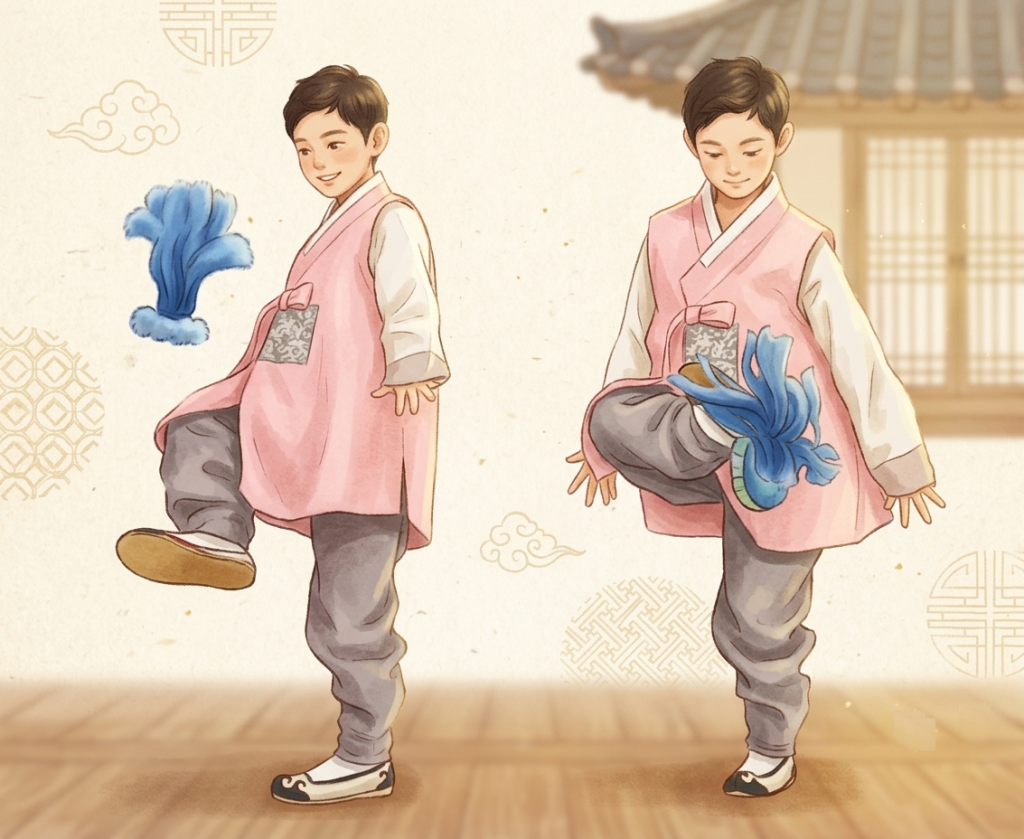
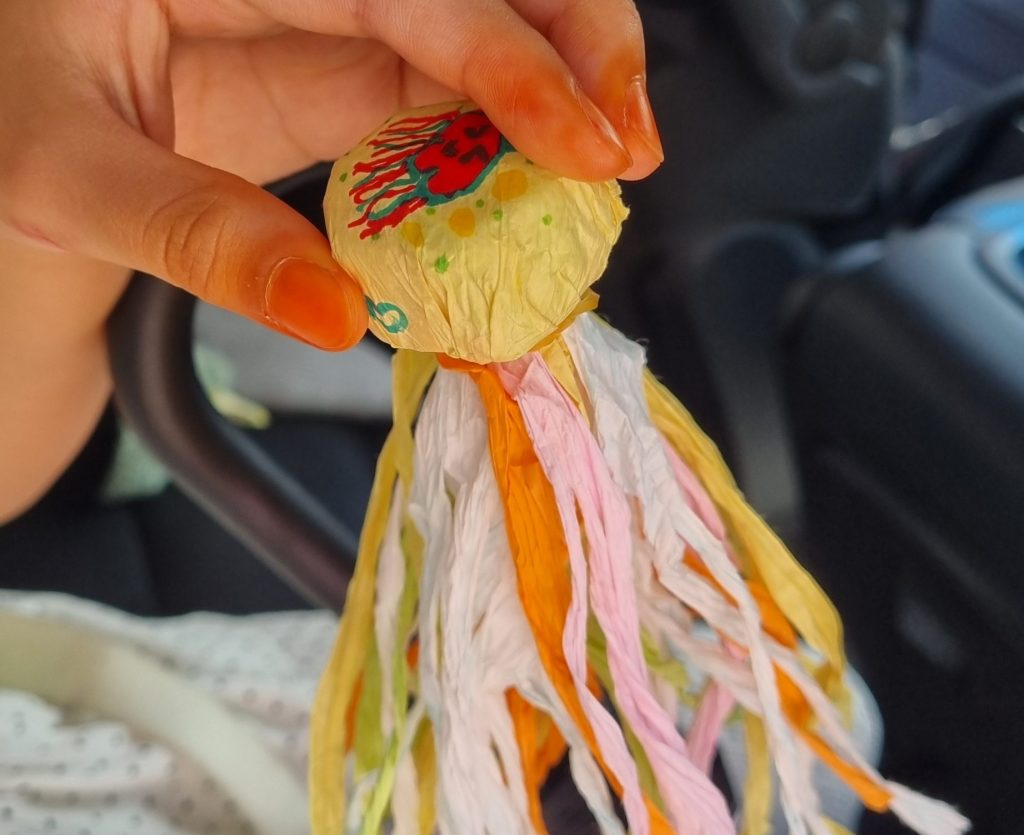
Jegi (제기), the shuttlecock you keep in the air with the inside of your foot, was usually bought. You could make one — a coin with a hole through it, a ten or hundred won piece, wrapped in a plastic bag cut into strips — and plenty of kids did. But the shop version was cheap enough that most of us just bought it. We played in the schoolyard, in the classroom, and out in the neighborhood.
Gonggi (공기), the five-stone game of throwing and catching on the back of your hand, was almost always shop-bought. The plastic sets were everywhere and cost very little. One thing English descriptions get wrong: it was not strictly a girls’ game. Boys played too, and nobody treated that as unusual.
What made gonggi interesting was that the rules were not fixed anywhere.
The basic progression is standard enough — pick up one stone at a time while a thrown stone is in the air, then two at a time, then three, then four. The trouble starts at the end. The finishing move involves tossing all five stones up, catching them on the back of your hand, throwing them up again and catching them in your palm, and the details of how that is scored varied constantly.
How many you need to catch, whether dropping one ends your turn or just costs you points, whether a stone that lands on your wrist counts, how many rounds win the match — none of this had an official answer. Neighborhoods differed. Schools differed. And quite often a group would simply agree on a version before starting, then play by that for the afternoon.
There was no authority to appeal to and no rulebook anyone had read. Whoever was playing decided, and a new kid arriving from two streets over would spend the first few minutes learning that this block did it differently.
Spinning tops came from the same shelf, sold as a top-and-string set. I have written about paengi chigi in detail elsewhere, but the supply story is the point here: earlier generations carved wooden tops, and mine bought manufactured ones with metal tips. The game continued. The craft around it did not.
The Shop Decided What a Generation Played
Put those three groups together and something becomes clear.
For the games in group three, what Korean children played was determined, to a real extent, by what the local stationery shop chose to stock. Not by tradition, not by schools, not by any cultural policy — by a shopkeeper’s ordering decisions.
That is a significant shift from how these games are usually described. English-language writing tends to present Korean traditional games as unbroken folk heritage passed down through generations. By the 1980s, at least in cities, a large share of them were passed down through retail.
The paper games and the stone games were the ones that stayed independent of that system. Notably, they are also the ones that needed nothing at all, which is why a child with no money could always play them.
Where All of This Happened
One more thing the three groups had in common: the ground.
Incheon in the 1980s was not yet a city of apartment complexes. It was detached houses and small low-rise buildings along narrow lanes, and scattered among them were flat patches where nothing was built and nobody parked. Those gaps were the playground — not a designated playground with equipment, just the flat spot everyone agreed was the flat spot.
Whichever game you were playing, that is where you went. Tops in the daytime, stones against a wall, paper tiles on any hard flat surface. The same few square meters hosted all of it. In the evenings, the ones farthest from the houses were where we lit cans of charcoal for jwibulnori.
Those spaces are gone. The same lanes are apartment complexes now, with managed grounds, designated parking, and no flat patch of nobody’s land where seven kids can stand around for two hours.
The Rules Were Negotiated, Not Inherited
There is one more thing these games shared, and it is the hardest part to convey to anyone who did not grow up with them: almost nothing was fixed.
Gonggi had a different finishing rule two streets over. The stone game went by a name the books do not use. Ddakji had house rules about whether you could re-fold a damaged tile mid-game. When a new kid joined from another neighborhood, the first few minutes were spent working out whose version applied, and the answer was usually whoever had more people on their side.
Written accounts of Korean traditional games present them as settled systems with correct rules, because that is what a reference work has to do. What actually existed was a loose family of local variants, renegotiated by whoever showed up that afternoon. The rules were a conversation, not an inheritance.
That flexibility is part of why the games worked so well with mixed ages. A group with a six-year-old and a twelve-year-old would quietly adjust the difficulty without anyone calling it a handicap. Nobody was reading from a rulebook, so nobody had to announce that they were departing from one.
It is also why these games are hard to revive properly. You can teach a class the standardized rules of any of them in ten minutes. What you cannot hand over is a group of children with enough unsupervised time to argue their own version into existence.
Which Ones Survived
The three supply lines predicted the outcomes fairly well.
The stationery shops closed. Not entirely, but the dense network of small shops near every school has thinned drastically. When the supply line goes, the games that depended on it go quietly with it — not banned, not forgotten, simply no longer within reach on the walk home.
The open ground was built on. That removed the games needing space, which is most of them.
The unstructured time disappeared. Korean childhood now runs on a schedule — school, academies, study, screens. Every game here assumed a loose group of children with an unplanned hour, and that hour is the scarcest item on the list.
The clear survivor is yutnori, and the reason fits the pattern exactly: it needs no open ground, no shop, and no unsupervised time. It needs a holiday and a full room, and Korea still has holidays.
One Last Thing
If you want to understand why a set of games vanished within about one generation, the rules will not tell you. The supply chain will.
Calendar paper stopped being common. Empty lots became apartment blocks. The shop near the school closed. None of those are cultural decisions, and nobody chose them as a matter of heritage policy. The games just stopped being possible, one supply line at a time.