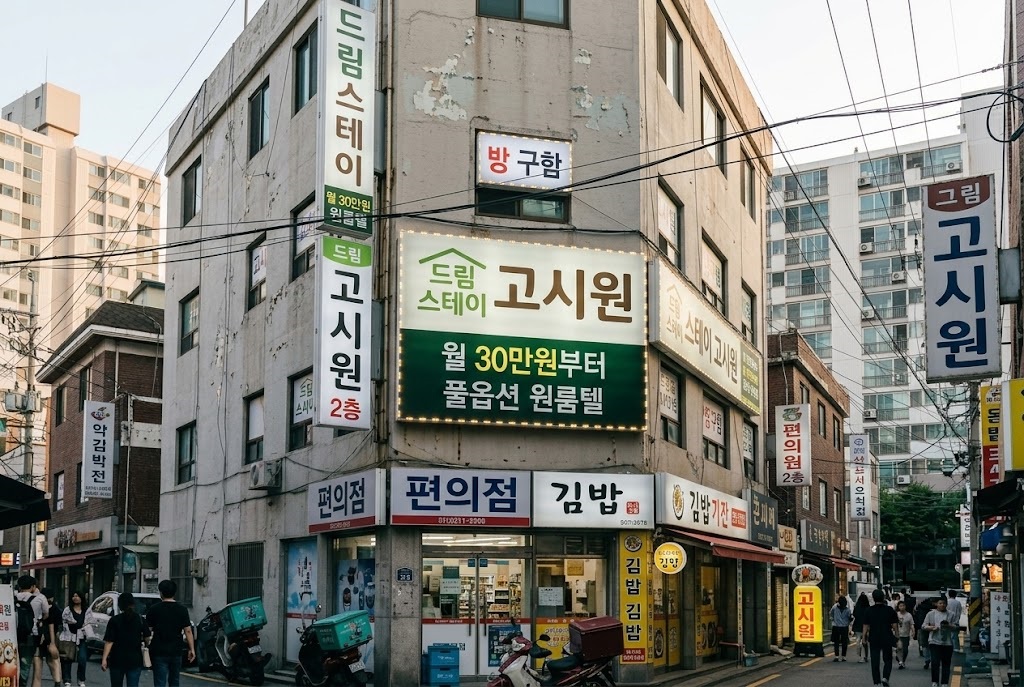
What is a goshiwon? A room, usually just large enough for a single bed and a desk, rented by the month with no deposit and no contract negotiation. You pay, you move in, and you can leave without months of notice.
For anyone who has read our guide to monthly rent in Korea, the appeal is immediate. Standard rentals require a deposit large enough to be a genuine obstacle — often the single biggest barrier for someone newly arrived, between jobs, or simply without savings. A goshiwon (고시원) removes that barrier entirely.
What it removes along with it is space, quiet, and privacy. Whether that trade is worth making depends enormously on who you are and what you need the room for, and the honest answer is that it works very well for some people and is genuinely hard for others.
Where the name comes from
Gosi (고시) means a high-level state examination — the civil service exam, the bar exam, the qualifications that in Korea have historically opened doors that nothing else could. Won (원) indicates an institution or establishment.
A goshiwon was, originally and literally, a building where people studied for those exams. The logic was straightforward: candidates spent years preparing, often needed to be near a particular cram school district, and required somewhere cheap, quiet, and free of distraction. Nobody needed a living room. Everybody needed a desk.
The buildings outlasted their original purpose. The exam-preparation population shrank, the rooms stayed, and the format turned out to suit a much wider group of people than it was designed for.
What the room is actually like
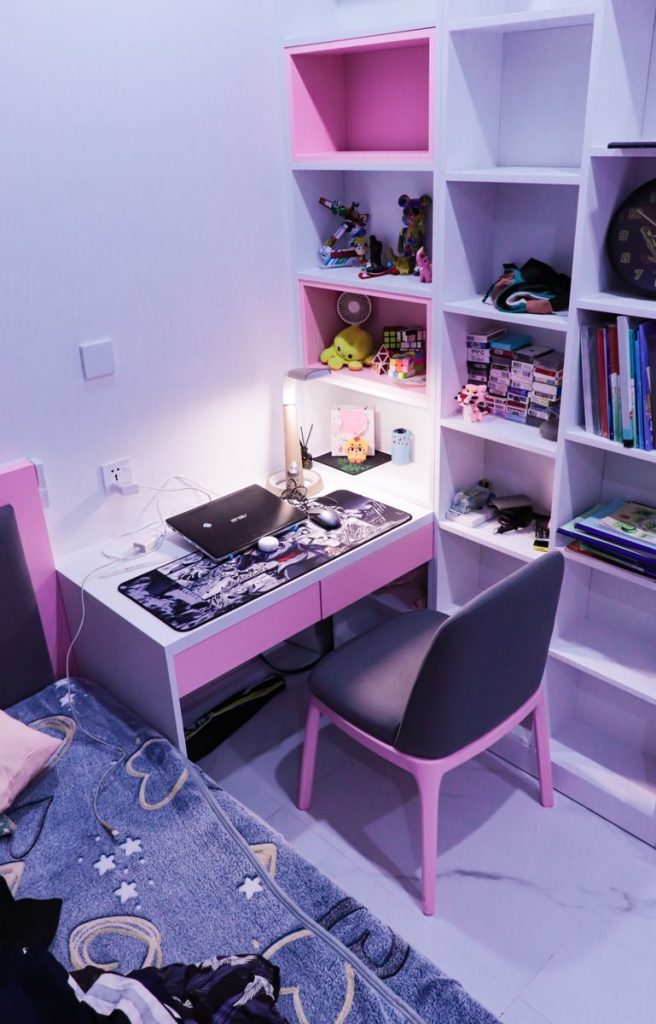
Small. Genuinely, immediately small in a way photographs tend to soften.
A typical room holds a single bed, a desk, a small wardrobe or shelf, and very little floor between them. Some have a window; many have one that opens onto a corridor or a wall rather than the outside. Better facilities include a tiny private bathroom, while cheaper ones share bathrooms down the hall.
The key thing to understand is that this is not a small apartment. It is a room in a building of rooms, and most of what you would expect a home to contain sits outside your door.
What is shared
- Laundry. Washing machines are communal, usually in a designated room, used on some kind of informal rotation.
- The kitchen area. Often called a tangbisil (탕비실) — a pantry or utility room rather than a full kitchen. Hot water, a microwave, a shared table, basic facilities.
- Bathrooms, in the cheaper places.
- Corridors, which carry sound in a way that matters more than any other single factor.
The food that comes with it
Here is something that rarely appears in English-language descriptions and genuinely defines the format: the operator usually keeps the shared pantry stocked.
Instant ramen, rice, kimchi, eggs, basic condiments, sometimes bread or snacks. Free to residents, restocked by whoever runs the building, available at any hour.
This is not a marketing extra. For someone whose budget is genuinely tight, knowing there is always something to eat downstairs changes the arithmetic of the month considerably. A goshiwon with a well-stocked pantry is understood by residents to be a better goshiwon, and operators know it.
The honest downside: sound
If there is one thing to understand before considering a goshiwon, it is this.
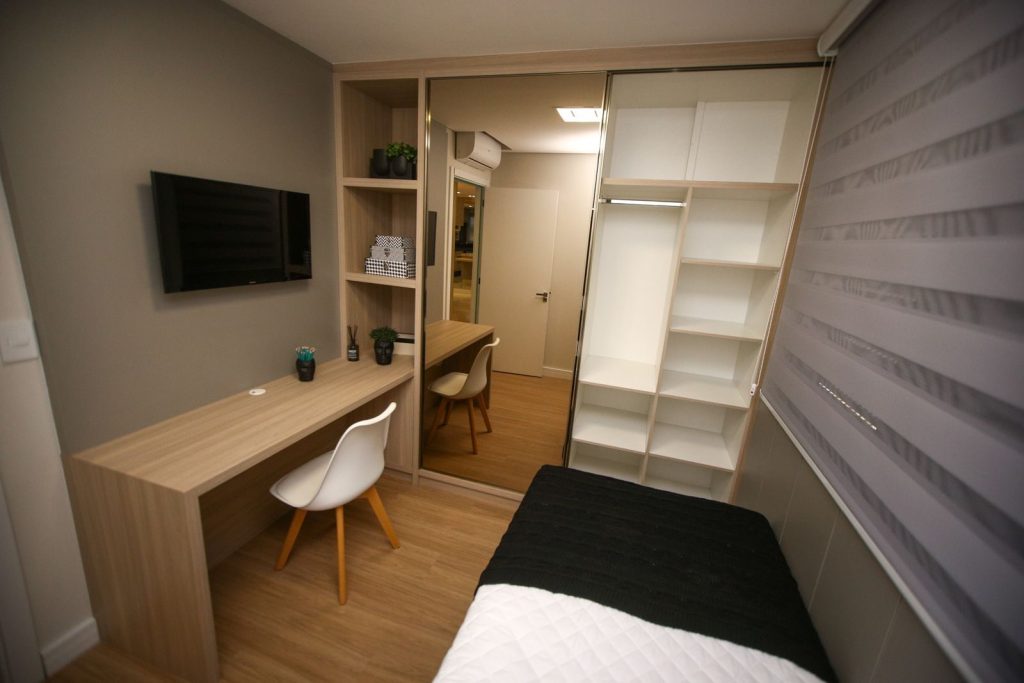
These buildings are typically subdivided — a larger floor plate partitioned into many small rooms — and the partitions are thin. Not “you can hear the television next door” thin. You can hear a phone conversation, a cough, an alarm, someone setting down a cup.
At the worse end of the market, the sound insulation is close to nonexistent, and residents describe living with a constant awareness of other people’s routines. You learn your neighbour’s schedule without ever meeting them.
This cuts both ways, which is the part people underestimate. You hear them, and they hear you. Phone calls become quiet. Music goes through headphones. Coming home late means moving carefully.
For some people this is entirely manageable. For anyone who needs solitude to recover from a day, it is the single most likely reason a goshiwon stops being viable.
Who actually lives in them
The resident mix is one of the more interesting things about these buildings, and it is broader than the name suggests.
Exam candidates still, in the districts built around cram schools. The original tenant, now a minority.
Day labourers and workers on short contracts. People whose work moves, whose income arrives irregularly, and for whom a large deposit and a fixed-term lease do not fit the shape of their life.
People in a temporary gap. Between apartments, between jobs, newly arrived in a city, waiting for something to resolve. A goshiwon absorbs the situation where a standard lease cannot.
People for whom it is not temporary. This deserves stating plainly rather than being written around. For some residents, a goshiwon is not a step between two apartments. Housing costs in Korean cities are high enough that for people on low or unstable incomes, a room like this is the housing available, and it is what they have. Any honest description of goshiwon culture has to include that.
The newer residents
More recently, foreign residents have become a visible part of the picture — and not only travellers passing through.
Korean-language YouTube has a small genre of videos showing foreigners living in goshiwon, usually at the better end of the market, and the interest is genuine on both sides. For someone arriving without savings, without a Korean guarantor, and without the documentation a standard lease requires, a room that needs none of those things solves a real problem.
The appeal is not only financial. A goshiwon can be arranged quickly, sometimes within a day, in a city where finding an apartment takes weeks. For a first month in Korea, that speed has its own value.
How the money works
Monthly, paid in advance, with no deposit or a very small one. That is the entire structure.
Utilities are typically included, which removes another administrative layer — no separate accounts, no meter readings, none of what our guide to utility bills in Korea describes. Internet is generally included too.
Prices vary enormously by neighborhood and by facility quality, and the gap between a windowless shared-bathroom room and a newer one with a private bathroom is substantial. Check current listings rather than trusting any figure quoted online, including in articles older than a few months.
One point worth understanding clearly: the legal protections that apply to standard rental contracts do not map neatly onto this arrangement. There is usually no deposit at risk, which removes the main thing those protections exist to defend — but it also means the relationship rests more on the operator’s practices than on paperwork. Read whatever you are asked to sign, and ask what the notice period is before you need to know.
Viewing one before you commit
Almost every experienced resident says the same thing: go and look, and look at more than one.
- Stand in the room in silence for a minute. What can you hear?
- Ask about the window. Does it open to outside air, or onto a corridor?
- Look at the shared pantry. How well stocked is it, and how clean? It tells you how the building is run.
- Check the bathroom ratio. Shared facilities are fine until the morning queue.
- Visit at night if you can. A building is a different place at 11pm than at 2pm.
- Ask who else lives there. Buildings develop a character — students, workers, long-term residents — and it affects daily life.
The range in quality is wide enough that two buildings on the same street can be completely different propositions. The good ones are genuinely liveable. The bad ones are difficult, and no price is low enough to fix them.
Why it is worth understanding
The goshiwon is a specifically Korean answer to a universal problem: how a city houses people who cannot produce a large sum of money up front.
Korea’s rental system is built around deposits, and that system works reasonably well for people who have savings. The goshiwon is what exists for everyone else — the workers, the students, the newly arrived, and the people for whom this is simply where they live. It is unglamorous and it is essential, and a lot of Korean life passes through these buildings without ever being written about.
If you are weighing one up, the calculation is clear enough. You are trading space and quiet for freedom from a deposit and a contract. For a few months, for many people, that is a straightforward trade. Just go and stand in the room first.