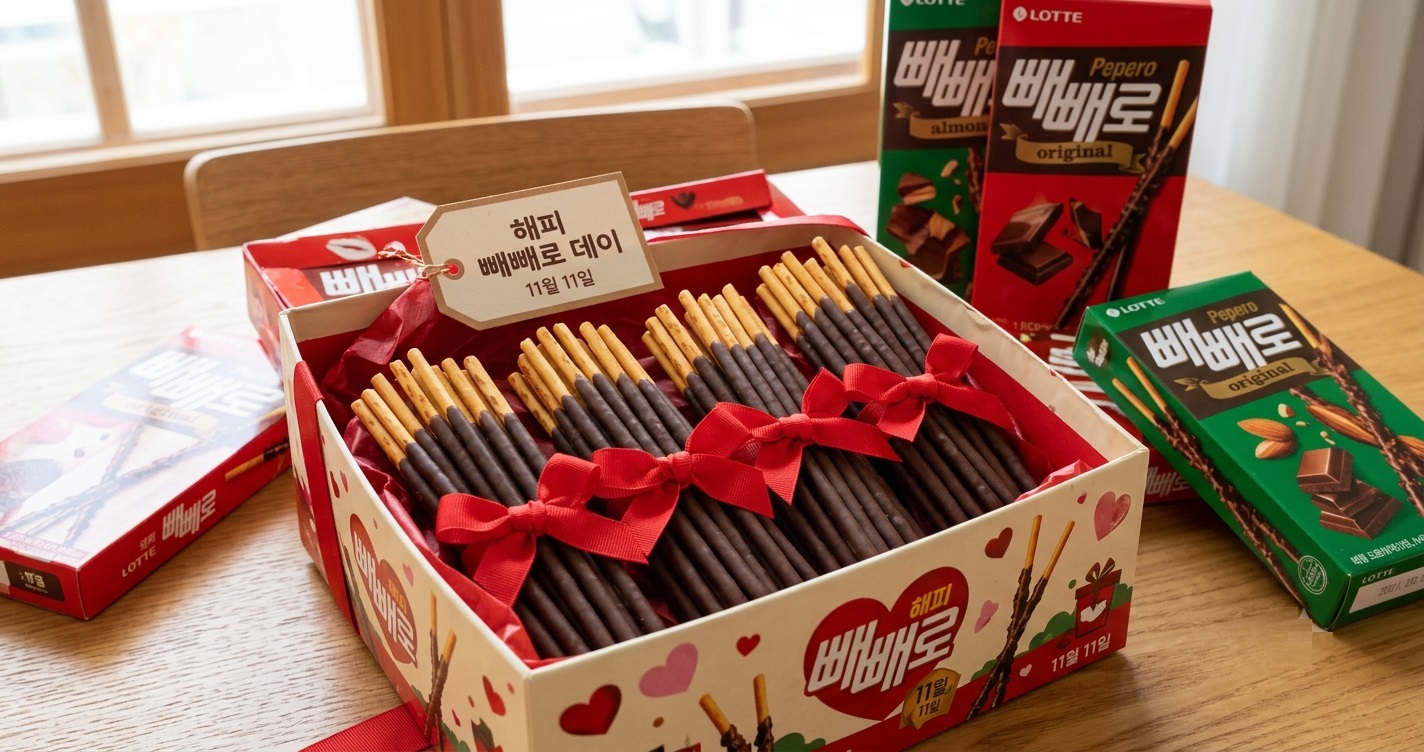
Pepero Day falls on November 11, and if you are in Korea in early November, you cannot miss it. Convenience stores stack towers of gift boxes by the door. Schoolchildren carry paper bags full of chocolate-dipped biscuit sticks. Couples exchange boxes tied with ribbons, and office workers leave a few packs on a coworker’s desk. For one day, a simple snack becomes the country’s favorite way of saying “I thought of you.”
This year, Pepero Day lands on Wednesday, November 11, 2026. This guide explains where the day came from, why the date matters, how Koreans actually celebrate it, and the quieter holiday that shares the same date, one that involves rice cakes instead of chocolate.
What Is Pepero Day?
Pepero (빼빼로) is a thin, crunchy biscuit stick dipped in chocolate, made by the Korean food company Lotte. It first went on sale in 1983, and it has been one of Korea’s best-known snacks ever since. If it reminds you of Japan’s Pocky, you are not wrong. Pocky came first, in 1966, and the two snacks look very similar.
Pepero Day is the day people give Pepero to friends, classmates, coworkers, and partners. There is no official status behind it. It is not a public holiday, and nobody gets the day off. Yet it has become one of the most visible “days” on the Korean calendar, especially for young people.
The date is the whole joke. Written as numbers, November 11 is 11/11, four ones standing in a row, and each one looks like a single Pepero stick. Once you see it, you cannot unsee it.
Where It Came From: Schoolgirls in Busan
Many people assume Pepero Day was invented in a marketing office. The story Lotte itself tells is different, and Korean news reports have repeated it for years.
According to that account, the custom began around 1993 among schoolgirls in Busan, Korea’s big port city in the southeast. Students started giving each other Pepero on November 11, with a playful wish attached: that the friend receiving the sticks would grow as tall and slim as a Pepero. The habit spread through schools in the wider Gyeongsang region, and local sales staff noticed that Pepero sales jumped every year around that date.
By the mid-1990s, the trend had reached national news, and Pepero sales took off. Over the following years, Lotte leaned into the day with advertising, special packaging, and huge store displays. One campaign in 2011 even promoted November 11, 2011, as a “millennium Pepero Day,” since the date 11/11/11 contained six ones.
So the honest answer to “is Pepero Day just a marketing gimmick?” is: it started with students, and marketing turned it into a national event. Both parts of that story are true.
How Big Is It?
The numbers explain why stores go all in. According to Korean news reports citing Lotte, Pepero has sold about 3.7 billion boxes since its launch. More than half of the brand’s yearly sales are said to happen in the weeks around November 11, and the company reportedly begins production for Pepero Day as early as September.
The snack has also gone global. Lotte now sells Pepero in about 50 countries, and its overseas sales have grown quickly in recent years as Korean food has become popular abroad. In some countries, Korean expat communities and fans of Korean culture now mark the day too.
How Koreans Celebrate Pepero Day
Pepero Day is relaxed and playful. There are no fixed rules, but a few patterns show up every year.
Friends and Classmates
For students, Pepero Day is mostly about friendship. Kids buy a handful of boxes and pass them around to classmates, sometimes with a short note. Getting a pile of Pepero by the end of the school day is a small sign of popularity, and sharing them out is part of the fun.
Because so much of the day happens at school, some teachers and parents have long worried about kids who receive nothing, or about the pressure to spend money. Some schools quietly discourage big exchanges, and many families keep it to a few inexpensive boxes.
Couples
For couples, Pepero Day works like a lighter version of Valentine’s Day. Partners exchange decorated gift sets, sometimes bundled with flowers, stuffed animals, or a handwritten letter. Some people skip the store-bought boxes entirely and make their own chocolate-dipped sticks at home, decorating them with nuts, sprinkles, or white chocolate. Home-made versions are seen as more personal and more romantic.
At Work
In offices, Pepero Day is a low-pressure way to be friendly. A coworker might drop a box on everyone’s desk in the morning, or a team leader might buy a big pack to share. Nobody expects much, and that is the point. It is a small gesture that costs little and lightens the mood of an ordinary weekday.
The Convenience Store Takeover
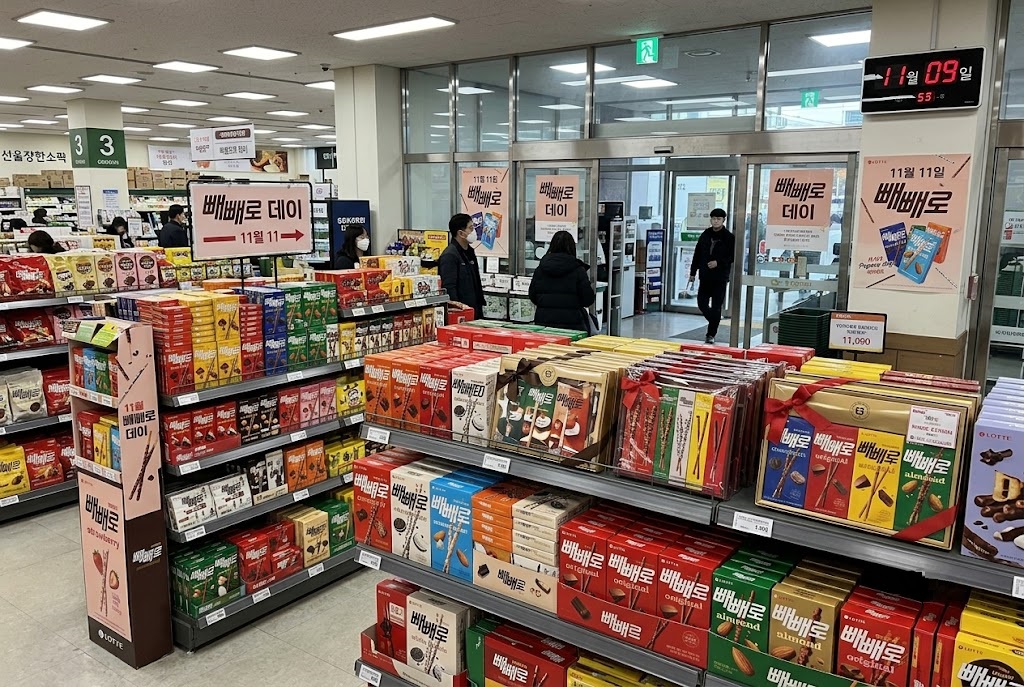
The most visible sign of Pepero Day is in stores. From late October, Korean convenience stores build huge displays near the entrance: giant boxes, character-themed sets, bundles with plush toys, and limited-edition flavors. Supermarkets and stationery shops near schools do the same. If you want to understand how seriously Korea takes this day, just walk into any convenience store in the first week of November.
The Flavors
The classic Pepero is a plain biscuit stick dipped in milk chocolate, with a short handle left bare so you can hold it without getting chocolate on your fingers. Over the years, many variations have appeared:
- Almond, with crushed almonds on the chocolate
- Nude, an inside-out version with chocolate filling inside the biscuit
- White chocolate and cookie-coated versions
- Seasonal and limited editions released around November
Flavors change from year to year, so the shelves in November are always worth a look, even if you are not buying for anyone.
Make Your Own Pepero-Style Sticks
Home-made sticks are a big part of the day, especially for couples and families with young children. You do not need any special equipment, and it takes less than an hour.
- Get plain biscuit sticks. Look for thin breadstick-style biscuits, or bake your own from a simple shortbread dough rolled into pencil-thin lengths.
- Melt the chocolate. Melt milk, dark, or white chocolate slowly over hot water or in short bursts in the microwave, stirring often so it does not burn.
- Dip, leaving a handle. Dip about three quarters of each stick, leaving the bottom bare so it is easy to hold. A tall glass makes dipping easier.
- Decorate quickly. Roll the wet chocolate in crushed nuts, sprinkles, or cookie crumbs, or drizzle a second color of chocolate on top.
- Let them set. Stand the sticks in a cup or lay them on baking paper until the chocolate hardens, then wrap a few together with ribbon.
In Korea, stationery and baking shops sell ready-made kits in November, with sticks, chocolate, toppings, and gift bags all in one box. A small bundle of home-made sticks with a short note is one of the most appreciated Pepero Day gifts you can give.
The Other November 11: Garaetteok Day
Here is the part most English-language guides skip. November 11 is also Farmers’ Day (농업인의 날), an official day set by Korea’s agriculture ministry in 1996.
The date was chosen for a clever reason. If you write the number 11 as Chinese characters, 十 (ten) over 一 (one), they combine into 土, the character for soil or earth. Eleven over eleven becomes “soil month, soil day,” which makes it a fitting date to honor the people who work the land.
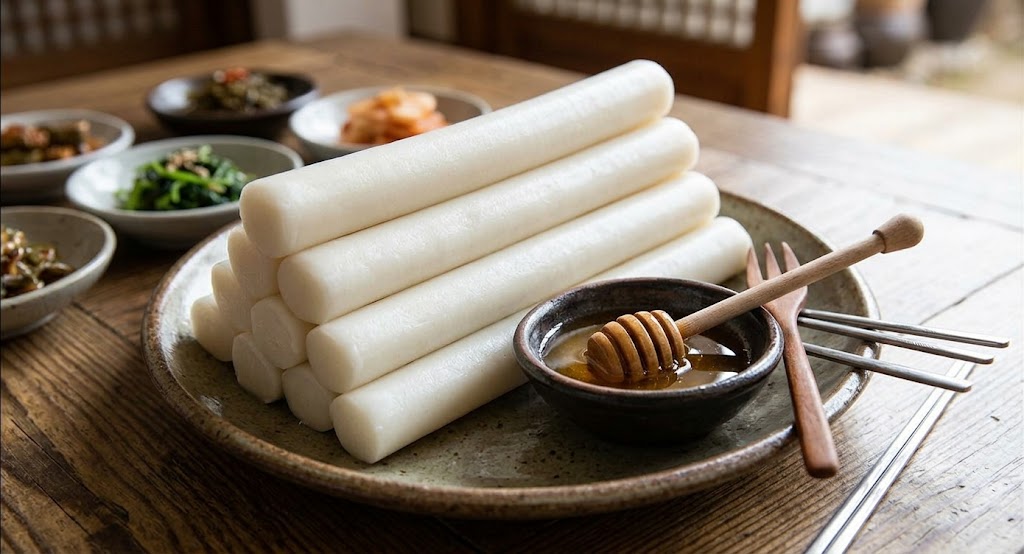
In 2006, the agriculture ministry gave the date a second name: Garaetteok Day (가래떡데이). Garaetteok are long, white, cylinder-shaped rice cakes. Line two of them up and they look just like “11,” the same visual joke Pepero uses. The idea was to encourage people to give rice cakes instead of factory-made chocolate, and to support Korean rice farmers at a time when rice consumption was falling.
Garaetteok is not an obscure food. Sliced up, it becomes the chewy rice cakes in tteokbokki, the spicy street food, and it is also used in rice cake soup on Lunar New Year. On Garaetteok Day, some schools, public offices, and local farming associations hand out fresh rice cakes. Many people grill them lightly and dip them in honey.
Pepero Day is still far louder. But a growing number of Koreans like to give both, or choose rice cakes as a quieter, more local alternative.
Even More Days on November 11
Because “11” looks like so many things, November 11 has collected several other observances in Korea:
- Pedestrians’ Day, because 11 looks like two legs walking
- Rail Day, promoted by Korea’s national railway, because 11 looks like train tracks
- Chopsticks Day, declared by the city of Cheongju, because 11 looks like a pair of chopsticks
November 11 also has a solemn side. It is Armistice Day, the end of the First World War, and since 2007 Busan has held Turn Toward Busan, a ceremony at 11 a.m. honoring the soldiers from many countries who died in the Korean War and rest at the United Nations Memorial Cemetery in Busan. It is a striking coincidence that the same city where Pepero Day began also hosts one of Korea’s most moving memorial moments on the same date.
Korea Loves Its “Days”
Pepero Day is part of a much bigger habit. Korea has a whole calendar of informal “days,” and many of them fall on the 14th of the month:
| Date | Day |
|---|---|
| February 14 | Valentine’s Day, when women traditionally give chocolate |
| March 14 | White Day, when men return the favor with candy |
| April 14 | Black Day, when singles eat black-bean noodles together |
| November 11 | Pepero Day and Garaetteok Day |
Some of these have commercial roots, and Koreans joke about them as “marketing days.” But they survive because they give people an easy excuse to do something small and kind. In a culture where gifts carry meaning and how you give matters, as I explain in my guide to Korean gift-giving etiquette, a box of chocolate sticks is a safe, cheap, and friendly message.
If You Are in Korea on Pepero Day
A few tips if you want to join in:
- Keep it small. One or two boxes for close friends or coworkers is plenty. Pepero Day is about the gesture, not the price.
- Do not worry about returning the favor exactly. Unlike White Day, there is no strict rule that you must give back what you received.
- Try a limited flavor. November is the best time to find seasonal versions you will not see later in the year.
- Consider rice cakes too. Bringing garaetteok to work or to a Korean friend’s home is a thoughtful nod to the other side of the day.
- Shop early. Popular gift sets sell out in the final days before November 11.
Teachers and parents of young kids should also keep in mind that some schools set their own rules. If you have a child in a Korean school, a quick check with the homeroom teacher is a good idea.
This year, Pepero Day comes just eight days before Suneung, Korea’s national university entrance exam, so for many high school seniors November is a month of snacks, notes, and good-luck wishes from every direction.
Quick Answers
When is Pepero Day?
Every year on November 11. In 2026, it falls on a Wednesday.
Is Pepero Day a public holiday in Korea?
No. Schools, offices, and shops all run as normal. It is an informal day, not an official one.
Who do you give Pepero to?
Anyone you like: friends, classmates, coworkers, family, or a partner. Students and couples are the biggest participants.
What is Garaetteok Day?
A campaign started by Korea’s agriculture ministry in 2006 that encourages people to give long rice cakes on November 11 instead of chocolate, in honor of Farmers’ Day and Korean rice farmers.
Final Thoughts
Pepero Day began with a few schoolgirls in Busan wishing each other well, and it grew into a nationwide ritual that fills every store in the country. You can call it a marketing day, and you would be partly right. But walk past a school on the afternoon of November 11, see the paper bags of chocolate sticks and the handwritten notes, and it is hard not to smile.
If you are in Korea this November, pick up a box, or a few sticks of rice cake, and hand them to someone. That is all the celebration really asks for.
Sources: Korean news reports citing Lotte Wellfood, the Ministry of Agriculture, Food and Rural Affairs, and local news coverage of November 11 observances.