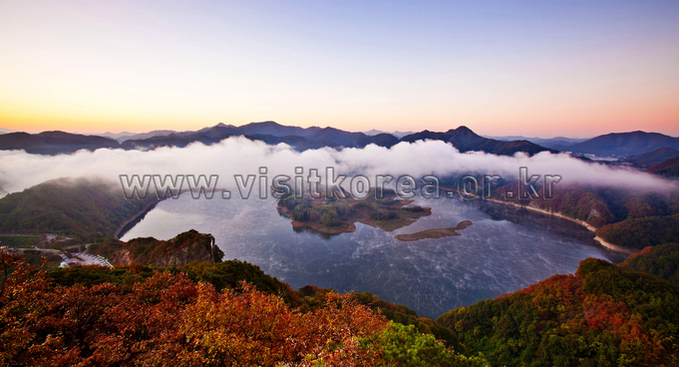
Tucked into the green hills of Imsil County in North Jeolla Province, Okjeong Lake is one of Korea’s most photographed reservoirs — and until recently, one of its best-kept secrets. A new cliffside boardwalk now traces the water’s edge along a path pinned to the rock face, letting walkers hug the shoreline in a way that wasn’t possible before. Add drifting morning mist, a swaying suspension bridge, and a small town that happens to be the birthplace of Korean cheese, and you have a day trip most foreign visitors never hear about. Here’s how to explore it.
Where Is Okjeong Lake?
Okjeong Lake (옥정호) sits in Imsil County, a rural county of roughly 25,000 people in North Jeolla Province, near the middle of the South Korean peninsula. Despite the name, it isn’t a natural lake — it’s a reservoir, formed in the mid-20th century when the Seomjin River was dammed to supply water and irrigate farmland downstream. Over the decades, its winding shoreline, wooded ridges, and scattered islets have made it one of the region’s signature scenic spots.
The most famous view is from Guksabong Peak, where a small observatory looks down on Bungeo Island — a fish-shaped islet that appears to float in the water when mist settles over the lake at dawn. That single image, repeated across Korean travel feeds, is what put Okjeong Lake on the map. But the shoreline itself is the real reward, and that’s where the new boardwalk comes in.
Mulangae-gil: Korea’s Longest Lakeside Cliff Walk
The reason to come now is the Mulangae-gil (물안개길), which translates roughly to “misty water trail.” It’s a wooden deck path that runs about 4 kilometers one way along the cliffs at the lake’s edge, from the Bungeo Island Suspension Bridge parking area to the entrance of Yongun Village. Much of it is a jandow (잔도) — a walkway bolted directly to the side of a cliff, a dramatic style of path borrowed from the mountains of China. Local authorities describe it as the longest lakeside boardwalk of its kind in Korea.
What the 4km Walk Is Like
Unlike most cliff trails, this one is surprisingly easy. The deck was built with gentle grades and handrails instead of stairs, so it’s friendly to older walkers, strollers, and — along the smoother stretches — wheelchairs. Walking one way takes most people about an hour and a half at a relaxed pace; the full out-and-back is closer to 8 kilometers and two to three hours. Because the path clings to the rock, some sections feel as though you’re walking just above the water, with the lake falling away on one side and forest rising on the other. Wildflowers and cliff plants grow right against the boards, and the view keeps changing as the shoreline curves in and out. It’s a walk built for slowing down rather than covering distance.
The Legendary Morning Mist
Okjeong Lake owes its reputation to fog. On cool mornings — especially in autumn and early summer — mist rises off the warmer water and pools between the hills, turning Bungeo Island into a dark silhouette adrift in white. Photographers climb to the Guksabong observatory before sunrise to catch it, and those images are exactly why the lake became a Korean bucket-list spot. If you can only pick one time to visit, make it an early start. Even on clear days without fog, the soft light on the water in the first hour after dawn is the best you’ll get, and the trail is at its emptiest.
The Bungeo Island Suspension Bridge
The walk begins near the Bungeo Island Suspension Bridge (붕어섬 출렁다리), which opened in 2023 and quickly became the lake’s headline attraction. The bridge crosses open water toward the small island, swaying gently underfoot and opening up a wide view back across the reservoir. It draws steady crowds on weekends, so if you want the peaceful version, arrive early on a weekday. The island and bridge area may charge a modest admission fee and keep seasonal hours, so it’s worth confirming the latest details with Imsil County tourism before you build your day around it.
Imsil, the Birthplace of Korean Cheese
Here’s the detail that surprises almost everyone: Imsil is where Korean cheese was born. In the 1960s, a Belgian priest named Didier t’Serstevens — known in Korea as Ji Jeong-hwan — was assigned to the local parish and went looking for a way to lift struggling farmers out of poverty. He started with two goats, and after years of failed batches and a study trip back to Europe, he produced the country’s first domestically made cheese here in the late 1960s, followed by Korea’s first mozzarella in the 1970s.
He spent the rest of his life in Korea, was granted Korean citizenship in 2016, and is still remembered as “the father of Korean cheese.” Today you can taste that legacy at the Imsil Cheese Theme Park, where cheese-making classes, wood-fired pizza, and a European-style village make an easy, family-friendly add-on to a morning at the lake. For foreign visitors especially, it’s a genuinely unexpected slice of Korean history hiding in a quiet rural county.
How to Get to Okjeong Lake
Imsil is rural and the lake is spread out, so a car is by far the easiest way to visit. From Seoul, it’s roughly a three-hour drive south. Many travelers instead base themselves in Jeonju — the famous hanok-village city — which sits under an hour away by car and pairs naturally with the lake. If you’re relying on public transport, take a train or intercity bus to Jeonju or Imsil and connect onward by local bus or taxi; services to the lakeside are limited, so allow extra time and confirm schedules locally. Free parking is available near the suspension bridge and at trail access points.
Best Time to Visit
The trail is open year-round, but three windows stand out. Early summer brings vivid green hills and some of the season’s best mist. Autumn layers the shoreline in color and produces the most dramatic dawn fog of the year. Winter is quiet and stark — beautiful if you don’t mind the cold and the bare trees. Whatever the season, aim for early morning: that’s when you get the mist, the softest light, and a path almost entirely to yourself.
Tips Before You Go
- Start at dawn for the mist and to beat weekend crowds.
- Wear comfortable shoes — the deck is even, but the full loop is long.
- Bring water and snacks, as facilities along the trail are limited.
- Check current bridge fees and opening hours with Imsil County tourism.
- Pair the lake with the Imsil Cheese Theme Park or Jeonju Hanok Village to fill a full day.
A Quiet Corner Worth the Detour
Okjeong Lake is the kind of place that rewards travelers who look past the obvious. There are no tour-bus convoys and no long ticket lines — just a still reservoir, a cliff-hugging boardwalk, and a small county with an unexpectedly rich backstory. Whether you come for the sunrise mist, the gentle walk above the water, or a plate of cheese with a very unusual history behind it, this is a piece of Korea most visitors miss entirely.
Planning more off-the-beaten-path Korean trips? Browse our Hidden Korea series, where we map out the quiet corners of the country that most visitors miss.