
The green frog Korean folktale, known in Korea as Cheonggaeguri (청개구리), is one of the shortest Korean folk tales and one of the most quoted. It tells of a little frog who always did the exact opposite of what his mother asked, and of the heartbreaking moment when, for once, he finally obeyed. Nearly every Korean child hears it, and the story has given the language one of its most common everyday words.
Today, when a Korean parent calls a child a cheonggaeguri, everyone knows what it means: a kid who says no to everything, who goes left when told to go right. The tale also offers a gentle explanation for something anyone can hear on a Korean summer night: why frogs croak so loudly when it rains. This guide retells the story, explains the values behind it, and shows how a small frog became part of the way Koreans talk about family.
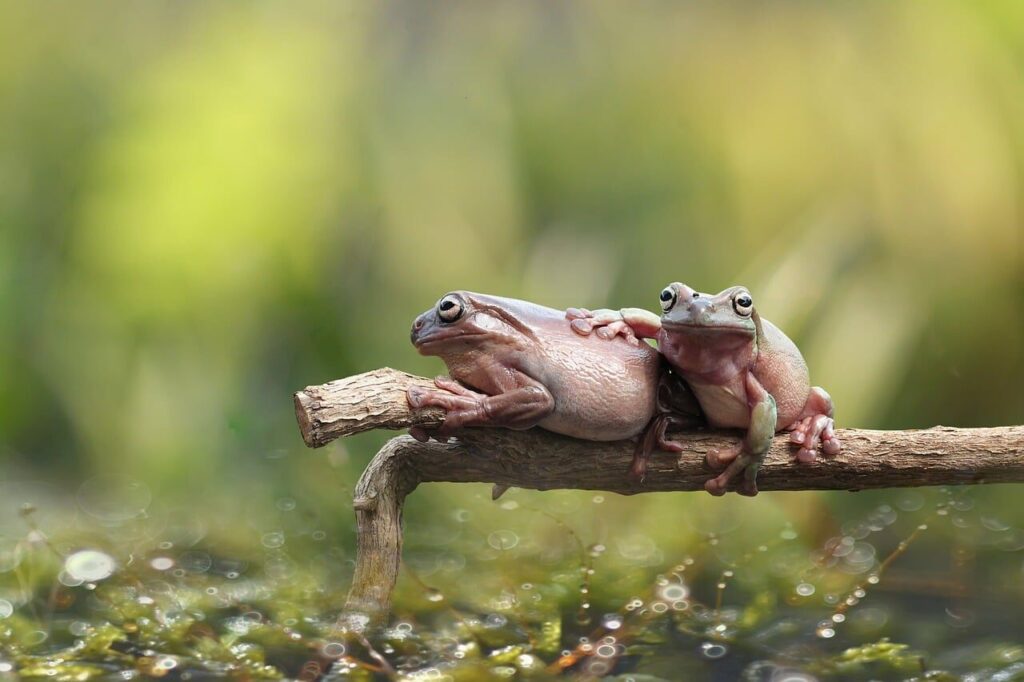
The Green Frog Korean Folktale at a Glance
| Korean title | Cheonggaeguri (청개구리), “green frog” or “tree frog” |
| Type | Short animal fable, told to young children |
| Main characters | A disobedient young frog and his mother |
| Main theme | Filial piety (hyo, 효) and regret |
| Explains | Why green frogs croak when it rains |
| Everyday use | “Cheonggaeguri” means a contrary child who does the opposite of what they are told |
The Story of the Green Frog
Long ago, beside a small stream at the foot of a mountain, there lived a mother frog and her only son, a young green frog. The mother loved him dearly, but he had one great fault. Whatever she told him to do, he did the opposite.
If she said, “Go and play by the stream,” he hopped off toward the mountain. If she said, “Come home before dark,” he stayed out until the stars came up. When she asked him to sit still, he jumped around. When she asked him to be quiet, he croaked as loudly as he could. Even when she taught him how a frog should croak, saying “gaegul, gaegul,” he would answer back “gulgae, gulgae,” just to be different.
The mother frog sighed and scolded and pleaded, but nothing changed. Day after day, year after year, her son went against every word she said. Worry and heartache wore her down, and in time she grew old and fell ill.
The Mother’s Last Wish
When the mother frog knew she did not have long to live, she called her son to her side. She had been thinking carefully about her burial. She wanted to rest on the sunny mountainside, where her grave would be safe and dry. But she knew her son all too well. If she asked to be buried on the mountain, he would surely bury her by the stream.
So she said the opposite of what she wanted. “When I die,” she told him softly, “do not bury me on the mountain. Bury me by the stream.”
Not long after, the mother frog passed away.
A Son’s Regret
The young frog was overcome with grief. Sitting beside his mother’s body, he remembered every time he had disobeyed her, every word he had ignored, every worry he had caused. “I never once listened to you while you were alive,” he cried. “At least now, I will do exactly what you asked.”
And so, for the first time in his life, he obeyed his mother to the letter. He dug a grave beside the stream and buried her there, just as she had told him.
But a grave by the water is not a safe place. Whenever dark clouds gathered and rain began to fall, the stream rose higher and higher, and the green frog was terrified that his mother’s grave would be washed away. He would sit beside it in the rain and cry with all his heart, “Gaegul, gaegul! Please don’t wash my mother away!”
That, the story says, is why green frogs croak so sorrowfully whenever it rains. They are still worrying about their mothers’ graves by the stream.
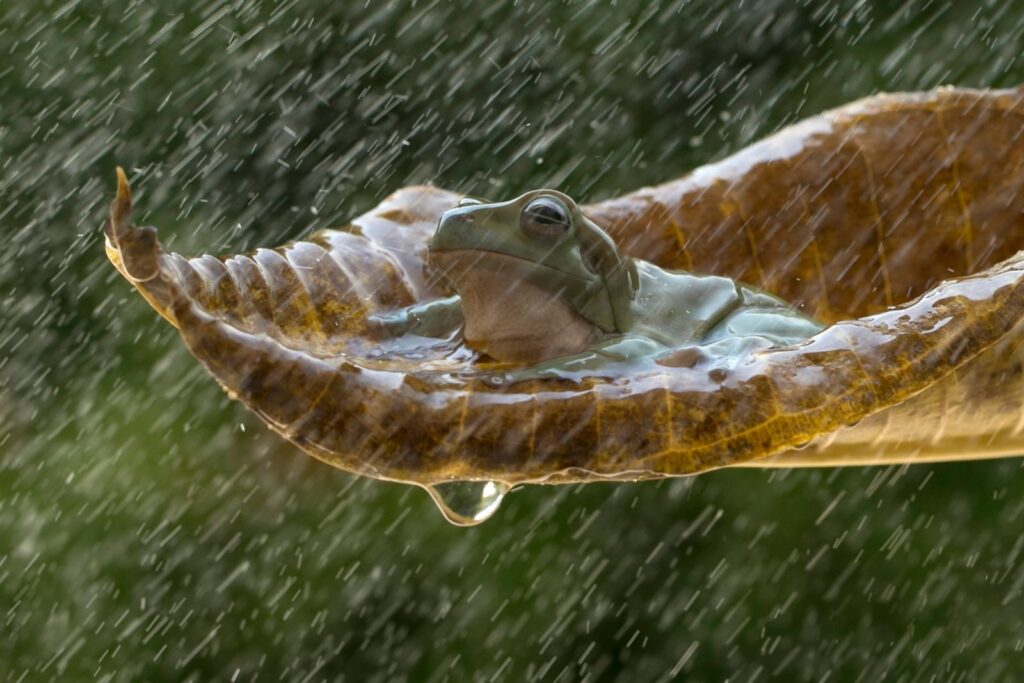
What the Green Frog Korean Folktale Means
The Green Frog is short, but it carries several layers of meaning that Korean children absorb long before they can explain them.
Filial Piety and the Cost of Waiting
At its heart, the story is about hyo (효), filial piety, the duty and devotion children owe their parents. This value runs through Korean culture, shaped over centuries by Confucian teaching. It appears in many other Korean folk tales, most famously in Sim Cheong, where a devoted daughter sacrifices herself so her blind father can see.
The green frog teaches the same value from the opposite side. He is not a model of filial piety but a warning. The lesson is not only “obey your parents,” but also “do not wait until it is too late.” The frog finally becomes a dutiful son only after his mother is gone, and his obedience then brings only sorrow. Many Korean adults say the story hits harder once they are grown, when they start thinking about their own aging parents.
The Danger of Doing the Opposite
The story is also a sharp little lesson about contrariness. The young frog’s habit of always doing the opposite is not real independence. It is just another way of letting someone else decide for you. Because he only ever reacts against his mother, he never stops to think about what is actually right. When he finally tries to make amends, he follows her words blindly instead of understanding what she truly wanted.
A Mother’s Love and Worry
The mother frog is quietly the most tragic figure. Even on her deathbed, she is still trying to manage her son, guessing what he will do and planning around it. Her final trick fails not because her son ignored her, but because he finally listened. The irony is painful, and it is exactly what makes the story stick in the memory.
“Cheonggaeguri”: A Word Every Korean Uses
The most lasting legacy of the tale is linguistic. In everyday Korean, cheonggaeguri has become shorthand for a person, usually a child, who does the opposite of whatever they are told.
You will hear it in many situations:
- A parent to a toddler who refuses to put on shoes: “Why are you being such a cheonggaeguri?”
- A teacher describing a student who always argues back.
- Friends teasing someone who orders a different dish just because everyone else ordered the same one.
- Even news headlines describing a market, a politician, or a sports team that moves against expectations.
There is also the phrase cheonggaeguri simbo (청개구리 심보), meaning a “green frog mindset” or contrary streak. Someone with cheonggaeguri simbo wants to do something precisely because they were told not to. It is usually said with a mix of frustration and affection, the way English speakers might call a child “stubborn as a mule” or say they have “a contrary streak.”
For learners of Korean, the word is a good example of how folk tales live on in daily language. Knowing the story behind it explains why a Korean mother might sigh “cheonggaeguri” at a child who suddenly decides to do the opposite of everything.
Growing up in Korea, I heard this word all the time. Probably because of the story, “cheonggaeguri” became the everyday label for a careless kid who never listens, and adults would mutter, “What a little green frog that one is,” about a child who did the opposite of everything. When I first heard the tale as a child, the ending made me genuinely sad. Imagining the little frog losing his mother stayed with me, and it made me quietly promise myself to listen to my own mother more. In that way, the story did exactly what it was meant to do: it stirred a child’s sense of hyo long before I knew the word.
The Real Green Frog of Korea
The frog in the story is based on a real animal. The Japanese tree frog (Dryophytes japonicus), called cheonggaeguri in Korean, is one of the most common frogs on the Korean peninsula. It is small, usually only a few centimeters long, bright green, and has sticky toe pads that let it climb leaves, stems, and even windows.
These frogs are found in rice paddies, gardens, parks, and wet fields across Korea, and they are famous for their loud calls. On humid evenings in early summer, especially before and after rain, the chorus from a nearby rice field can be surprisingly loud. Their habit of calling more when the air is damp is exactly what gave rise to the story’s explanation. To people working in the fields, it seemed that the little green frogs could sense rain coming and began crying out.
Korea is also home to a close relative, the Suweon tree frog (Dryophytes suweonensis), named after the city of Suwon where it was first described. It lives mainly in rice paddies and is now endangered because of habitat loss, which has made it a symbol of efforts to protect Korea’s wetlands.
Rainy Days and Frog Songs
Frogs and rain have long been linked in Korean culture. Monsoon season, called jangma (장마), usually arrives in late June or July and brings weeks of heavy rain. In the countryside, it also brings a nightly chorus of frogs from the flooded paddies.
For many Koreans, the sound of frogs croaking on a rainy evening brings back the story instantly. Parents sometimes point it out to children: “Listen, the green frog is crying for his mother again.” It turns a natural sound into a small moral reminder, and it is one reason the tale has lasted so long in a country where so many people grew up near rice fields.
The story also reflects an old Korean concern about where graves are placed. Traditionally, families took great care in choosing burial sites, preferring sunny hillsides with good drainage and a pleasant view, guided by the principles of pungsu (풍수), Korea’s version of feng shui. A grave by a stream, at risk of flooding, would have been seen as a terrible location. Korean listeners of earlier generations would have understood immediately why the mother wanted to be buried on the mountain and why the son’s literal obedience was a disaster.
How Korean Children Meet the Story
The green frog Korean folktale is usually one of the first stories Korean children hear, often from a parent or grandparent at bedtime or from a colorful picture book. Kindergarten teachers use it to talk about listening to parents, and it appears in many collections of traditional stories for young readers.
Because it is so short, it is easy to tell from memory, and many families have their own way of telling it. Some versions make the young frog more mischievous and comic at the beginning, with long lists of all the silly opposite things he does. Others focus on the sadness at the end. In some tellings, the mother frog explains her plan to the reader before she dies, so even very young children understand the twist.
The story is also popular with people learning Korean. Its simple vocabulary, clear structure, and well-known ending make it a common choice for beginner reading exercises, and knowing it helps learners understand the everyday expression.
The Green Frog and Other Korean Folk Tales
The green frog Korean folktale sits comfortably alongside other animal tales that Korean children grow up with. In The Tiger and the Dried Persimmon, a fearsome tiger is scared off by a crying baby and a misunderstanding. In The Rabbit and the Turtle, a clever rabbit talks his way out of losing his liver to the Dragon King. Like these stories, the Green Frog uses animals to teach something about people.
Its focus on family duty also links it to stories like Heungbu and Nolbu, which contrasts a kind brother and a greedy one, and The Sun and the Moon, where a mother’s love and her children’s courage drive the tale. Together, these stories form a kind of moral map of the traditional Korean family.
Useful Korean Words From the Story
| 청개구리 (cheonggaeguri) | Green frog, tree frog; also a contrary person |
| 개구리 (gaeguri) | Frog |
| 개굴개굴 (gaegul gaegul) | The sound a frog makes, like “ribbit” |
| 청개구리 심보 (cheonggaeguri simbo) | A contrary streak, wanting to do the opposite |
| 효 (hyo) | Filial piety, devotion to one’s parents |
| 장마 (jangma) | The summer monsoon season |
Why the Green Frog Still Matters
It would be easy to dismiss the green frog Korean folktale as a simple bedtime story about doing what you are told. But the tale has lasted because it touches something everyone recognizes: the stubbornness of children, the worry of parents, and the regret that comes from realizing too late how much someone cared for you.
The next time you hear frogs croaking on a rainy night in Korea, you will know what many Koreans hear in that sound. It is a little green frog by a stream, still crying for his mother, and still reminding everyone listening to say the important things while there is time.
For more stories like this, explore our collection of Korean folk tales.
Note: Some images in this post are AI-generated illustrations.