Your first winter in Korea usually comes with a small mystery on the wall: a Korean boiler controller covered in Korean buttons. It runs both your floor heating and your hot water, and knowing how to use it well can mean a warm, affordable winter instead of a cold apartment or a shocking gas bill.
This guide explains how a Korean boiler works, what each button on the controller means, which modes to use when you go out or travel, how to keep pipes from freezing, and what to do when the boiler shows an error. Information is current as of November 2026. Controllers differ by brand and building, but the basic buttons are surprisingly similar from one home to the next.
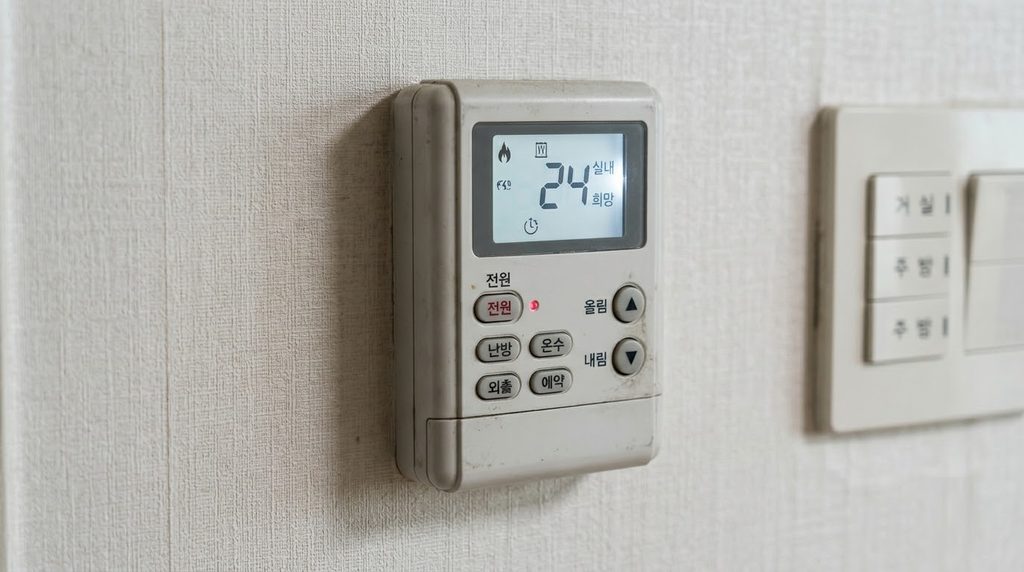
Korean Boiler Basics at a Glance
| What it does | Heats water for floor heating (ondol) and for taps and showers |
| Where it is | The boiler unit is usually on the balcony or in a utility room; the controller is on a living room wall |
| Fuel | Usually city gas (도시가스) in individually heated homes |
| Key buttons | 전원 power, 난방 heating, 온수 hot water, 외출 away, 예약 timer |
| Best habit when leaving home | Use away mode or lower the temperature instead of switching it off |
| Main winter risk | Frozen pipes during cold snaps |
How Korean Heating Works
Korea heats homes from the floor up. The system grew out of ondol (온돌), the traditional method of running smoke from a kitchen fire through channels under a stone floor. Today, the same idea works with hot water instead of smoke. In a modern Korean home, a boiler pumps hot water through a network of pipes laid inside the floor, and the floor itself becomes the radiator.
Because the warmth comes from the floor, Korean homes feel different from homes with radiators or forced air. The air may stay cooler, but the floor is warm to sit, sleep, and walk on. It is one reason Koreans take their shoes off indoors, as explained in our guide to why Koreans remove their shoes, and why many families still eat and relax sitting on the floor.
A Korean boiler also heats your tap water. Inside the unit, a valve sends the heated water either to the floor pipes or to your taps and shower, depending on what you need at that moment. In practice, this means the boiler is the heart of your home’s comfort for half the year.
Individual, District, and Central Heating
Not every home has its own boiler. Government figures for 2023 show that roughly eight in ten Korean households had their own individual boiler, about 15 percent received district heating from a power plant, and around 3 percent relied on a central boiler room shared by a whole complex.
- Individual heating (개별난방): You have your own gas boiler and pay your own gas bill. Most villas, officetels, houses, and many apartments work this way.
- District heating (지역난방): Common in large apartment complexes in new towns. There is no gas boiler in your unit, but you still have a wall controller for each room, and heating appears on your apartment bill.
- Central heating (중앙난방): Found in some older complexes. Heating runs on a schedule set by the building, and you have little control.
If you are not sure which you have, check your balcony or utility room for a boiler unit, or look at your monthly bills. Our guides to utility bills in Korea and apartment management fees explain where heating costs appear.
The Controller: What Each Button Means
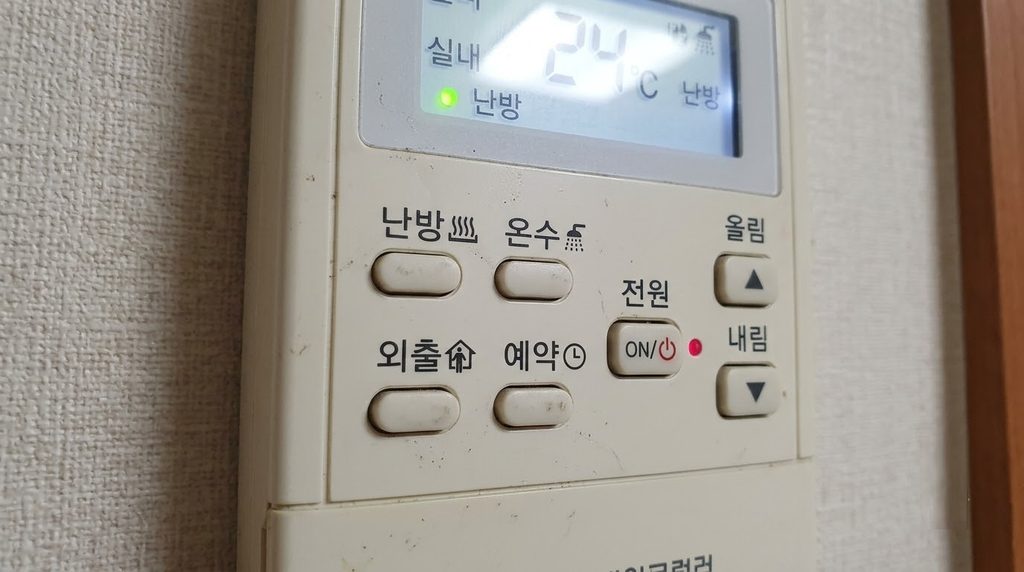
The controller is the small panel on your wall. Dozens of companies make these controllers, and almost all of them are labeled only in Korean. The good news is that nearly all of them use the same few words. Learn these and you can operate almost any Korean boiler.
| 전원 (jeonwon) | Power on/off |
| 난방 (nanbang) | Heating mode, floor heating on |
| 온수 (onsu) / 온수전용 | Hot water only, no floor heating |
| 외출 (oechul) | Away mode, minimal heating to protect pipes |
| 예약 (yeyak) | Timer mode, heats for a set period at intervals |
| 실내 / 실온 (silnae / sillon) | Room temperature mode, controls by air temperature |
| 온돌 (ondol) | Floor temperature mode, controls by heating water temperature |
| 온수온도 (onsu ondo) | Hot water temperature for taps and showers |
| ▲ / ▼ | Raise or lower the temperature setting |
Room Temperature Mode or Floor Mode?
Newcomers are often puzzled by the choice of two heating modes, one based on the air and one based on the floor.
- Room temperature mode (실내/실온): You set a target air temperature, such as 22°C. The boiler runs until the room’s sensor reaches that temperature, then stops. This is the easiest mode for most people.
- Floor mode (온돌): You set the temperature of the water flowing under the floor, often on a scale or in degrees much higher than room temperature. The boiler keeps the water at that level. It warms the floor steadily and is common in older homes or where the room sensor is unreliable.
If your controller shows numbers like 40 to 80, you are probably in floor mode, and those numbers are water temperatures, not room temperatures. Do not panic and turn it down to 22, or the floor will barely warm up.
The Hot Water Button
Many foreigners get caught out by this one. On some controllers, turning off heating also stops hot water, and on others, pressing 온수 or 온수전용 switches to hot-water-only mode and stops the floor heating. If you switch to hot-water-only for a shower, remember to switch back to heating afterward.
In summer, hot-water-only mode is exactly what you want. In winter, it is an easy way to come home to a cold apartment by mistake.
Korean Boiler Away Mode vs. Turning It Off
The most common mistake newcomers make is switching a Korean boiler off every time they leave home to save money. It feels logical, but it often backfires. When the floor and the concrete beneath it go completely cold, the boiler has to work very hard to warm everything up again when you return.
Korean experts give consistent advice here. Energy agencies and boiler makers advise lowering the temperature or using away mode rather than switching the system off completely, whether you have your own boiler or district heating. Korea’s district heating provider says the same: its systems work most efficiently when homes keep a steady temperature around the clock.
A simple rule of thumb many residents follow:
- Out for the day: Lower the temperature a few degrees, or use timer mode.
- Away for several days in winter: Use away mode (외출). It keeps just enough heat in the system to protect the pipes.
- Away in summer: Turning the power off is fine.
Timer Mode (예약)
Timer mode works differently from what many people expect. On most Korean boilers, it does not mean “turn on at 7 p.m.” Instead, it means “run the heating for a short burst every few hours.” For example, a setting of 3 might mean the boiler runs for a set time once every three hours, then rests.
This is useful for keeping a home from getting too cold without running the boiler constantly, and many people use it overnight or during working hours. Because each brand handles timer mode a little differently, check the manual or the brand’s website if the results do not match what you expect.
As gas prices have climbed in recent years, Koreans often talk about the winter “gas bill bomb,” and for ordinary households, heating costs land on top of every other living expense. So people trade tips. Many stick bubble wrap on their windows to block the cold drafts that creep in, which Koreans call utpung (웃풍). Some turn the boiler down and rely more on an electric heater, a kerosene stove, or even a wood-burning stove, which brings a cozy winter mood of its own. Lately, some homes have started replacing boiler heating with graphene heating film laid under the floor or inside the walls. People say it gives a gentle, even warmth without drying out the air, though I honestly do not know how much it adds to the electricity bill.
I have also had my boiler freeze during a severe cold wave. Because it sits outside the house, its pipes froze solid, and I had to thaw them slowly with a hair dryer and warm water. Since then, I wrap the outdoor pipes in thick foil-lined insulation covers before the coldest weeks arrive, so it does not happen again.
Saving Money on Your Gas Bill
Winter gas bills in Korea can be much higher than summer ones, especially in older buildings with poor insulation. Surprisingly often, a high bill comes not from heavy use but from using the controller the wrong way. A few habits make a real difference:
- Raise the temperature gradually. Turning the boiler to maximum does not heat the home faster. It mainly burns more gas.
- Keep a steady temperature. Small adjustments use less energy than repeated full shutdowns and restarts.
- Close off unused rooms. Many homes have valves (분배기) that control floor heating room by room. Closing them for unused rooms saves gas.
- Use bubble wrap on windows. Koreans commonly stick insulating bubble wrap, called bbokbbogi (뽁뽁이), on windows in winter. It is cheap and helps keep heat in.
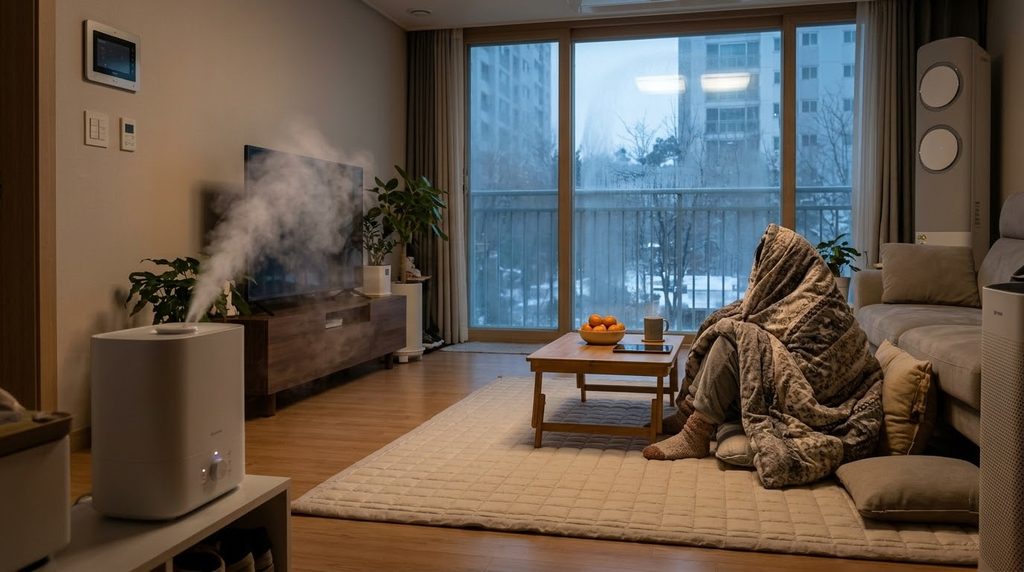
- Use a humidifier. Humid air holds heat better and feels warmer, and Korean winters are very dry.
- Wear warm clothes indoors. Many Korean households keep the room temperature moderate and add a thick blanket or indoor jacket.
- Check your shower temperature. Setting hot water lower saves gas year-round.
Preventing Frozen Pipes
Korea’s winters can bring sharp cold snaps, with temperatures well below freezing for several days. When that happens, water pipes, water meters, and the boiler itself can freeze, a problem known as dongpa (동파). Repairs are inconvenient and can be costly, and tenants are often expected to take reasonable precautions.
To protect your home:
- Never turn the boiler completely off in severe cold. Use away mode at minimum.
- Let a tap drip slightly. On very cold nights, leaving a hot water tap running at a thin trickle keeps water moving through the pipes.
- Insulate the water meter box. Stuff the meter box with old clothes or insulating material if it is outside or in a cold hallway.
- Close balcony windows. If your boiler is on the balcony, keep the windows closed and avoid drafts.
- Watch for warnings. Korean authorities send freeze warnings and cold-wave alerts by text message. Take them seriously.
If water stops coming out of a tap during a cold snap, the pipe may already be frozen. Do not pour boiling water directly on pipes or the meter, which can crack them. Warm the area gently with a hair dryer or warm towels, or contact your landlord, management office, or the local water office.
When the Boiler Shows an Error
A Korean boiler displays an error code when something goes wrong. Common causes include low water pressure, a gas supply problem, a frozen pipe, or a blocked exhaust. The big Korean brands include Navien, Kiturami, Rinnai, and KD. Each brand uses its own codes, so the same number can mean different things on different machines.
Here is a sensible approach:
- Write down the error code and the brand name on the boiler.
- Try a reset. Turning the controller off and on again sometimes clears a temporary error.
- Check the gas. Make sure the gas valve is open and your gas has not been cut off for an unpaid bill.
- Search the brand’s website for the code, or call the manufacturer’s customer service. Major brands run service centers and can send a technician.
- Tell your landlord. In most rentals, boiler repairs and replacements are the landlord’s responsibility, as long as the damage was not caused by misuse.
If you ever smell gas, do not turn on lights or switches. Close the gas valve, open the windows, leave the home, and call the gas company or emergency services.
Boilers and Your Rental Contract
Heating questions often come up for tenants and landlords. A few points are worth knowing before winter:
- Test the Korean boiler before you move in. Check heating and hot water during your viewing, especially if you are moving in autumn.
- Ask about the boiler’s age. Old boilers are less efficient and more likely to break down.
- Know who pays for repairs. Usually the landlord covers major repairs, while tenants handle damage caused by neglect, such as frozen pipes after turning the boiler off in a cold wave.
- Take photos of the controller. Saving the model name makes it easy to look up instructions later.
Our guides to monthly rent in Korea and Korean apartments cover more of what to check when renting.
Useful Korean Words
| 보일러 (boileo) | Boiler |
| 온돌 (ondol) | Floor heating |
| 도시가스 (dosi gaseu) | City gas |
| 개별난방 (gaebyeol nanbang) | Individual heating |
| 지역난방 (jiyeok nanbang) | District heating |
| 동파 (dongpa) | Frozen and burst pipes |
| 뽁뽁이 (bbokbbogi) | Bubble wrap for window insulation |
| 분배기 (bunbaegi) | Floor heating valve manifold for each room |
Staying Warm Through a Korean Winter
Once you know what the buttons mean, a Korean boiler is easy to live with, and the warm floor becomes one of the best parts of winter in Korea. Keep the temperature steady, use away mode instead of switching off, protect your pipes during cold snaps, and you will get through the season comfortably without dreading your gas bill.
Winter in Korea has its own traditions too. Learn about the longest night of the year in our guide to Dongji, or warm up the Korean way at a public bathhouse with our jjimjilbang etiquette guide.