
Sim Cheong is the heroine of Korea’s most famous story about a daughter’s love for her father. A poor girl raised by her blind father sells herself to sailors to buy the rice offering that might restore his sight, throws herself into a raging sea, and comes back to the world inside a lotus flower. Almost every Korean knows the outline, and almost every Korean has an opinion about it.
Known in Korean as Simcheong-jeon (심청전), “The Tale of Sim Cheong,” the story lives on as a classical novel, as one of the five surviving works of pansori, and as a picture book for children. It also has a surprising real-world address: an island off the coast of Incheon that still claims to look out over the sea where Sim Cheong jumped. This guide walks through the whole tale, its characters, its meaning, and why modern readers argue about it.
Sim Cheong at a Glance
| Korean title | Simcheong-jeon (심청전); as pansori, Simcheongga (심청가) |
| Other spellings | Shim Cheong, Sim Chong, Shim Chung |
| Type | Classical novel, pansori, and folk narrative |
| Main characters | Sim Cheong, her blind father Sim Hak-gyu, a monk, sailors, the Dragon King, and Lady Ppaengdeok |
| Central theme | Hyo (효), filial piety |
| Famous moment | A father’s eyes open at the moment he hears his daughter’s voice |
Nobody knows who first told the story or exactly when. References suggest a complete version existed by the eighteenth century, and scholars have collected more than 80 variant texts. The outline below follows the version most Koreans know, with notes where common tellings differ.
The Story, Part One: A Girl Raised on Borrowed Milk
Long ago, in a village in Hwangju, in what is now North Korea, lived a poor man named Sim Hak-gyu. He came from a respectable family, but he had lost his sight and his fortune, and villagers simply called him Blind Sim. His wife, Lady Gwak, longed for a child, and at last a daughter was born. But a few days later, Lady Gwak died.
Left alone with a newborn, Blind Sim carried his baby from house to house, asking nursing mothers in the village to feed her. The daughter, named Cheong, grew up on the kindness of neighbors. By the time she was a young girl, she was the one taking care of her father, begging for food and doing needlework to keep the two of them alive.
This opening is one of the most moving parts of the story for Korean readers. Before Sim Cheong does anything heroic, she has already spent her whole childhood repaying the people who kept her alive.
It also shows a side of old village life that many older Koreans still remember: neighbors sharing food, mothers nursing each other’s babies, and a whole community quietly stepping in when a family fell on hard times. In the pansori version, these scenes are sung slowly and tenderly, and the image of a blind father carrying his baby through the village at night is one that audiences never forget.
The Story, Part Two: Three Hundred Sacks of Rice
One day, Blind Sim stumbled into a ditch while waiting for his daughter to come home. A Buddhist monk passing by pulled him out and told him something astonishing: if he offered 300 sacks of rice to the temple, the Buddha would restore his sight.
Without thinking, Blind Sim promised the rice. Only later did he realize what he had done. Three hundred sacks of rice was an impossible amount for a man who could barely feed himself, and breaking a promise to the Buddha seemed even worse than staying blind.
When Sim Cheong learned what had happened, she quietly looked for a way to keep her father’s promise. She found one. A crew of sea merchants was searching for a young woman to offer to the sea god, a sacrifice they believed would calm the dangerous waters of a place called Indangsu (인당수). In exchange, they would pay 300 sacks of rice.
Sim Cheong, fifteen years old, agreed.
The Story, Part Three: The Sea at Indangsu
Sim Cheong told her father that she had been adopted as a foster daughter by a wealthy family, a lie meant to spare him. On the day of departure, the truth came out, and the farewell scene, with Blind Sim crying out and grabbing at his daughter as she is led away, is one of the most famous moments in all of Korean storytelling.
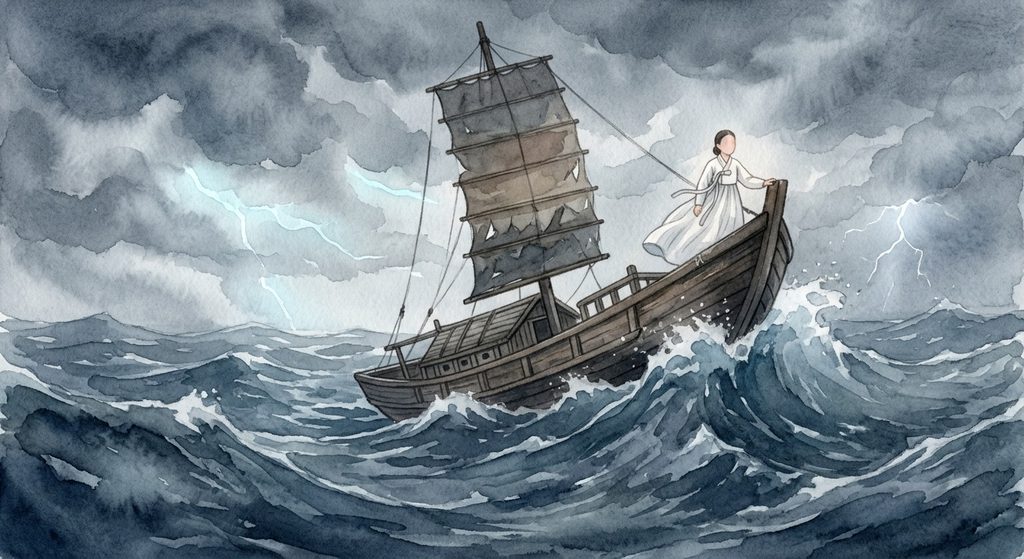
The ship sailed out until it reached Indangsu, where the waves rose wildly. Sim Cheong prayed for her father, covered her face with her skirt, and threw herself into the sea.
The Story, Part Four: The Dragon King and the Lotus
Sim Cheong did not die. Moved by her devotion, heaven ordered the Dragon King of the sea to receive her in his underwater palace. In some versions, she even meets her mother there, now a heavenly being, for a brief, tearful reunion.
When the time came to return her to the world, the Dragon King placed Sim Cheong inside a huge lotus flower and sent it floating up to the surface. The same sailors, passing back the way they had come, found the extraordinary flower drifting on the water and presented it to their ruler. When the lotus opened, Sim Cheong stepped out, and the ruler, struck by her beauty and her story, made her his queen.
The Dragon King appears in other Korean tales too, though rarely so kindly. In the rabbit and turtle Korean folktale, he is the sick, greedy ruler a clever rabbit has to outwit.
The Story, Part Five: The Banquet for the Blind
Even as queen, Sim Cheong could not stop thinking about her father. She asked the king to hold a great banquet and invite every blind person in the kingdom, hoping her father would come.
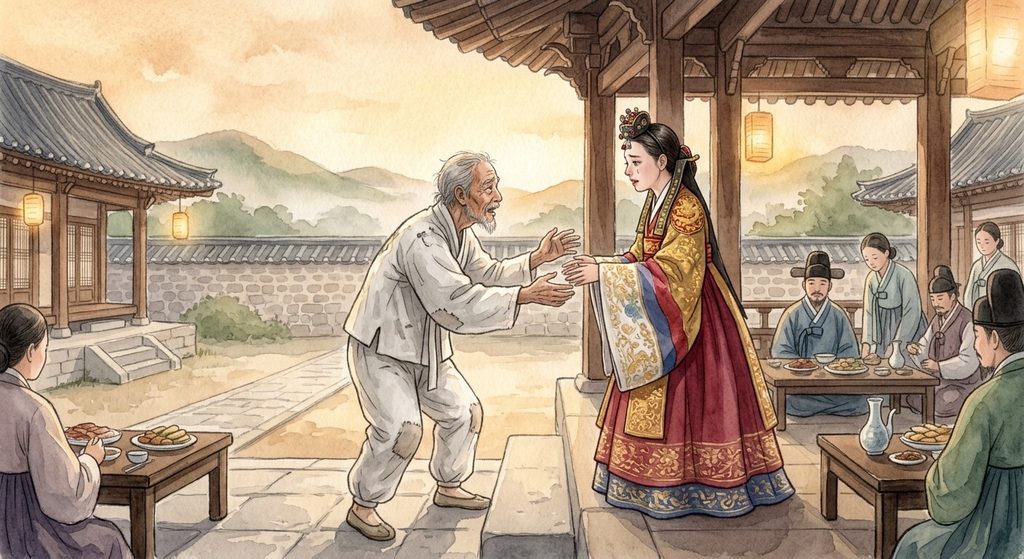
Meanwhile, Blind Sim had fallen on hard times again. A scheming widow known as Lady Ppaengdeok had married him for his money, spent it, and finally run off with another man on the road to the banquet. Blind Sim arrived last, ragged and alone.
When he heard the queen’s voice calling him “Father,” he cried out in shock, struggled to see his daughter, and his eyes suddenly opened. In many tellings, the miracle does not stop with him: at the same moment, every blind guest at the banquet can see.
Who Is Lady Ppaengdeok?
Lady Ppaengdeok, or Ppaengdeok-eomi (뺑덕어미), “Ppaengdeok’s mother,” is the story’s comic villain. She is greedy, lazy, and loud, and in pansori performances her scenes are played for laughs. Her name became shorthand in Korean for a selfish, scheming woman, though some modern critics point out that the portrayal relies on unkind stereotypes.
She also serves a purpose in the plot. Without her, Blind Sim would arrive at the banquet with some dignity. Because of her, he arrives with nothing, which makes the final reunion even more powerful.
Simcheongga: The Story as Pansori
Pansori (판소리) is a traditional Korean art form in which a single singer tells a long story through song, speech, and gesture, accompanied by a drummer. Of the many pansori stories once performed, only five survive in full, and Simcheongga is one of them, alongside the songs behind The Tale of Chunhyang, Heungbu and Nolbu, and the rabbit and turtle story.
Simcheongga is known as the most sorrowful of the five. The farewell at the ship and the blind father’s lament demand enormous emotional power from the singer, and many Korean listeners say these are the passages that make them cry. The joyful ending, by contrast, is full of energy and humor, which gives the full performance a dramatic arc from grief to celebration.
Is Indangsu a Real Place?
The story itself never gives exact coordinates, but one place has made the strongest claim: Baengnyeongdo (백령도), a small island in Incheon’s Ongjin County, in the far northwest corner of South Korea’s waters.
The sea off Baengnyeongdo, close to North Korea’s Jangsan Cape, has long been feared for its strong tidal currents and sudden weather. Historical writers noted how dangerous these waters were for ships, and the Indangsu legend settled there. Local legend also says the lotus carrying Sim Cheong drifted ashore near the island, and places on and around Baengnyeongdo carry names linked to the story.
In 1999, a two-story memorial hall called Simcheonggak (심청각) opened on a hilltop in Baengnyeongdo’s Jinchon-ri. It displays materials related to the tale, including old books, recordings, and film materials, and from its upper floor, visitors can look out across the water toward North Korea, the direction of the sea that tradition calls Indangsu.
Getting there is part of the story. Ferries to Baengnyeongdo leave from Incheon’s coastal passenger terminal and take roughly four hours each way, and sailings are often canceled when the sea turns rough. For an island tied to Indangsu, that unpredictability feels strangely fitting. Check the latest ferry schedule and weather before planning a visit.
Other places have their own claims. Gokseong County in South Jeolla Province has promoted itself as Sim Cheong’s hometown and has run a festival in her honor, while scholars have proposed other locations for both her village and the sea. As with most folk tales, the “real” Indangsu is less a fact than a feeling about where such a story belongs. Incheon has another legendary landmark too: on Ganghwa Island, a mountaintop altar is tied to the Dangun myth, Korea’s founding story.
What the Story Teaches About Filial Piety
On the surface, Sim Cheong is the ultimate model of hyo (효), filial piety, the Confucian virtue of devotion to one’s parents. For generations, Korean children were taught to admire her as the perfect daughter: patient, selfless, and willing to give everything, even her life, for her father. The green frog Korean folktale teaches the same value from the opposite side, through a son who only obeys his mother once it is too late.
The story also mixes in Buddhist and folk elements. The monk’s promise drives the plot, the sea god demands a sacrifice, and heaven itself rewards Sim Cheong’s goodness. That blend of Confucian, Buddhist, and shamanic ideas is typical of Korean folk narratives, and in some regions shamans even sang the Sim Cheong story during rituals.
How Modern Koreans Read Sim Cheong
Today, many Koreans read the tale with mixed feelings. Some of the questions people raise:
- Was the father responsible? Blind Sim makes a reckless promise, and his teenage daughter pays the price. Some readers find it hard to admire a story where a child dies to fix an adult’s mistake.
- Is sacrifice really the ideal? Modern readers often ask whether a story that celebrates a girl giving up her life should still be held up as a model for children.
- What is the story criticizing? Some scholars read the father, a down-on-his-luck aristocrat who is easily fooled and quickly loses his money, as quiet satire of the old upper class rather than a figure to sympathize with.
Newer retellings often give Sim Cheong more choice and voice, or focus on the community of neighbors who raised her. Our overview of Korean folk tales looks at how several classic stories are being reread in a similar way.
Sim Cheong in Everyday Korean
The tale has left traces in everyday language. Saying someone “opened their eyes like Blind Sim” describes a sudden moment of understanding, and calling a devoted daughter “a real Sim Cheong” is still a familiar compliment. The story has been adapted into films since the silent era, as well as operas, ballets, musicals, and countless children’s books, and new versions keep appearing for each generation.
Reading Sim Cheong in English
You can find the story in English in illustrated picture books, Korean folk tale collections, and books on pansori. A few tips:
- Search several spellings. Try “Sim Cheong,” “Shim Cheong,” “Sim Chong,” and “The Blind Man’s Daughter.”
- Check how the sacrifice is handled. Picture books for young children often soften the jump into the sea.
- Look for Lady Ppaengdeok. Fuller versions include her subplot; shorter ones skip it.
- Listen to a pansori performance. Even without understanding the words, the farewell scene shows why the story has moved audiences for centuries.
More Korean Folk Tales to Explore
If you were moved by Sim Cheong, try Kongjwi and Patjwi, another story of a kind daughter facing impossible hardship, or The Woodcutter and the Fairy, a tale where family love stretches from earth to heaven. Together, these stories show how deeply family runs through the folk tales Koreans grow up with.
Illustrations in this post were created with AI.