
The Dangun myth is the story Koreans tell about how their country began: a heavenly prince comes down to a mountain, a bear and a tiger beg to become human, and the bear that survives a dark cave on nothing but mugwort and garlic becomes the mother of Korea’s first king. It is short enough to tell in five minutes, and almost every Korean child knows it by heart.
Known in Korean as Dangun sinhwa (단군신화), the myth is more than a bedtime story. It gave Korea a national holiday, a traditional calendar, and a phrase that still sits in the country’s education law. It even has an address in my home city: a stone altar on a mountaintop in Incheon’s Ganghwa Island, where the flame for Korea’s national sports festival is lit every October. This guide walks through the full story, what each part means, and where you can still feel its presence today.
The Dangun Myth at a Glance
| Korean name | Dangun sinhwa (단군신화), “the myth of Dangun” |
| Earliest written source | Samguk Yusa (삼국유사), compiled by the monk Iryeon in the late 13th century |
| Main figures | Hwanin, his son Hwanung, a bear, a tiger, the bear-woman Ungnyeo, and Dangun Wanggeom |
| Kingdom founded | Gojoseon (고조선), traditionally dated to 2333 BCE |
| Key idea | Hongik ingan (홍익인간), “to broadly benefit humanity” |
| Holiday | Gaecheonjeol (개천절), National Foundation Day, October 3 |
Like most founding myths, the Dangun story was told long before anyone wrote it down. The version below follows the Samguk Yusa, which says it drew on an older Korean record that no longer survives. Later books retell the story with small differences, and I will point out the ones Koreans argue about most.
Part One: A Prince Who Wanted the World Below
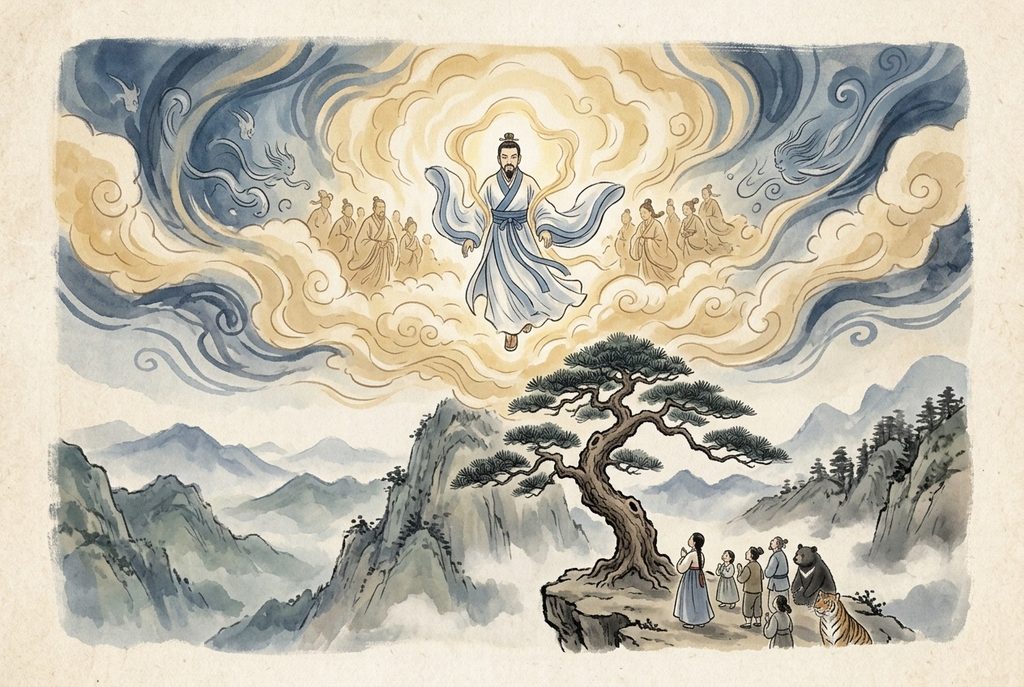
In the beginning there was Hwanin (환인), the lord of heaven. One of his sons, Hwanung (환웅), kept looking down at the human world and longing to live there. Hwanin looked over the land, saw that a mountain called Taebaeksan was a good place from which to help people, and gave his son permission to go.
He also gave Hwanung three heavenly seals as signs of his authority. Hwanung came down with 3,000 followers and arrived beneath a sacred sandalwood tree, the Sindansu (신단수), on the top of the mountain. There he founded a settlement called Sinsi (신시), “the City of God.”
Hwanung did not arrive alone. He brought the Earl of Wind, the Master of Rain, and the Master of Clouds, and through them he looked after farming, life and death, sickness, punishment, and right and wrong, along with hundreds of other human affairs. In other words, the first thing heaven sent to Korea was not a warrior but a government, and one that knew the weather mattered more than anything to a farming people.
Where exactly Taebaeksan was is one of the story’s open questions. Many Koreans today picture Baekdusan, the great volcano on the border of North Korea and China, while older texts point to other mountains. For the story, the important part is simply that heaven touched the earth on a mountaintop.
Part Two: The Bear and the Tiger
Living in a cave nearby were a bear and a tiger. Both of them wanted, more than anything, to become human, and they came to Hwanung every day to pray for it.
Hwanung gave them a test. He handed each of them a bundle of mugwort and twenty cloves of garlic and told them to eat only this and stay out of the sunlight for 100 days. If they could do it, they would take human form.
Both animals went into the cave. The bear stayed quiet, ate its bitter food, and waited in the dark. The tiger could not stand it. Restless and hungry, it ran out of the cave and went back to the forest. The bear kept going, and on the twenty-first day it became a woman. She was called Ungnyeo (웅녀), which simply means “bear woman.”
This is the scene every Korean remembers, and it explains why mugwort and garlic feel almost patriotic in Korea. Mugwort, or ssuk (쑥), still goes into rice cakes and spring soup, and garlic is in nearly every Korean meal. Some historians point out that modern garlic probably reached Korea much later, and they suggest the original plant was a wild relative such as dallae (달래), a small mountain chive. Most Koreans happily keep the garlic.
A Detail Most People Get Wrong: 21 Days, Not 100
Ask Koreans how long the bear stayed in the cave, and many will say 100 days. The text says otherwise. Hwanung set a 100-day rule, but the bear turned into a woman after three times seven days, or 21 days.
That number is not random. In Korean tradition, a newborn baby and its mother stayed indoors for 21 days, called samchiril (삼칠일), and families hung a straw rope across the gate so visitors would keep away. Read with that custom in mind, the bear’s time in the cave looks a lot like a birth. She goes into the dark as an animal and comes out as a person.
The tiger, by the way, is not punished in the story. It simply leaves. Tigers come back again and again in Korean folk tales, often as the scary but slightly foolish villain, as in the Korean folktale of the sun and moon, where a tiger chases two children up a tree. And in The Tiger and the Dried Persimmon, another tiger runs off in terror from a snack it has never even seen.
Part Three: The Birth of Dangun
Ungnyeo had become human, but she had no husband, and no one would marry a woman who had been a bear. So she went to the sacred sandalwood tree and prayed for a child.
Hwanung heard her. He took on human form for a while and married her, and she gave birth to a son. They named him Dangun Wanggeom (단군왕검).
His name is worth a closer look. Dangun is often read as a title for a priest or shaman who spoke with heaven, while Wanggeom suggests a political ruler. The founder of Korea, in other words, was both at once: the man who led the rituals and the man who governed the land. That pairing tells historians something about what early Korean leadership may have looked like.
Part Four: Gojoseon, the First Kingdom
When Dangun grew up, he built a capital at Pyeongyang and named his kingdom Joseon (조선). Historians now call it Gojoseon, “Old Joseon,” so nobody confuses it with the Joseon dynasty that ruled Korea from 1392 to 1910.
Later he moved his capital to a place called Asadal (아사달). According to the Samguk Yusa, he ruled for 1,500 years. At the end of his reign he returned to Asadal, hid himself in the mountains, and became a mountain god. He was 1,908 years old. That is one reason Korean mountain spirits, like the white-bearded old man in Golden Axe, Silver Axe, carry such deep roots in Korean imagination.
The famous date of 2333 BCE comes from later Korean scholars, who matched the story to the reign of the legendary Chinese emperor Yao. Different old books give slightly different years, but 2333 BCE became the standard. That is why you will sometimes hear Koreans proudly say their history is “5,000 years old,” even though Gojoseon as a kingdom you can study in the archaeological record is much younger.
What the Myth Might Mean
Scholars have spent more than a century reading the Dangun story as a coded memory of real events. None of these readings can be proven, but they are fun to think about.
- Two peoples joining together. One popular theory sees Hwanung’s followers as newcomers who worshipped the sky, perhaps bringing bronze tools, and the bear and tiger as local tribes who honored those animals. The bear tribe joined the newcomers. The tiger tribe did not.
- Bear worship. Respect for the bear appears across northeast Asia and Siberia. Ungnyeo may be a memory of a time when the bear was seen as an ancestor.
- Heaven chooses the land. Many Asian founding myths give the first king a divine father. The Dangun story fits that pattern but adds a uniquely Korean twist: the mother comes from the earth, and she earns her place through patience.
For Korean readers, though, the story usually works on a simpler level. The bear wins because she endures. The tiger loses because it cannot wait. Patience, or innae (인내), is a virtue Korean parents still praise, and Ungnyeo is its oldest hero.
Hongik Ingan: A Myth in the Law Books
The most surprising legacy of the Dangun myth is a phrase. When Hwanin looked down at the world before sending his son, the text says he saw that his son could hongik ingan (홍익인간), “broadly benefit humanity.”
That four-character phrase became the founding ideal of modern South Korean education. It appears in the country’s basic education law as the guiding principle of schooling, and generations of Korean students have memorized it. A line from a 13th-century myth sits, quite seriously, at the center of how Korea describes the purpose of its classrooms.
The myth also shaped the calendar. South Korea officially counted years from Dangun’s founding, a system called Dangi (단기), from 1948 until 1961. By that count, 2026 is the year 4359. You will still see Dangi years printed on some traditional calendars.
Gaecheonjeol: Korea’s Birthday
Every year on October 3, South Korea celebrates Gaecheonjeol (개천절), which means “the day heaven opened.” It marks Dangun’s founding of Gojoseon and is a national public holiday.
For most Koreans, Gaecheonjeol is a quiet day off, often tucked close to the long Chuseok holiday. There are official ceremonies, and some people take part in rituals honoring Dangun, but there are no special foods or big family traditions the way there are on New Year’s Day or Chuseok. Many Koreans enjoy the holiday without thinking much about bears at all, which is probably how most national birthdays work.
Chamseongdan: Dangun’s Altar in Incheon
The place where the Dangun myth feels most alive is not a museum. It is on top of Manisan (마니산), the highest mountain on Ganghwa Island, which is part of Incheon.
Near the summit sits Chamseongdan (참성단), an ancient stone altar with a round base and a square top. Tradition says Dangun himself built it to offer rites to heaven. The altar was rebuilt several times over the centuries, including in 1270 during the Goryeo dynasty, and it is now a designated national historic site.
Two things still happen here. On Gaecheonjeol, a ritual to heaven is held at the altar. And since 1955, the flame for the National Sports Festival, Korea’s own version of a national Olympics, has been lit at Chamseongdan before being carried to the host city. It is a striking image: a modern sports torch kindled at a stone altar tied to a 4,000-year-old story.
Ganghwa Island also has Samnangseong (삼랑성), a mountain fortress that legend says Dangun’s three sons built. Inside its walls is Jeondeungsa, one of Korea’s oldest Buddhist temples, which makes it an easy pairing with a Manisan hike.
Ganghwa is connected to the mainland by bridges, and buses run from Seoul and Incheon to Ganghwa’s bus terminal, with local buses and taxis continuing to the foot of Manisan. The climb to the altar is a real hike with long stretches of stone steps, so bring water and good shoes, and check the latest trail and altar access information before you go. Incheon is also home to another legendary landmark: Baengnyeongdo, the island said to look out over the sea where Sim Cheong threw herself into the waves.
For me, Manisan has always been “the mountain where they hold the rites to heaven,” and on any weekend it is just as much a hikers’ mountain. As a child, I learned the Dangun story the way most Koreans do: Korea was founded by Dangun, and a bear and a tiger once sat in a cave eating something bitter until the day they could become human. I honestly remembered that food as onion, or maybe ginger, which shows how easily the small details of a story drift when you first hear it as a child.

Dangun in Everyday Korean Life
You do not have to visit an altar to bump into Dangun in Korea. A few places he shows up:
- Bear sayings. Because of Ungnyeo, a “bear-like” person in Korean is patient, steady, and a little slow to show feelings. Koreans contrast the bear with the fox, the clever and charming one, and there is a well-known joke that you can live with a fox, but you cannot live with a bear.
- Mugwort and garlic. Restaurants and food brands sometimes nod to the myth, and a 100-day challenge of any kind can earn a joking comparison to the bear in the cave.
- School lessons. The story appears early in Korean history classes, usually with a debate about what is myth and what may reflect real history.
- Schoolyard statues. Starting in late 1998, a private organization donated hundreds of seated Dangun statues to schools and public places across South Korea. The statues set off a heated public debate, several were damaged, and the donations stopped in 2000.
- Religion and identity. In the early 20th century, a religion called Daejonggyo, which honors Dangun, grew alongside the Korean independence movement, and Dangun became a symbol of a shared Korean ancestry.
Dangun also matters in North Korea, which in 1993 announced that it had found his remains near Pyongyang and later built a large mausoleum there. Most historians in South Korea and abroad treat that claim with strong caution, but it shows how deeply both Koreas still connect themselves to the same founding story.
Reading the Dangun Myth in English
The Dangun story appears in most English collections of Korean myths and folk tales, and translations of the Samguk Yusa include the original version. A few tips:
- Search several spellings. Try “Dangun,” “Tangun,” and “Dangun Wanggeom.”
- Look for the 21-day detail. Careful retellings keep it. Quick summaries often say the bear waited 100 days.
- Check the name of the kingdom. Good sources explain how Gojoseon differs from the much later Joseon dynasty.
- Read it next to other tales. The bear’s patience makes more sense once you have met the impatient tigers and the devoted children of other Korean stories.
More Korean Stories to Explore
Our wider guide to Korean folk tales shows how values like patience and devotion carry into later stories. If you liked the idea of heaven reaching down to earth, try The Woodcutter and the Fairy, a tale of a heavenly woman who comes down to a mountain spring. And for a hero who chooses his own path rather than waiting for heaven’s blessing, read The Story of Hong Gildong.
Illustrations in this post were created with AI.