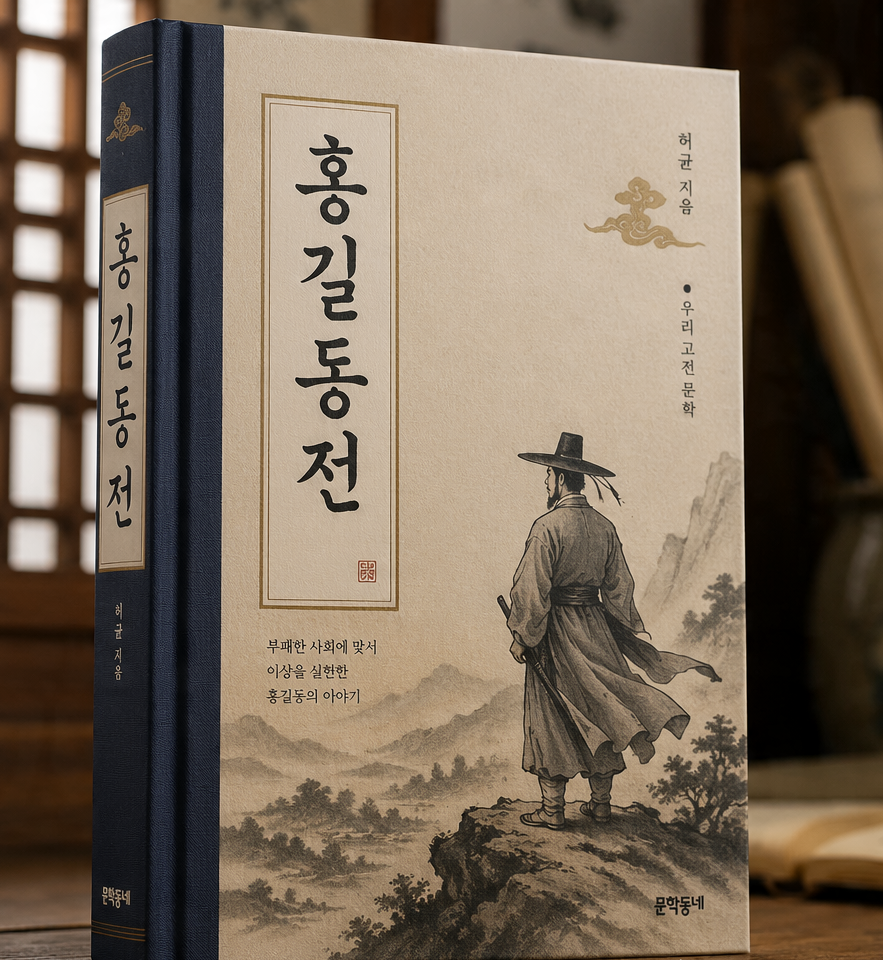
Imagine a hero so famous that his name became your country’s version of “John Doe” — the placeholder scribbled onto every sample form and blank application. That hero is Hong Gildong. He is often called Korea’s Robin Hood: a magical outlaw who robs corrupt officials, outwits royal assassins, and eventually founds his own kingdom across the sea. But The Story of Hong Gildong is far more than an adventure tale. It is arguably the single most important classic novel in all of Korean literature, and the quiet heartbreak at its center still speaks to readers today. Here is a beginner-friendly guide to the story — and how to read it in English.
Who Is Hong Gildong?
If you spend any time in Korea, you will eventually meet Hong Gildong — not a real person, but a name. On sample forms at the bank, the post office, or a government office, the space showing you where to write your name is almost always filled in with “홍길동.” He is Korea’s John Doe, its Everyman, its default placeholder. Few fictional characters anywhere have burrowed that deeply into a nation’s daily life.
His fame runs through modern pop culture, too. The story has been retold in countless films, television dramas, comics, and video games. Even Korean rapper G-Dragon name-drops him in his lyrics. In other words, long before the global rise of K-dramas and K-pop, Hong Gildong was already Korea’s original folk superhero — and understanding him gives you a shortcut into the Korean imagination.
What Happens in the Story
The plot moves in three swift acts, and at roughly 100 pages, the whole thing reads like a fast-paced fable.
Act one: a gifted son, born to the wrong mother
Hong Gildong is the brilliant son of a high-ranking government minister — but his mother is a lowborn concubine, not the minister’s wife. Under the rigid Confucian order of Joseon-era Korea, that single fact defines his entire life. He is forbidden to sit the civil service examinations, the only path to an honorable career. Most painfully of all, he is not permitted to call his own father “Father” or his older brother “Brother.” This lament is the emotional core of the whole book.
Act two: the righteous outlaw
When jealous members of the household plot to have him killed, Gildong leaves home. He becomes the leader of a band of bandits, but he gives them a code: they target only officials and aristocrats who grew rich by squeezing the common people, and they share the spoils with the poor. Wielding supernatural powers — he can multiply himself, summon storms, and vanish at will — he humiliates the authorities again and again while the king’s forces fail to catch him.
Act three: a king of his own making
Rather than overthrow Joseon, Gildong ultimately sails away, conquers a distant island realm, and builds his own kingdom. There he finally receives the recognition denied to him at birth — and, tellingly, he makes sure the sons of concubines in his own court are treated with dignity.
More Than a “Korean Robin Hood”
The Robin Hood comparison is a useful doorway, but it can be misleading. Robbing the rich to feed the poor is only part of Gildong’s story. The deeper subject is the injustice of a caste system that judged a person’s entire worth by the status of their mother.
Gildong is not really a revolutionary who wants to tear the whole system down. His new kingdom is just as hierarchical as the one he left. What he wants is recognition — a fair chance to use his talents and to be acknowledged by the family and society that pushed him aside. That longing for dignity in the face of an accident of birth is what has kept the tale alive for generations of Korean readers, especially during eras when Korea itself felt underestimated by the wider world.
A Genuine Literary Mystery: Who Actually Wrote It?
Here is where the book gets even more interesting. Most Koreans learn in school that The Story of Hong Gildong was written in the early 17th century by Heo Gyun, a famous poet and courtier who was executed for treason in 1618. That story is neat and romantic: a rebellious aristocrat writing a subversive novel about social injustice.
But the historian and translator Minsoo Kang argues the evidence does not hold up. No text of the novel is known to have circulated until the mid-19th century, and the surviving version reads unmistakably like the popular commercial fiction of that later era. Kang’s conclusion is that the tale we actually read today was most likely written by an anonymous commoner author, for profit, roughly 200 years after Heo Gyun’s death. It is a little like discovering that a treasured national classic was penned not by a celebrated genius, but by an unknown writer making a living off popular taste — which, Kang suggests, may make it more remarkable, not less.
Which Edition of The Story of Hong Gildong Should You Read?
For English readers, the clear starting point is the Penguin Classics edition, translated by Minsoo Kang and published in 2016. It carries real historical weight: it was the first work ever translated from Korean to be published as a Penguin Classic, and it was named a Best Book of the Year by both NPR and The Washington Post.
Two things make this edition especially friendly for newcomers. First, Kang worked from the longest and oldest surviving manuscript, so you get the fullest version of the story rather than an abridged one. Second, his introduction and notes do the heavy lifting for you — explaining Joseon-era society, the caste system, and the authorship debate — so you can enjoy the adventure without needing any background in Korean history. At around 100 pages, it is an easy afternoon read.
Why It’s Worth Reading Today
You do not need to be a scholar of Korean literature to enjoy Hong Gildong. It works on the simplest level as a swashbuckling fantasy — magic, monsters, assassins, and a clever hero who always stays one step ahead. But it also gives you something a K-drama binge cannot: a direct line to the values, anxieties, and sense of fairness that have shaped Korean storytelling for centuries.
If you have fallen for modern Korean culture and want to understand where its heroes come from, this little book is the perfect place to begin. Start here, and the fandom terms, historical dramas, and even the pop lyrics you already love will start to feel a little more connected.
Keep Exploring Korea
Curious about the modern side of Korean culture? Our K-pop terminology glossary breaks down the fandom words every new fan needs to know. And if you would rather see the real Korea for yourself, take a look at Okjeong Lake, one of the country’s most beautiful hidden getaways.
For another Korean tale where the English version tends to stop early, see Heungbu and Nolbu.