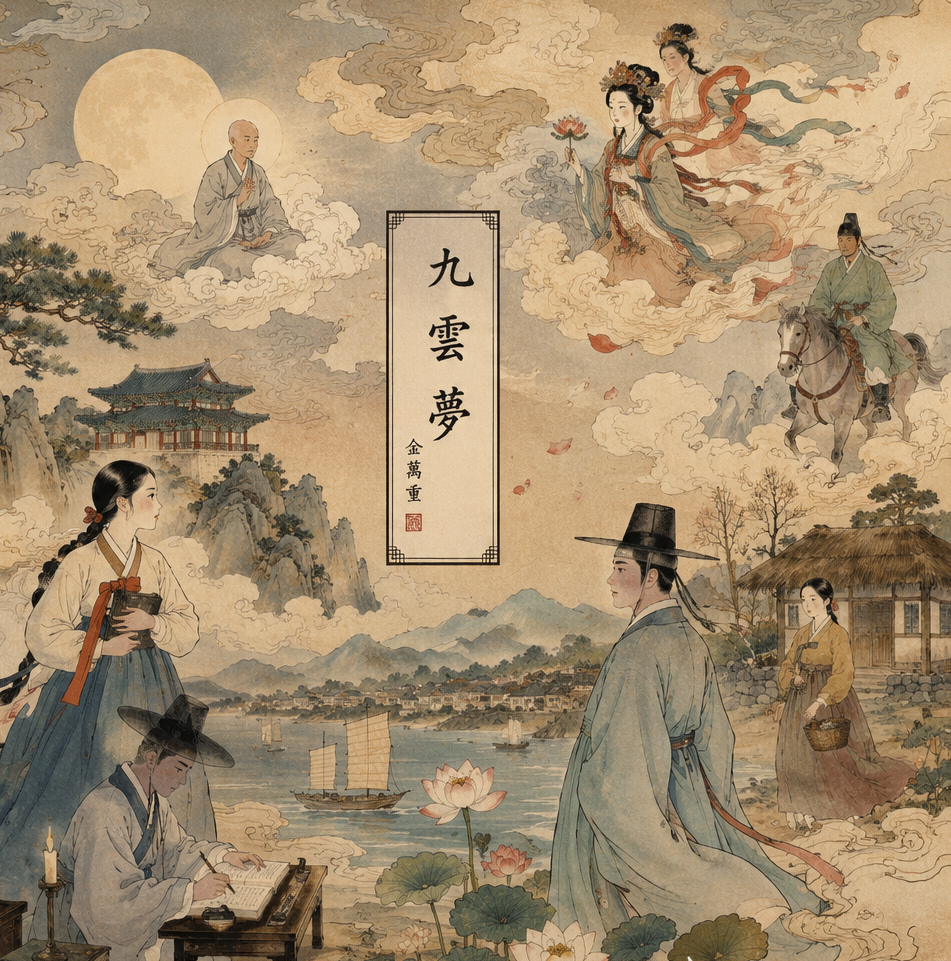
Here is a question worth 350 years of thought: if you could have everything you ever dreamed of — top honors, wealth, military glory, and the love of eight beautiful women — would it actually make you happy? The Nine Cloud Dream, often called the single greatest classic novel in Korean literature, follows one man who gets exactly that. Written in the 17th century by a scholar in exile, it wraps a dazzling adventure around a quiet, profound question about the meaning of a good life. Here is a beginner-friendly guide to the story, its Buddhist heart, and how to read it in English.
A Novel Written to Comfort a Mother
The story behind the book is almost as moving as the book itself. Its author, Kim Man-jung (1637–1692), was a high-ranking scholar-official of the Joseon court — at one point the head of the Confucian Academy. But court politics were brutal, and he spent long stretches of his life banished in exile. According to tradition, he wrote The Nine Cloud Dream during one of these exiles as a comfort to his elderly mother, who was lonely and grieving his absence.
That origin matters. This is not a dry philosophical treatise. It was meant to entertain and console a beloved reader — which is exactly why it still reads like a page-turner today, even as it delivers a serious message underneath the sparkle.
What Happens in The Nine Cloud Dream
The tale is set not in Korea but in Tang dynasty China, a common choice for Korean writers of the era who wanted the prestige and distance of a classical setting.
The temptation
A gifted young Buddhist monk named Seongjin lives on a sacred mountain under a stern master. One day he encounters eight fairy maidens and lingers, flirting and dreaming of the pleasures of the ordinary world instead of pursuing enlightenment. As punishment for these worldly desires, his master casts him out of paradise and into a human life.
The perfect life
Reborn as Yang So-yu, the monk grows into the ideal man of his age. He passes the civil service examinations at the very top, wins battles as a brilliant general, rises to become chancellor of the empire, and — one by one — meets and marries the eight fairies, now reincarnated as remarkable women. For most of the book, it reads as a glittering fantasy of total success, not so different from the wish-fulfilment arcs of many modern K-dramas.
The awakening
At the height of his glory, an old and celebrated Yang So-yu looks back on his magnificent life and feels a strange emptiness. In that moment, he wakes — and discovers that his entire dazzling existence was a single dream, dreamed in an instant back on the mountain. He is once again the young monk, and the real lesson is only just beginning.
More Than a Fairy Tale: Its Buddhist Heart
On the surface, The Nine Cloud Dream is pure entertainment — romance, war, magic, and court intrigue. But its title hints at the deeper meaning. The “nine” are the monk and the eight fairies; the “cloud” and “dream” point to the Buddhist idea that all worldly life is as fleeting and insubstantial as a passing cloud or a dream we wake from.
The novel gently argues that even a life with every possible success cannot bring lasting satisfaction, because all of it is impermanent. It draws on the philosophy of the Diamond Sutra, a core Buddhist text, to ask its central question: will the life we dream of truly make us happy? Readers have compared its spiritual journey to Hermann Hesse’s Siddhartha — a story of a man who must experience the world fully before he can see beyond it.
A Surprising “First” in Korean Literature
Here is a fact that delights new readers: The Nine Cloud Dream was the very first work of Korean literature ever translated into English, back in 1922, by a Canadian missionary named James Scarth Gale. Long before the global Korean Wave, this 17th-century tale was Korea’s first literary ambassador to the English-speaking world.
It also makes an interesting contrast with another Joseon classic. Where The Story of Hong Gildong is celebrated as a landmark of vernacular Korean storytelling, The Nine Cloud Dream was composed in Classical Chinese, the language of the educated elite. Read together, the two books show the two very different worlds of Joseon literature — the scholar’s study and the popular imagination.
Which Translation Should You Read?
The novel has been translated into English several times, so it helps to know your options. The 1922 Gale version is historically important but reads in an old-fashioned style and simplifies many cultural references for its early readers. Richard Rutt produced another respected translation in 1974.
For most new readers today, the best starting point is the 2019 Penguin Classics edition translated by Heinz Insu Fenkl, a novelist and scholar who was a PEN/Hemingway finalist. Fenkl deliberately recreates the flavor a 17th-century reader would have felt, and his generous introduction and notes unpack the Buddhist symbolism, the Chinese poetry, and the political undertones so you never feel lost. It was named one of the most anticipated books of its year by The New York Times, making it both the most accessible and the most richly annotated version available.
Why It Still Resonates Today
You do not need any background in Buddhism to be moved by this book. At heart, it asks a question every person eventually faces: once you have chased everything you thought you wanted, what then? In an age of endless ambition and comparison, a 350-year-old Korean monk’s dream feels startlingly modern.
If you enjoy the swoon-worthy heroes and sweeping destinies of Korean historical dramas, you will recognize their ancestor here. And if you want to understand the spiritual roots beneath so much of Korean art and thought, there are few better places to begin than Korea’s most beloved dream.
Keep Exploring Korea
New to classic Korean fiction? Start with our guide to The Story of Hong Gildong, Korea’s Robin Hood and its most famous folk hero. Or, for a taste of modern Korean culture, browse our K-pop terminology glossary for the fandom words every new fan should know.