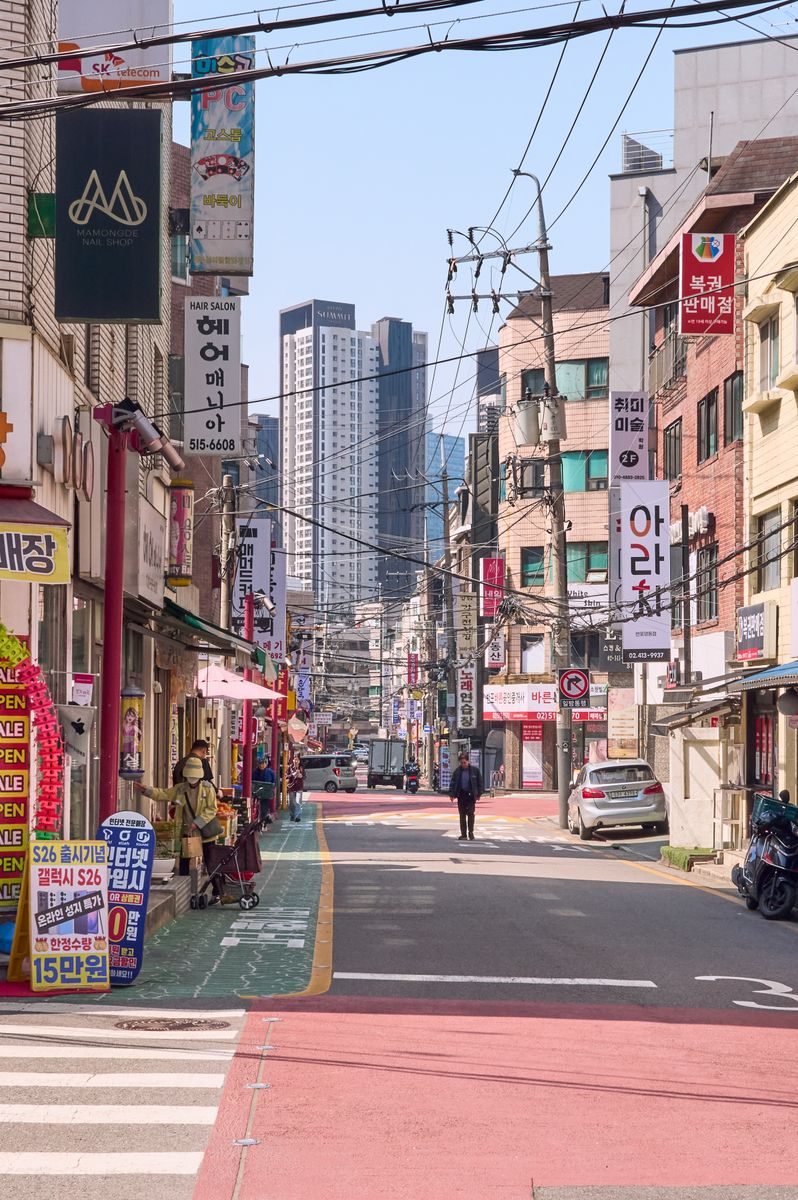
Most visitors to Incheon head straight for Chinatown or the airport and never see the city where people actually live. But in the heart of Michuhol-gu, the Juan-dong neighborhood around Citizens’ Park tells a quieter, richer story — one of a vanished cultural landmark, an underground shopping maze, and a modern complex full of restaurants and entertainment that only locals seem to know about. This is a walk through a corner of Incheon that no guidebook will send you to, and that’s exactly why it’s worth knowing.
From Citizens’ Hall to Citizens’ Park
To understand this neighborhood, you have to start with a building that no longer exists. The Incheon Citizens’ Hall (시민회관) opened here in 1974 and quickly became one of the city’s main cultural stages. For decades it hosted film screenings, musical performances, indoor sporting events, and public gatherings of every kind. For a whole generation of Incheon residents, it was the place to meet — a landmark you named when you told a friend where to find you, the city’s unofficial meeting plaza well into the 1990s.
The hall carried historical weight, too. In 1986, during Korea’s long struggle toward democracy, the intersection outside became the stage for a major pro-democracy protest, one of the significant demonstrations of that era. In 1992 a basement gallery was added for permanent art exhibitions. But by the late 1990s the aging building was raising safety concerns, and with a large new arts center having opened elsewhere in the city, the Citizens’ Hall was demolished in 2000. In its place, the city created a green rest area — the park that gives the area its current name.
The Intersection That Never Forgot Its Name
Here’s a detail that says everything about how memory works in a neighborhood. The building has been gone for over two decades, yet locals — including young people who were born after it was torn down and never saw it — still call the crossroads “Citizens’ Hall Intersection” (시민회관사거리). The name outlived the building. Bus stops, directions, and everyday conversation still reference a hall that exists now only in memory. It’s the kind of small, human detail that makes a place feel lived-in rather than staged.
Today the park itself is a modest, leafy rest spot rather than a tourist attraction — benches, trees, and a place for residents to pause. Nearby you’ll also find the Teum Culture Creation Zone (틈 문화창작지대), a small arts and creative space that carries a piece of the old hall’s cultural spirit into the present. It’s even reflected in the subway station’s official name.
Citizens’ Park Station and the Underground Arcade
In 2016, Incheon Subway Line 2 opened a station right here, named Citizens’ Park Station (its full name now includes “Culture Creation Zone” and “Ain Hospital”). But the most interesting part isn’t the platform — it’s what’s underground around it.
Connected directly to the station is the Juan Citizens’ Underground Shopping Arcade, a sprawling network of shops beneath the intersection. This underground mall has been here for years and is still very much alive, lined with stores selling clothing, accessories, and all manner of everyday goods. For newcomers, these underground arcades are a distinctly Korean experience — a whole bustling shopping street hidden below the road, sheltered from summer heat and winter cold. It effectively functions as the neighborhood’s underground hub, linking the subway to the streets above.
The Ain Complex: A Local’s Hangout
The biggest change to the area in recent years sits right at the intersection: a large new development anchored by Ain Hospital, built together with apartment towers and a mixed-use complex called Ain Avenue. It’s part of a wider redevelopment that is transforming this once low-rise neighborhood into a dense residential district.
For a visitor — or a resident — the real draw is downstairs. The complex’s lower levels are packed with restaurants, so you can find well-known Korean, Chinese, and Japanese spots without traveling far. It’s the kind of place where you can settle a “what should we eat” debate simply by taking the escalator down. Alongside the food, there’s a CGV multiplex cinema, plus arcades and claw-machine games (known in Korea as ppopgi) for a bit of after-dinner fun.
Put it together and you have a self-contained little world: eat, catch a movie, play a few games, all under one roof beside the subway. It’s not on any tourist map, but for people who live around Juan-dong, this underground cluster is a genuine local playground — the sort of everyday spot that only residents really know how to enjoy.
The Food Alley Toward Juan Station
Walk from Citizens’ Park Station toward Juan Station and you’ll hit one of the neighborhood’s liveliest stretches. Koreans call this kind of street a meokja-golmok — literally a “let’s eat alley,” a dense run of restaurants, bars, karaoke rooms, arcades, and clubs. This area was a well-known nightlife hotspot in its heyday and still draws crowds looking for a night out.
There’s far too much here to cover in a single visit, so we’ll be dedicating a separate guide to the Juan Station food alley down the road. For now, just know that if you find yourself around Citizens’ Park in the evening, the walk toward Juan Station is where the neighborhood comes alive.
How to Visit
Getting here is easy. Take Incheon Subway Line 2 to Citizens’ Park Station, which drops you right at the underground arcade and the Ain complex. If you’re coming on the national Line 1, get off at Juan Station and walk about six minutes toward the old Citizens’ Hall intersection. The whole area is a transport hub, so plenty of buses pass through as well.
There’s no admission, no ticket line, and no set itinerary — this is a neighborhood, not an attraction. Come to browse the underground shops, grab a meal in the complex, catch a movie, and get a feel for how ordinary life unfolds in a Korean city away from the tourist trail.
Why This Corner of Incheon Matters
Juan-dong won’t show up on a highlight reel of Korea, and that’s precisely its charm. Here, layers of history sit on top of one another — a beloved cultural hall reduced to a name that refuses to fade, a park where it once stood, an underground arcade full of daily commerce, and a gleaming new complex where locals eat and unwind. Understanding a city means seeing where its people actually spend their time, and few places capture that better than this quiet crossroads in Michuhol-gu.
Want to explore more of the country’s overlooked corners? Check out our guide to Okjeong Lake and its cliffside boardwalk in Imsil, part of our ongoing Hidden Korea series.