Ask a Korean adult to name a story they knew before they could read, and you will get one of about five answers. These tales are not obscure folklore studied by specialists. They are the shared floor of Korean childhood — in school textbooks, in animation, in the phrases people use without thinking about where they came from.
Most of them are also genuinely strange. Korean folk tales are less sanitised than the versions of European fairy tales that reached modern English readers, and several end in ways that would not survive a Western children’s publisher. That is a large part of what makes them worth reading.
Where These Stories Come From
Korean folk tales were oral for most of their life. They were told in villages, adapted by whoever was telling them, and only written down in fixed form relatively late — many of the standard versions Koreans know today were set during the Japanese colonial period or after, when the stories were collected and printed for schools.
This matters because it means there is rarely one authoritative text. Endings vary. Details contradict each other. Some tales exist simultaneously as folk story, as pansori song, and as a printed novel, with different emphases in each. If you read two English collections you may find the same tale resolved two different ways.
A second thing worth knowing: the moral spine of most of these stories is hyo (효), filial duty. Not kindness, not courage, not cleverness — duty to one’s parents, specifically. Once you notice it you cannot stop noticing it, and it explains why some of the endings feel so alien.
Sim Cheong (심청) — The Daughter Who Drowned Herself
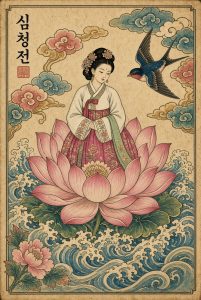
Sim Cheong’s mother dies days after her birth, leaving her to be raised by her blind father. She begs for food to keep him alive. One day her father falls into a stream, is pulled out by a monk, and is told that an offering of three hundred sacks of rice to the temple would restore his sight. He promises it without having anything close to that amount.
Sim Cheong hears about the promise and sells herself to merchant sailors, who need a young woman to sacrifice to the sea god at the treacherous waters of Indangsu. She throws herself into the sea. Because of her devotion, the Dragon King of the sea returns her to the world inside a lotus flower, which is presented to the king, who marries her. She holds a banquet for every blind person in the country in the hope of finding her father. He arrives, hears her voice, and his eyes open.
Korean readers are not troubled by the happy ending, but they are increasingly troubled by the setup. A story that presents a teenage girl’s suicide as the highest expression of virtue reads very differently now than it did a century ago, and modern Korean retellings — including a well-known webtoon — have taken the story apart and rebuilt it around what Sim Cheong herself might have wanted. The version children learn in school still ends with the lotus.
Heungbu and Nolbu (흥부와 놀부) — The Swallow’s Leg
Two brothers. Nolbu, the elder, is greedy and inherits everything. Heungbu, the younger, is poor, kind, and has more children than he can feed. When Heungbu finds a swallow with a broken leg, he splints it and nurses it through the winter. The following spring the bird returns with a gourd seed. The gourds Heungbu grows split open to reveal treasure.
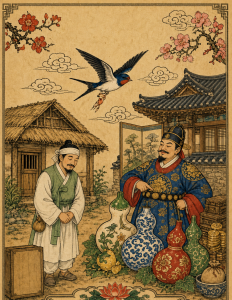
Nolbu, hearing this, catches a swallow and deliberately breaks its leg, then heals it. His gourds split open too — and out come goblins, filth, and ruin.
This is the most purely comic of the five, and in pansori performance the gourd-opening scenes are the showpiece, drawn out with escalating absurdity. It is also the one tale on this list where the moral is straightforwardly legible to any reader anywhere: kindness rewarded, calculated imitation punished. If you want a single tale to start with, start here.
One of the best known of these is the story of Heungbu and Nolbu, which does not end where most English retellings say it does.
Kongjwi and Patjwi (콩쥐팥쥐) — The Korean Cinderella
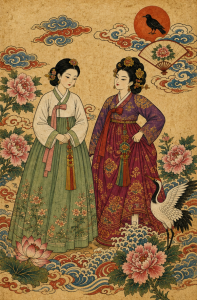
Kongjwi loses her mother; her father remarries, and the stepmother arrives with her own daughter, Patjwi. Kongjwi is given impossible tasks — filling a cracked water jar, hulling an enormous quantity of grain — and is helped each time by animals and a heavenly figure. She eventually attends a festival, loses a shoe, and is found by a magistrate who marries her.
The Cinderella comparison is unavoidable and English collections lean on it heavily. It is also where most English readers stop, because most English retellings end at the wedding.
The Korean tale does not end at the wedding. What follows is a second act in which Patjwi murders Kongjwi, takes her place in the household, and Kongjwi returns — as a flower, then as a bead, then finally in a form that allows her to expose what happened. The punishment inflicted on the stepmother in the traditional ending is gruesome enough that Korean children’s editions almost always cut it.
The names, incidentally, are food. Kong is soybean, pat is red bean — the same red bean used in patjuk and in the sweet fillings of Korean bakery bread. The naming is affectionate and slightly comic in a way no English translation preserves.
The Sun and the Moon (해와 달이 된 오누이)
A mother walking home over the hills with a basket of rice cakes meets a tiger. It demands a rice cake and says it will not eat her if she hands one over. She does. At the next ridge it appears again with the same demand. This repeats until the cakes run out, and then the tiger eats her.
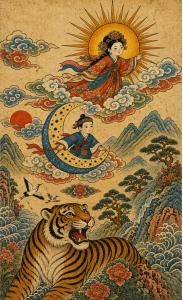
The tiger puts on the mother’s clothes and goes to her house, where her son and daughter are waiting. It calls through the door in her voice. The children notice the paw at the doorframe, escape up a tree, and pray for rescue. A rope descends from the sky and lifts them up. The tiger prays for a rope too and is sent a rotten one, which snaps.
The children become the sun and the moon. In the most common version the sister is frightened of the dark, so they trade — and because she becomes the sun, she stares fiercely at anyone who looks at her, which is why you cannot look directly at it.
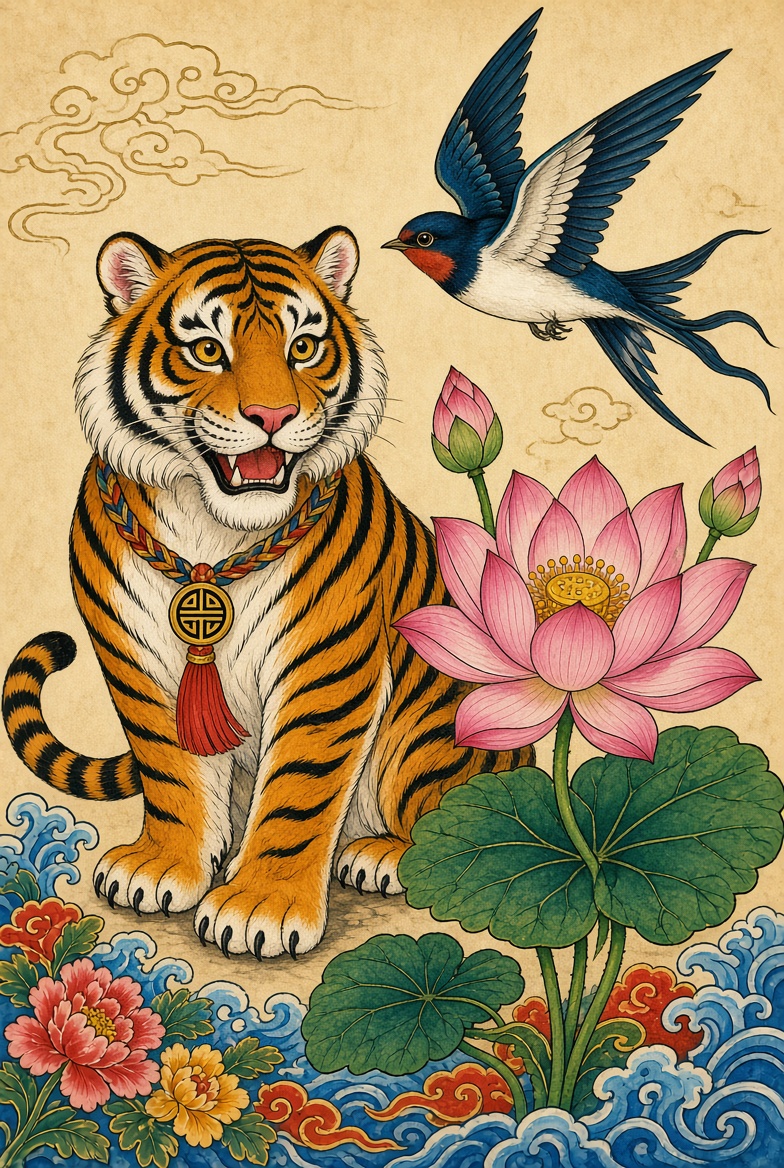
This is the tale that most reliably frightens Korean children, and the door-side dialogue with the disguised tiger is quoted constantly in Korean the way “what big teeth you have” is in English. Tigers dominate Korean folklore in general — they are the default danger, the default trickster, and occasionally the default fool.
The Woodcutter and the Fairy (선녀와 나무꾼)
A woodcutter hides a deer from a hunter. In gratitude the deer tells him that heavenly women bathe in a mountain pool, and that if he hides one of their feathered robes, she cannot return to the sky and will become his wife. It warns him not to return the robe until she has borne three children.
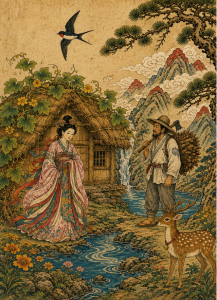
He does as instructed. She stays, they have two children, and she asks for the robe. He gives it back. She takes both children and returns to heaven.
Here is the misconception worth flagging: English summaries often frame this as a romantic tale about a mortal loving a celestial being, in the register of a swan-maiden story. Contemporary Korean discussion frames it very differently. The woodcutter’s act is theft, and the marriage is founded on removing a woman’s ability to leave. Korean feminist criticism has treated the tale as a case study for decades, and it is now regularly taught in schools as a story to argue with rather than a story to admire.
Both readings are present in the material. The tale itself is ambivalent — the woodcutter is not villainous, merely lonely and obedient to bad advice, and the endings that follow (he tries to reach heaven, sometimes succeeds, sometimes ends as a rooster crowing at the sky) are melancholy rather than punitive.
Where These Stories Live Today
All five are in the Korean primary school curriculum in some form. All five have been animated repeatedly. Phrases from them function as idioms — describing someone as a Nolbu needs no further explanation.
They also feed directly into contemporary Korean culture in ways international audiences encounter without recognising the source. The structure of a virtuous poor sibling and a grasping rich one runs through an enormous amount of Korean television drama. The same is true of the traditional games and childhood customs collected in our guide to traditional Korean games — the reference points are shared, and Korean writers assume you have them.
Where to Read Them in English
The standard scholarly-but-readable collection is Folk Tales from Korea, collected and translated by Zong In-sob, first published by Routledge in 1952 and reissued several times since. It contains ninety-nine tales grouped into myths, legends, fairy tales, fables, and prose narratives, with a substantial introduction. It is not a picture book — the tone is plain and the tales are given without softening, which is exactly why it is useful.
Several illustrated single-tale editions exist for younger readers, and quality varies considerably; check whether the edition tells you which Korean version it is following, because many do not. For reference rather than reading, the National Folk Museum of Korea’s Encyclopedia of Korean Folk Culture has English entries on individual tales and their variants.
If you would rather start with Korea’s written literature than its oral tradition, the natural next step is the classical novels — The Story of Hong Gildong, Korea’s outlaw hero and arguably its first novel in Korean script, or The Tale of Chunhyang, which began as a pansori song much like Sim Cheong’s story did. For something stranger and more philosophical, The Nine Cloud Dream is a seventeenth-century Buddhist fever dream about a man who gets everything he wants.
We will be covering several of these tales individually in more depth. More translated Korean works are collected in the Korean Books section.