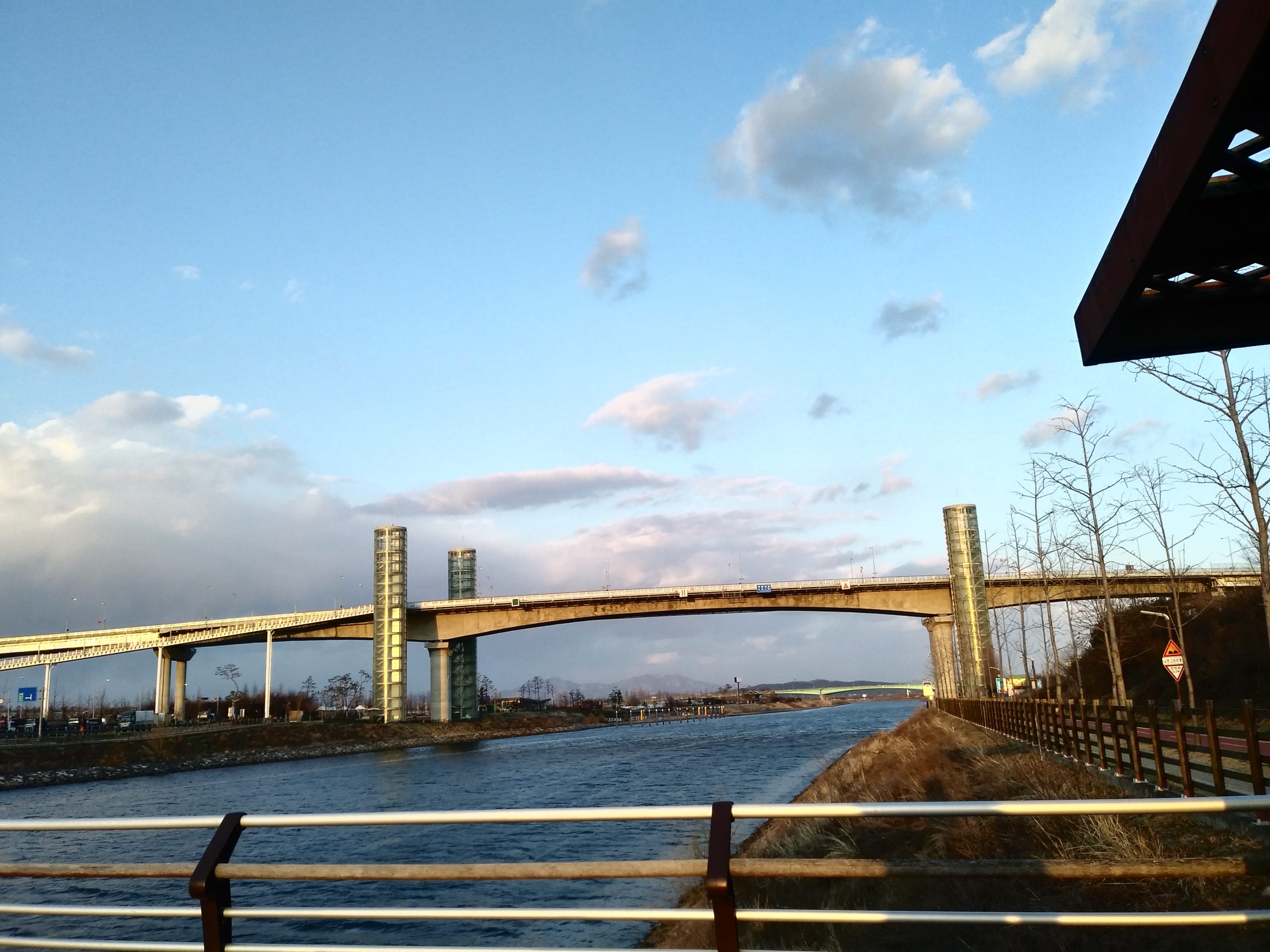
If you follow Korea’s most famous long-distance cycling route from the very beginning, this is where it starts. The Ara Cycleway runs dead straight along a canal from the Yellow Sea all the way to the Han River in Seoul — and the stretch around Gyeyang Bridge, just a short walk from Gyeyang Station, is one of the most rewarding places to experience it without a bicycle at all.
This is a place most foreign visitors never hear about: a working canal turned into a riverside park, where cruise boats glide under a tall bridge, campers set up on the weekends, and after dark a “street of light” glows in neon across the water. Here’s what the Ara Waterway (경인 아라뱃길) around Gyeyang Bridge is really like, and how to reach it.
What Is the Ara Waterway?
The Gyeongin Ara Waterway is a canal that cuts across the neck of the Korean peninsula, connecting Incheon’s Yellow Sea coast to the Han River in Seoul. It opened in 2012, built partly for shipping and partly for recreation. As a freight route it never really took off — but as a public space, it found a second life.
Running along both banks of the canal is a long, flat cycling and walking path: the Ara Cycleway. This is no ordinary park path. It’s the official starting point of Korea’s cross-country bike route — the trail that runs all the way from here on the west coast to the Nakdong River near Busan in the far southeast. Cyclists come to this exact spot to begin a journey across the entire country. The Ara section itself is famously straight and smooth, described by riders as being like a runway you can just open up and roll along.
You don’t need to be a cyclist to enjoy it, though. The canal-side parks, the bridges, the cruise boats, and the light displays make it a genuine local destination in their own right — and Gyeyang Bridge is the natural center of it all.
Gyeyang Bridge: The Center of It All
Gyeyang Bridge (계양대교) is the tall road bridge that spans the canal near Gyeyang Station. It’s built high above the water to let boats pass beneath it, which gives the whole area its sense of scale — and makes it the best vantage point around.
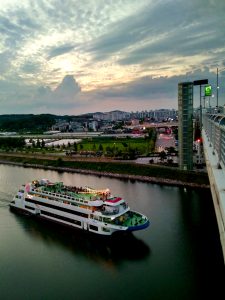
Stand on the bridge and the canal stretches out in a perfectly straight line in both directions — toward the sea one way, toward Seoul the other. If your timing is right, you’ll catch one of the cruise boats passing directly beneath you, leaving a long white wake down the middle of the water. It’s the kind of view that makes the enormous engineering of the place suddenly click into focus.
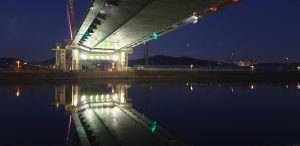
Underneath the bridge is a different scene entirely. The space below the deck has been turned into a riverside plaza, and on weekends it hosts small performances — locals playing music, community events, people simply gathering in the shade. At night the underside of the bridge lights up, and its reflection stretches across the still canal in long colored streaks.
The Cycleway and the Weekend Crowd
The Ara Cycleway is the beating heart of this place. On any decent-weather weekend it fills with cyclists — serious riders in full kit beginning their cross-country run, families on rental bikes, couples out for a slow roll along the water. The path is wide, flat, and well maintained, and small parks are spaced along it with restrooms, bike rental stands, and convenience stores.
Between the riding, the canal banks turn into a casual leisure zone. Weekend campers pitch tents in the green spaces near the water. There are rest spots and small eateries scattered along the route, so you can break up a walk or a ride with a meal. It has the relaxed, unhurried feel of a place that belongs to the people who live nearby rather than to tourists.
The Street of Light After Dark
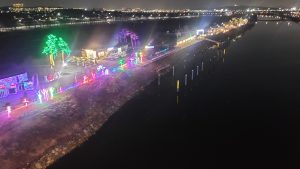
Cross to the far bank and, once night falls, the Ara Cycleway reveals its other face: a “street of light.” Trees and sculptures along the water are wrapped and lit in vivid neon — greens, purples, pinks, reds — and the whole display mirrors down into the dark canal in shimmering vertical ribbons of color.
It turns an evening stroll into something a little magical, and it’s completely free. Photographers come for the reflections; couples come for the atmosphere. Combined with the lit-up bridge, the after-dark version of this place feels entirely different from the bright, breezy daytime one — which is a good reason to time a visit for late afternoon and simply stay as the lights come on.
A Place for Every Season
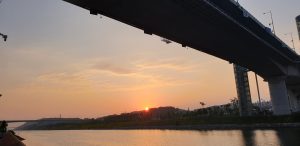
What makes this stretch of the Ara Waterway special is how completely it changes through the year. In summer the canal glows orange under long sunsets toward the Yellow Sea. In autumn the light softens and the crowds thin. And in winter, when snow falls, the empty red-and-green cycle path running off into the mist becomes one of the quietest, most atmospheric walks in the whole Incheon area.
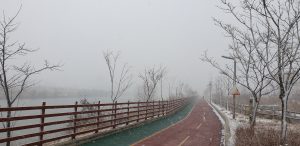
One practical note: because the path runs right along the water, the northern cycleway around Gyeyang Bridge is sometimes closed in deep winter when the canal banks ice over. If you’re visiting specifically to ride in cold weather, it’s worth checking conditions first.
How to Get There
The Ara Waterway around Gyeyang Bridge is easy to reach by train. Take the Airport Railroad (AREX) or Seoul Subway Line 9 to Gyeyang Station (계양역), then walk a short distance to the canal and the cycle path. Because Gyeyang is on the airport line, it’s genuinely convenient — you can reach this spot directly from Incheon International Airport without going into central Seoul first.
One thing to know: Gyeyang Bridge itself is built high and has no bus stop, and the roads immediately around the station can get congested, so arriving by train and continuing on foot or by bike is by far the easiest approach. Bikes can be rented at stands along the cycleway if you want to ride rather than walk.
Where to Stay Nearby
This is a spot most people visit as a half-day trip rather than a place to base themselves, but its location makes it flexible. Because Gyeyang Station sits on the airport line between Incheon Airport and Seoul, it works well as a stopover — you could ride out here on your way in or out of the country.
For accommodation, you have two easy options. Stay near Gyeyang Station itself, where you’ll find business hotels and smaller motels within a short distance, convenient if you want to be right by the waterway. Or, since the airport line connects quickly to both Incheon’s city center and Seoul, simply base yourself in either city and treat this as an easy day trip. As always, check current rates and reviews before booking, since options near transit hubs vary widely in price and quality.
Is It Worth Visiting?
If you want to see a side of the Incheon–Seoul corridor that almost no guidebook mentions, yes. The Ara Waterway around Gyeyang Bridge isn’t a polished tourist attraction — it’s a living local space, the starting line of a nationwide bike route, a weekend spot for campers and cyclists, and after dark a quiet riverside light show. Come in the late afternoon, watch a cruise boat slide under the bridge, walk the glowing path as the sun sets over the canal, and you’ll have seen a genuinely local corner of Korea.
This is only one stretch of a very long waterway, too. The Ara Cycleway continues for many kilometers in both directions, with more parks, plazas, and neighborhoods to explore near other stations along the line — plenty of reasons to come back.
Keep Exploring
The Ara Waterway is one part of a wider Incheon that most visitors never see. For another local viewpoint over the city, read about G-Tower’s free observatory in Songdo. For a district built on reclaimed sea, see Cheongna, Incheon. And for an everyday, lived-in neighborhood, explore Juan-dong and its underground arcade.