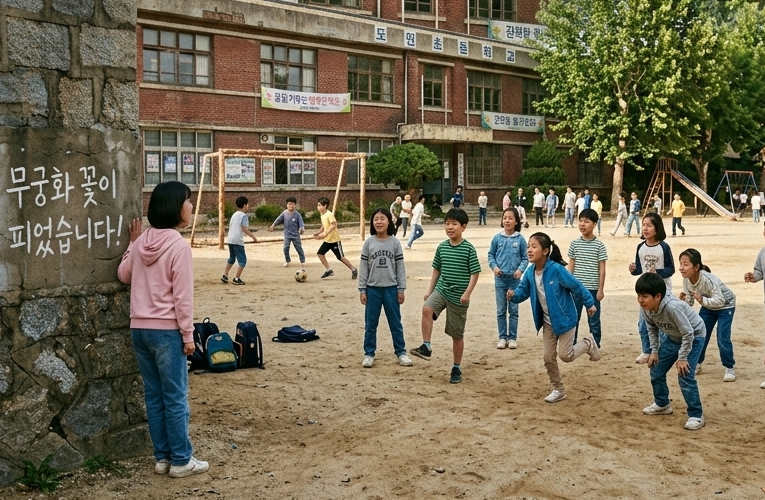
When Squid Game opened its first episode with hundreds of players sprinting across a field while a giant doll chanted, then froze them with a single glance, the world met a Korean childhood game for the first time. Strip away the deadly stakes and that game is something every Korean grew up playing in schoolyards and parks: Mugunghwa kkochi pieotseumnida (무궁화 꽃이 피었습니다).
The name means “the mugunghwa flower has bloomed,” and the game is Korea’s version of Red Light, Green Light. It’s simple, needs no equipment, and turns any open space into a tense, giggling standoff. Here’s how to play it, what the name means, and how it differs from the Western version you might already know.
What the Name Means
The full phrase — mugunghwa kkochi pieotseumnida — translates to “the mugunghwa flower has bloomed.” The mugunghwa (무궁화), known in English as the rose of Sharon or hibiscus, is South Korea’s national flower, and it even appears in the national anthem.
The flower carries real meaning here. Its name literally suggests “eternal blooming,” and it’s long been a symbol of resilience and endurance — a flower that blooms and blooms again, no matter what. That symbolism made it especially meaningful to Koreans during difficult periods of the country’s history. So while the phrase functions simply as the game’s chant, it also plants a small piece of national identity into a children’s pastime.
How to Play Mugunghwa Kkochi Pieotseumnida
The game needs nothing but an open space and a group of people. One player is the “it” — the tagger — and everyone else are the runners.
The setup
- The tagger stands at one end, facing a wall or a tree so they can’t see the others. Everyone else lines up at the far end, at the starting line.
- The goal for the runners is to cross the whole space and touch the tagger.
The chant and the freeze
Here’s the core loop that makes the game work:
- Facing away, the tagger chants “Mugunghwa kkochi pieotseumnida.” While the chant is going, the runners rush forward as fast as they can.
- The instant the tagger finishes the phrase, they spin around. Everyone must freeze exactly where they are.
- If the tagger catches anyone still moving — a wobble, a stumble, a single step — that player is out (or sent back to the start, depending on house rules).
- The tagger turns back to the wall, chants again, and the cycle repeats. The chant can be fast or slow, which is the tagger’s main weapon: a sudden quick chant catches runners mid-stride.
Winning
A runner who reaches the tagger and touches them “breaks” the round — often freeing any caught players — and everyone dashes back to the start line while the tagger tries to tag someone before they’re safe. The first to complete the crossing, or the last one standing, wins depending on the version, and the winner typically becomes the next tagger.
How It Differs from Red Light, Green Light
Versions of this game exist all over the world — the American “Red Light, Green Light,” the Japanese “daruma-san ga koronda,” and many more. They share the same freeze-and-go heart, but the Korean version has its own character:
- The chant, not commands. Instead of a referee calling “red light / green light,” the Korean tagger recites a full phrase. Runners move for the whole length of the chant and must freeze the moment it ends — so the tagger controls the tempo by speeding up or dragging out the words.
- The flower. The phrase ties the game to Korea’s national flower and its symbolism, giving a simple children’s game a cultural undertone the Western version doesn’t have.
- The touch. Reaching and tagging the “it” is a central win condition, adding a burst of chase-and-escape at the end of a round.
If you already know Red Light, Green Light, you can pick this up in seconds — the only real new element is the chant and the freeze timing.
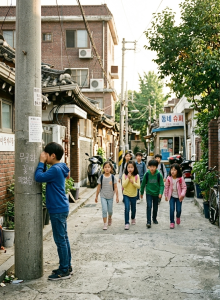
The Squid Game Effect
For most of the world, this game arrived through a television screen. In Squid Game, it appears as the deadly first round, presided over by a giant motion-sensing doll named Young-hee — herself based on a character from old Korean schoolbooks. The show turned an innocent playground game into a global phenomenon and sent millions of people searching for what that eerie chant actually meant.
The real game, of course, is the opposite of deadly: it’s loud, funny, and harmless, a staple of Korean elementary school recess and family gatherings. If anything good came from the show’s dark spin on it, it’s that a genuine piece of Korean childhood is now recognized around the world — and anyone can play the real thing with nothing but a wall and a few friends.
Try It Yourself
- Difficulty: instantly learnable; mastering the “freeze” without wobbling is the fun part.
- Players: best with 4 or more. The bigger the group, the better.
- Space: any open area — a yard, a park, a gym.
- Tip: if you’re the tagger, vary your chant speed. A slow chant lulls runners; a lightning-fast one catches them mid-step.
Practice the phrase — “Mugunghwa kkochi pieotseumnida” — and you’ll have both a game and a little piece of Korean to show for it.
Keep Exploring
This is one of many games in our guide to traditional Korean games, several of which were featured in Squid Game. For a first-hand look at where the equipment for these games actually came from, see where Korean kids got their toys in the 1980s. For a loud, physical group game, try how to play malttukbakgi.
Games that needed no equipment lasted longest; ones that needed a purchase, like paengi chigi, faded with the shops that sold them.