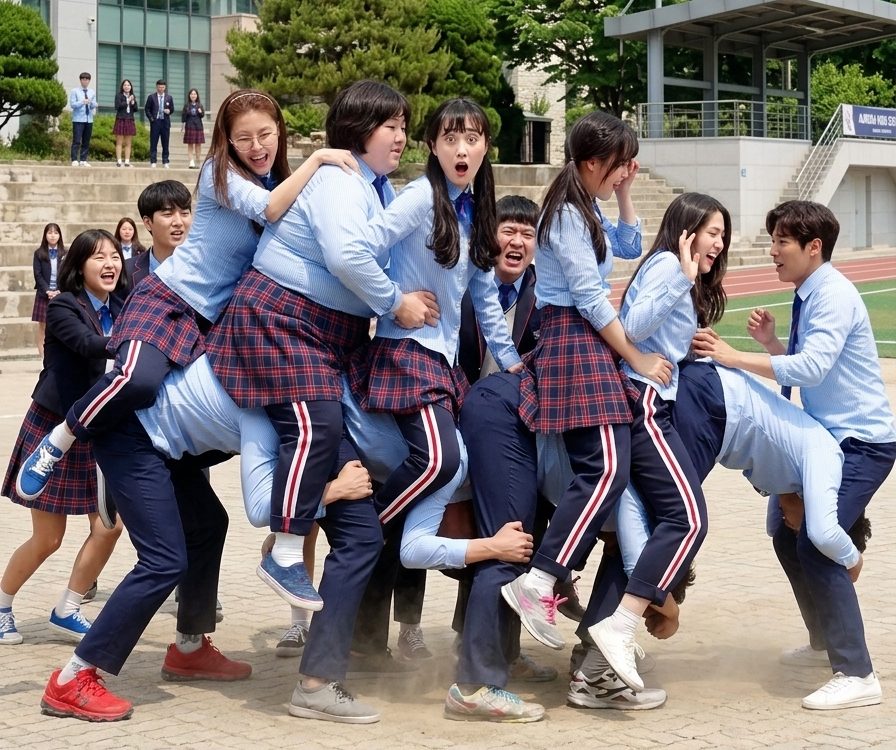
Malttukbakgi (말뚝박기) is the Korean schoolyard game where one team bends over in a line and the other team runs and jumps on top of them. If that sounds less like a game and more like an accident waiting to happen, you have understood it correctly. It was also, for boys of my generation, one of the best things about school.
I played it in Incheon through the 1980s and 90s, first in elementary school and later in an all-boys middle school and high school. Those are two completely different games with the same rules, and I will get to why.
Most English descriptions of malttukbakgi stop at “kids pile onto each other’s backs.” That misses the actual structure, which is genuinely well designed: there are three separate ways to lose, and the final one is decided by rock-paper-scissors.
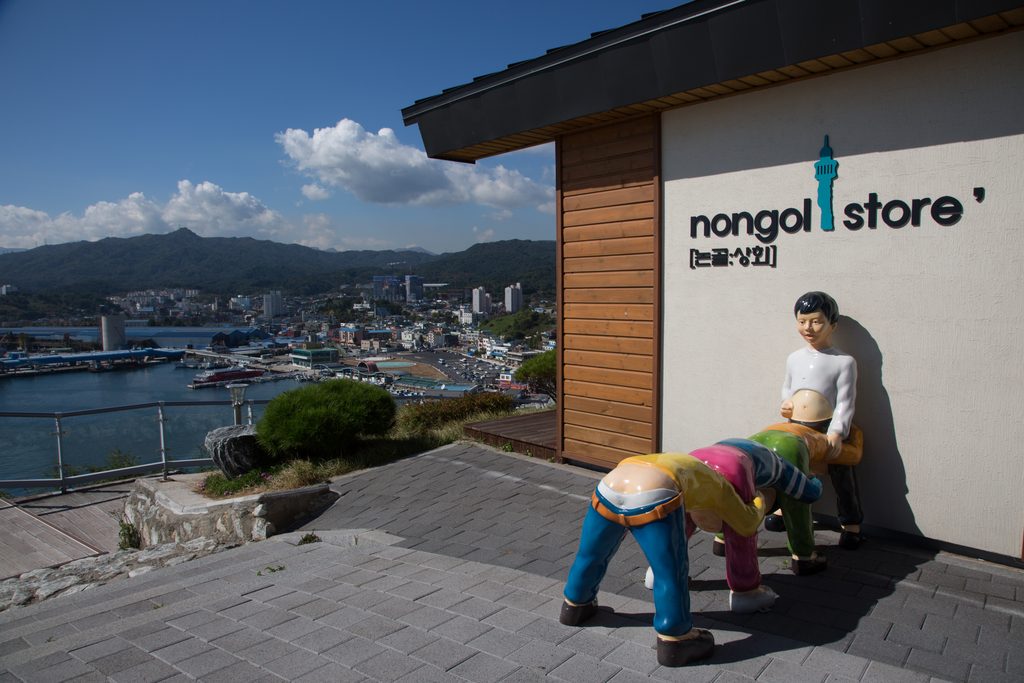
Photo source : 한국저작권위원회 – 채지형
What You Need
Nothing. That is the whole appeal.
- About ten players, split into two teams. Five against five was our usual size.
- A wall. A school building, a boundary wall, the side of a house. One player has to lean against something solid.
- Flat ground in front of it.
No equipment at all means no shop, no cost, and nothing to lose or forget. It could start in the ten minutes after lunch and end when the bell rang.
How to Play Malttukbakgi
1. Decide who goes underneath
Teams settle it with rock-paper-scissors. The losing team becomes the “horse.” This is not a small loss — being underneath is the hard, unglamorous, slightly humiliating half of the game, and everyone knows it.
2. Build the horse
One player from the losing team stands upright with their back against the wall. The next player bends at the waist, pushes their head forward under that standing player’s legs, and grips their thighs with both arms. The third player does the same to the second, head down under the hips, arms locked around the legs. And so on, until the team forms one long bent-over chain running out from the wall.
The grip is the whole defense. When someone lands on you, the force travels down the line, and the only thing keeping the chain from collapsing is how hard each player is holding the legs of the person in front.
3. Jump
The other team runs at it one at a time, plants both hands on the backs, and launches. The goal is to land as far forward as possible — the first rider needs to reach almost to the wall, because everyone after them needs space. A rider who lands short makes life impossible for their own teammates.
Landing is only half of it. Once you are on, you often have to work your way further forward, pushing along the line with your hands while the backs beneath you shift and buck.
4. Settle it at the front
If the horse holds and every rider stays on, the rider at the very front plays rock-paper-scissors against the player standing at the wall. Winner’s team attacks again. Loser’s team goes underneath.
That final detail is the part outsiders never expect. After all the running and crashing and straining, the round is decided by a hand gesture.
Order Matters More Than Strength
Because space on the horse runs out, the order your team jumps in is a real tactical decision, and teams argue about it before every round.
The first rider carries the most responsibility. They have the entire length of the chain available and must travel almost all of it, landing deep near the wall so the rest of the team has room. A first rider who plays it safe and lands in the middle has effectively cut their own team’s capacity in half, and the last one or two players will have nowhere to go.
The last rider has the opposite problem. By then the horse is loaded, sagging, and shifting under the weight of everyone already on it, and the remaining landing space is a narrow stretch near the back. Going last is the least glamorous job and the easiest way to lose the round for everyone.
Three Ways to Lose
This is the structure that makes malttukbakgi work, and it is why the game is more balanced than it looks.
- The horse collapses. If the bent-over chain buckles under the weight, the defending team loses the round and stays underneath.
- A rider falls. If anyone slips off, or a foot touches the ground, the riders lose and the teams switch.
- Rock-paper-scissors. If neither of the above happens, the front rider and the wall player decide it.
So the team underneath is not merely suffering. They are actively trying to win — twisting, dipping, timing a shudder to throw a rider off balance at the moment they land. And the riders are not simply enjoying themselves. They are fighting a low-grade wrestling match to stay on top of a surface that wants them off.
The Player at the Wall
The standing player is the strange one. They do no lifting, absorb no impact, and simply lean against the wall waiting. Then they decide the entire round with one throw of rock-paper-scissors.
Regional accounts of the game describe this player as the team’s daejang (대장), the captain, and note that teams would deliberately give the position to whoever was considered best at rock-paper-scissors. In my neighborhood I do not remember us using any title for it at all. The player was just the one at the wall. I would not be surprised if other regions had a name we never heard.
The same goes for the name of the game itself. We called it malttukbakgi, literally “driving in a stake,” which describes the head-down posture. Elsewhere in Korea the same game is called maltagi (말타기), “horse riding,” and in some areas it goes by a local name entirely.
The Moving Version
There is a looser relative worth mentioning, sometimes described as the moving form of horse riding.
Instead of a fixed chain, one player acts as the horse and a second as the handler. The handler stands beside the horse and covers the horse’s eyes with one hand, specifically so the horse cannot see riders approaching and time a kick at them. The horse’s job is to shuffle, twist and kick backward to stop anyone climbing on. Riders who get kicked become the horse. Riders who get on try to stay on while the horse does everything possible to shake them loose.
It is the same idea reduced to two people, and it needs no wall, which made it the version you played when the group was too small for the real thing.
Elementary School and High School Are Different Games
Here is the part I most want to get across, because it is invisible in any rules description.
In elementary school, malttukbakgi is safe. Ten-year-olds weigh very little. They cannot jump far. The impact when one lands on another is real but small, and I do not remember anyone being hurt. The game at that age is mostly comedy — kids collapsing sideways, everyone laughing, rebuild, go again.
In an all-boys middle school or high school, the same game is something else. The players are suddenly much heavier and can jump much harder, and the social temperature has changed. Nobody wants to be the one whose grip fails. Nobody wants to land short in front of thirty watching classmates. So the runs get faster, the jumps get more violent, and the team underneath braces instead of yielding.
Did people get hurt? In my experience, nothing serious — nothing I remember as a real injury. And I think the reason is almost funny: teenage boys at that age are strong, loose, and resilient enough to absorb an amount of force that would injure an adult.
But it was a dangerous game, and I want to be honest rather than nostalgic about it. A rider landing with poor form, a spine taking weight at a bad angle, a player underneath not braced at the moment of impact — the conditions for a serious injury were fully present. We were not careful. We were lucky, and the fact that it happened to work out for us does not make it safe.
Why It Disappeared
Malttukbakgi has essentially vanished from Korean schools, and the reasons are easy to list.
Supervision changed. Schools now take responsibility for injuries in a way they did not in the 1980s. A game whose core mechanic is jumping onto a classmate’s spine cannot survive a modern duty-of-care standard. No teacher watching a playground today would let that continue for thirty seconds.
The framing changed. A line of boys with their heads under each other’s hips, being jumped on, reads differently now than it did then. Whatever it meant to us at the time, a school in the 2020s is not going to leave that unexamined.
The free time went. The game needs a loose crowd of ten and an unsupervised stretch of ground. Korean school life runs on a tighter schedule now, and afternoons belong to academies.
It survives mainly as something adults do once, badly, at a company outing or a university trip — where the average weight is far higher and it is considerably more dangerous than it ever was at school.
It Is Not Only Korean
Worth knowing, because it surprises Korean readers as much as foreign ones: this game is not unique to Korea.
Versions of it turn up in Japan under a different name, in Western Europe, and elsewhere in Asia — the same basic shape of one group bent over and another group leaping on. Korean reporting on the game has noted the European parallels with some amusement.
That makes sense. The game requires no equipment, no language, and no instruction beyond demonstration. Children in different places arrived at the same idea independently, probably more than once.
Should You Try It?
Honestly, no — not the full version.
I am not going to write a “give it a go at your next picnic” section for a game that puts adult body weight onto someone else’s lower back. Among adults it carries real risk of back and neck injury, and unlike the other games I have written about here, there is no light version that preserves what made it fun.
If you want to understand it, watch footage rather than attempting it. What you are looking for is the moment after the last rider lands: the chain shuddering, everyone straining, and the two players at the front getting ready to throw rock-paper-scissors as if none of the rest of it happened.
One Last Thing
Malttukbakgi is the game from my childhood I feel most conflicted about. It was genuinely thrilling, it cost nothing, and it produced the loudest ten minutes of any school day. It was also reckless in a way that I can see clearly now and could not see at all then.
Unlike paengi chigi or jwibulnori, which lost the ground they needed, this one was deliberately put down. Korean schools decided it was not worth the risk, and I think they were right. Some traditional Korean games deserve to be brought back. This one I am content to remember.