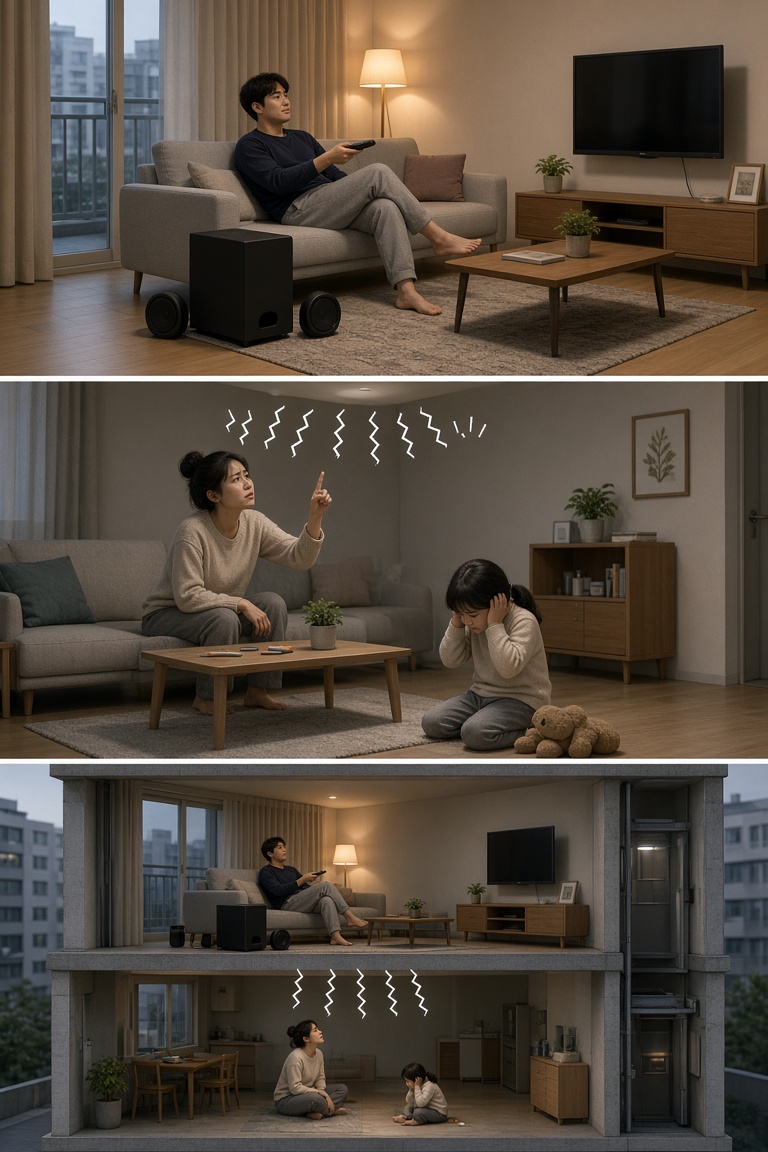
Korean apartment noise complaints have their own name here — cheunggan soeum (층간소음), literally “between-floor noise” — along with a government hotline, a legal decibel standard, and a long history of disputes that escalated badly. It is one of the most persistent sources of conflict in Korean residential life.
If you are living in a Korean apartment and hearing your upstairs neighbor’s every step, there are two things worth knowing immediately. The legal threshold is far higher than you expect. And how you handle the first conversation matters more than anything that comes after it.
Why It Happens
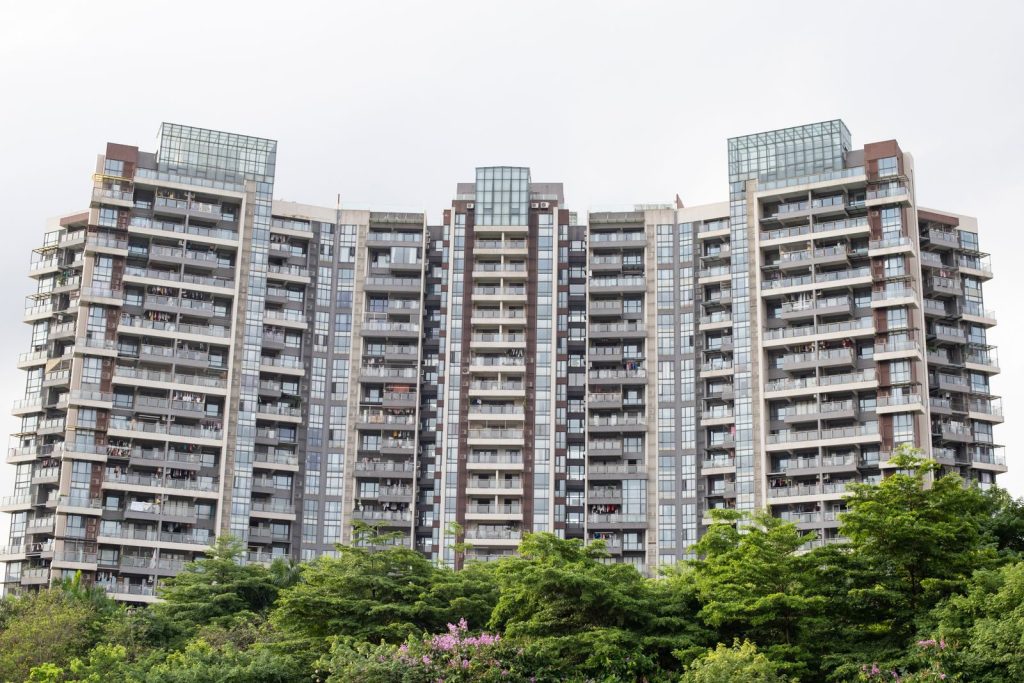
The problem is structural, not a matter of thin walls. Korean apartments are built as reinforced concrete slab structures, where the floor of one unit is the ceiling of the one below with relatively little between them. Impact noise — footsteps, dropped objects, a chair scraping — travels straight down through the concrete rather than being absorbed.
Add the sheer proportion of Koreans who live in apartment towers and you get a situation where a large share of the population is stacked vertically in buildings that transmit impact noise efficiently.
Newer buildings have improved floor insulation standards. Older ones, which is most of them, do not.
The Legal Standard, and Why It Rarely Helps
Korea does have official noise limits for apartments, set jointly by the Ministry of Environment and the Ministry of Land, Infrastructure and Transport. For direct impact noise, the current standard is:
- Daytime (6am–10pm) — 39 dB averaged over one minute, with a peak limit of 57 dB
- Nighttime (10pm–6am) — 34 dB averaged over one minute, with a peak limit of 52 dB
Airborne noise, meaning televisions and music rather than impacts, is measured separately at 45 dB daytime and 40 dB at night over five minutes.
Now the part that surprises people. To qualify as a violation, the threshold has to be exceeded three or more times within one hour. And 39 dB is quiet — roughly the level of light footsteps. Ordinary living generates noise around that line constantly.
The practical result is that most of what genuinely disturbs you will not meet the legal definition. The standard exists mainly to support formal mediation and civil claims in severe, sustained cases.
What Does Not Count
Several things people assume are covered fall outside the framework entirely:
- Plumbing noise — toilets flushing, showers running. Classified as a building defect, handled with the management office or landlord.
- Dogs barking — handled under different laws.
- Renovation work — regulated separately, and legal during permitted hours.
- Air conditioner units — treated as general environmental noise.
There is also a coverage gap that matters a great deal for foreign residents. The apartment noise standard applies to buildings with 30 or more households. Officetels, villas, and one-room studios — where many foreigners in Korea actually live — fall outside it. Mediation services will still take your call, but the decibel standard carries no legal weight for your building.
Going Upstairs: The Real Calculation
In many countries, knocking on your neighbor’s door to raise a problem directly is the reasonable first step. In Korea, plenty of people do this too — a downstairs resident goes up, rings the bell, and politely asks the family to be mindful of children running or a piano late in the evening. Handled well, it works, and it is faster than any official channel.
So the caution here is not legal. Ringing a bell and speaking politely is not trespassing; that line is crossed by opening someone’s door or entering their space uninvited. The caution is about what happens if it goes badly.
The cases that reach Korean news — assaults, occasionally worse — almost always follow the same shape. A confrontation at the doorway escalates, the door opens, and it becomes physical. Nobody involved planned that when they walked up the stairs.
There is also a slower failure mode, and it is far more common than violence. Two neighbors who have exchanged words start escalating in the ways available to them: a subwoofer aimed at the ceiling, a stick used to knock upward, deliberate noise at deliberate hours. From there it tends not to resolve. People in this situation often end up either moving out or simply living with it for years.
The practical calculation is this. If you have a reasonable neighbor, going up and asking politely will probably work, and Koreans do it. If you do not know what kind of neighbor you have — and with a stranger, you do not — the management office costs you nothing and keeps your name out of it. Meet in person only if the first approach through official channels has already established that the other side is willing to talk.
One thing to rule out entirely: retaliating with noise of your own. It has produced criminal convictions in Korea, and more importantly, it is the step that converts an annoyance into a war.

What to Actually Do
The escalation ladder, in order:
- Management office (관리사무소). Every apartment complex has one. They will contact the unit above on your behalf, usually by phone or broadcast announcement, without naming you. For a large majority of cases this is where it ends.
- Keep a record. Dates, times, duration, type of noise. A phone recording with a timestamp helps. This matters if things progress further.
- The Floor Noise Neighbor Center. A government-run mediation service reachable at 1661-2642. Phone consultation is free, and in qualifying cases they will send someone to take measurements at no cost. This is the step most residents, Korean and foreign alike, do not know exists.
- Environmental Dispute Resolution Commission. Formal mediation if the center’s intervention does not resolve it.
- Civil action. Last resort, slow, and requiring the documented evidence from step two.
None of this constitutes legal advice, and thresholds and procedures change. If a dispute reaches the point of formal action, get proper guidance.
The management office that handles noise complaints is the same one that bills you every month — see our guide to Korean apartment management fees for what that office actually does and what you are paying for.
Being a Good Upstairs Neighbor
The other half of this, and the half worth attending to before you have a problem: you are also somebody’s upstairs neighbor.
- Wear slippers indoors. Korean households remove outdoor shoes, but bare heels on concrete still carry. Indoor slippers are standard partly for this reason.
- Put mats down. Noise-reduction mats are sold everywhere and are the single most effective intervention, particularly with children.
- Laundry and vacuuming before 10pm. Washing machines in particular transmit strongly through concrete.
- Close doors gently. A door slammed by wind from an open window is a common and entirely avoidable complaint.
- Furniture pads. Chair legs dragged across a floor register loudly downstairs.
If you have young children, many Korean families take the initiative of introducing themselves to the downstairs unit early, sometimes with a small gift. It is not an apology so much as an acknowledgment, and it makes later friction much easier to handle.
The Underlying Point
Korean apartment noise is often described by outsiders as evidence of poor construction, and the construction is genuinely part of it. But the reason it carries such weight here is that it sits at the intersection of two things: very high-density living, and a strong preference for resolving conflict without direct confrontation.
Most of the time this works. Neighbors who are reasonable adjust for each other, and a quiet word or a note from the management office is the end of it. The system fails when one side is not reasonable, and there is no good mechanism for that case — which is why the disputes that do go wrong go so badly wrong.
The most useful thing you can do is the least dramatic one: put mats down, wear slippers, keep the washing machine off after ten, and be the neighbor who does not generate the first complaint.
Lease terms matter here too. Standard contracts run two years, so a noise problem is rarely something you can walk away from quickly — see our guide to jeonse for how Korean rental contracts are structured.