Korean cafe culture has one detail that startles almost every foreign visitor within the first week: people leave their laptops on the table and walk away.
Not tucked under a jacket. Open, unlocked, screen glowing, next to a phone and a wallet, while the owner goes to the bathroom two floors down. Nobody watches it. Nobody takes it. The table is being held, and everyone in the room understands that.
That single habit explains more about how Korean cafes work than any list of rules could. A cafe here is not a place you pass through on the way somewhere. It is somewhere you settle.
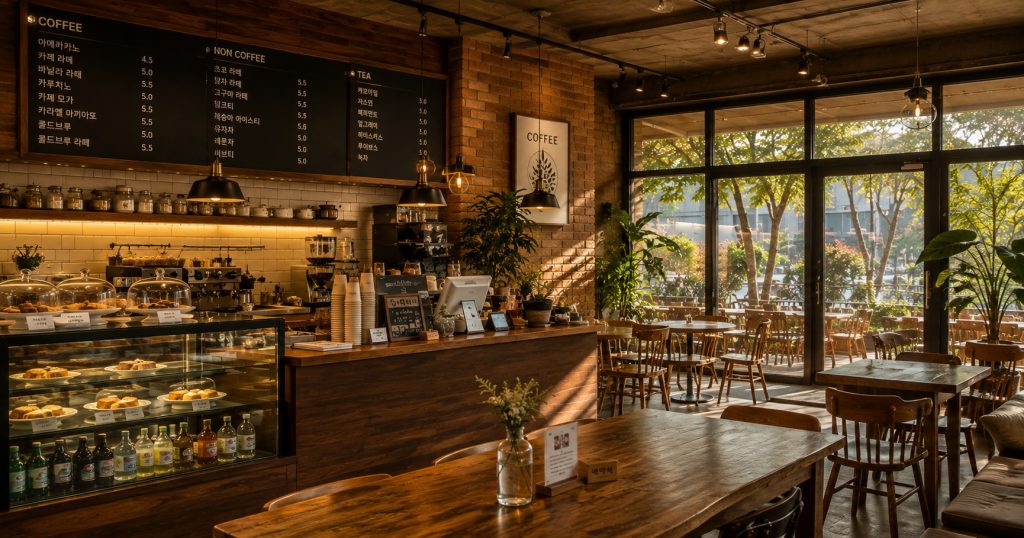
Why There Are So Many Cafes
Walk any commercial street in a Korean city and you will pass four or five cafes in a single block. Some are the size of a closet. Some occupy three floors of a building with a rooftop terrace on top.
The density is not really about coffee. It is about space. Most people live in apartments that are compact by Western standards, often with family, and inviting friends over is a much bigger gesture in Korea than it is in most countries. Homes are private. So the meeting moves outward.
The cafe absorbed that role. It is where you catch up with a friend, where you have a first date, where you interview a job candidate, where you kill two hours between appointments, and where you go after dinner because the meal is finished but the evening is not.
That last one is worth noting. Koreans move venues during a night out — dinner, then somewhere else, then somewhere else again. In the structure of Korean drinking culture those rounds usually involve alcohol, but plenty of groups make the second stop a cafe instead.
How Ordering Actually Works
The sequence is fixed and it is not the same as most Western cafes.
- Order and pay at the counter first. Before you sit, before you take your coat off. Sitting down and waiting for someone to come over will get you nothing but a long wait.
- Take the buzzer. Most cafes hand you a round pager that vibrates when the drink is ready. There is almost no table service.
- Collect your own drink at the pickup counter when it goes off, and return the buzzer at the same time.
- Find your seat. You choose it yourself. Nobody seats you.
- Return your tray to the collection station on your way out. This one matters — see below.
Cards and phone payments are standard everywhere, including at the smallest neighborhood shops. Carrying cash for a cafe is unnecessary. And there is no tipping, at any cafe, ever. There is no line on the card terminal for it and offering extra creates confusion rather than goodwill.
The self-service bar
Look for a counter labeled 셀프바 (self bar). Water, cups, napkins, straws, sugar, syrup, and cup sleeves live there and you help yourself. Asking a staff member for a glass of water when the self bar is ten steps away is a small, harmless mistake that immediately marks you as new.
The Rules Nobody Writes Down
One drink per person. If three of you sit at a table, three drinks get ordered. Splitting one coffee between two people and occupying a table for an hour is the clearest way to annoy a cafe owner in Korea. Some shops post the rule on the wall; most simply expect it.
Return your tray. There is a station near the counter, usually with separate slots for cups, liquid waste, and trash. Leaving your cup on the table is not catastrophic, but it is noticed, and the same self-clearing logic runs through convenience store seating areas too.
Staying long is normal. Nobody will approach you at the ninety-minute mark. Nobody will make a point of wiping your table. If a cafe does have a limit, it will be written on a sign — commonly two or three hours during weekend peak times at busy locations — and it applies to everyone equally.
Keep your voice down, mostly. Korean cafes run quieter than American ones and louder than Japanese ones. Groups of friends talk freely; phone calls on speaker do not happen.
The seat-holding thing is real. A bag, a laptop, or a phone left on a table means the table is taken and will be respected. This is genuinely safe in Korea, and you can do it too. It still feels wrong the first few times.
Iced Americano, Always
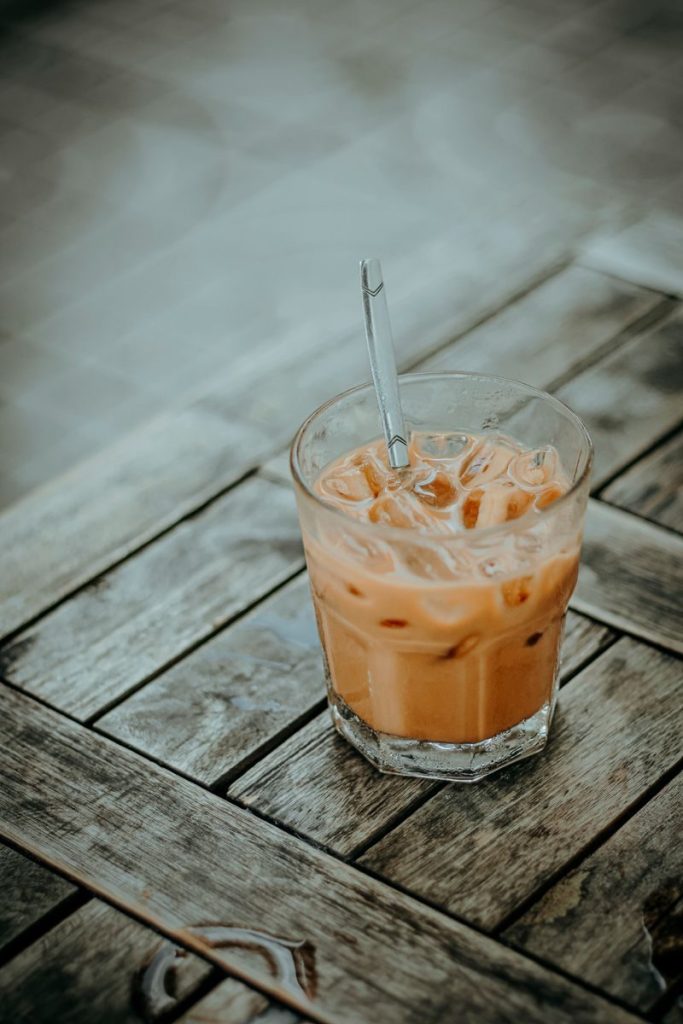
The default drink in Korea is the iced americano, and calling it a default understates it. There is a slang term, eoljuka (얼죽아), short for a phrase that means roughly “iced americano even if I freeze to death.”
It is January, it is minus eight degrees outside, and the office order is six iced americanos. This is not a joke about Korea. It is simply what the counter sees.
A few practical notes that follow from this:
- Say hot explicitly if you want a hot drink. Just saying “americano” often gets you ice.
- Sizes at independent cafes are usually regular and large, not the chain-specific vocabulary you may be used to.
- Filter coffee and pour-over exist but are specialty items. The americano is the baseline against which everything is priced.
The Kinds of Cafes You Will Run Into
| Type | What it is | Rough price |
|---|---|---|
| Budget chains | Small counters, takeout-focused, minimal seating | Around 2,000 won |
| Large chains | Multi-floor, reliable Wi-Fi and outlets | 4,500 won and up |
| Design cafes | Built for photographs, dessert-led menus | 6,000 won and up |
| Bakery cafes | Suburban, huge, with parking. A weekend outing | Varies widely |
| Themed cafes | Books, comics, cats, dogs. Often an entry fee | Entry plus drink |
One category that looks like a cafe but is not: the study cafe (스터디카페). These sell time, not drinks. You badge in, pay by the hour, sit in a partitioned desk in near silence, and the vending machine coffee is included or cheap. If you walk into one expecting a latte and conversation, you will find a very quiet room of people who would prefer you leave.
Kagongjok: The Study Crowd
Kagongjok (카공족) translates roughly as “the cafe study tribe” — students and freelancers who set up a laptop, a notebook, and a single americano, and stay for four hours.
They are a permanent feature of Korean cafes and the reason power outlets are built into so many walls and table legs. Attitudes are mixed. Most owners accept it as the cost of doing business. Some post gentle signs asking for a fresh order every few hours during busy periods. Very few will confront anyone.
For a visitor this is straightforwardly good news. If you need to work for an afternoon, a Korean cafe is one of the easiest places in the world to do it. Wi-Fi is free and fast, and the password is usually on the receipt or taped to the counter.
What to Order Besides Coffee
Dessert is often the actual reason a group picks one cafe over another, and the menu goes well past the pastry case.
- Bingsu (빙수) — shaved milk ice under red bean, fruit, or matcha, served in a bowl meant for two or three people to share. Summer staple, and the sharing is the point.
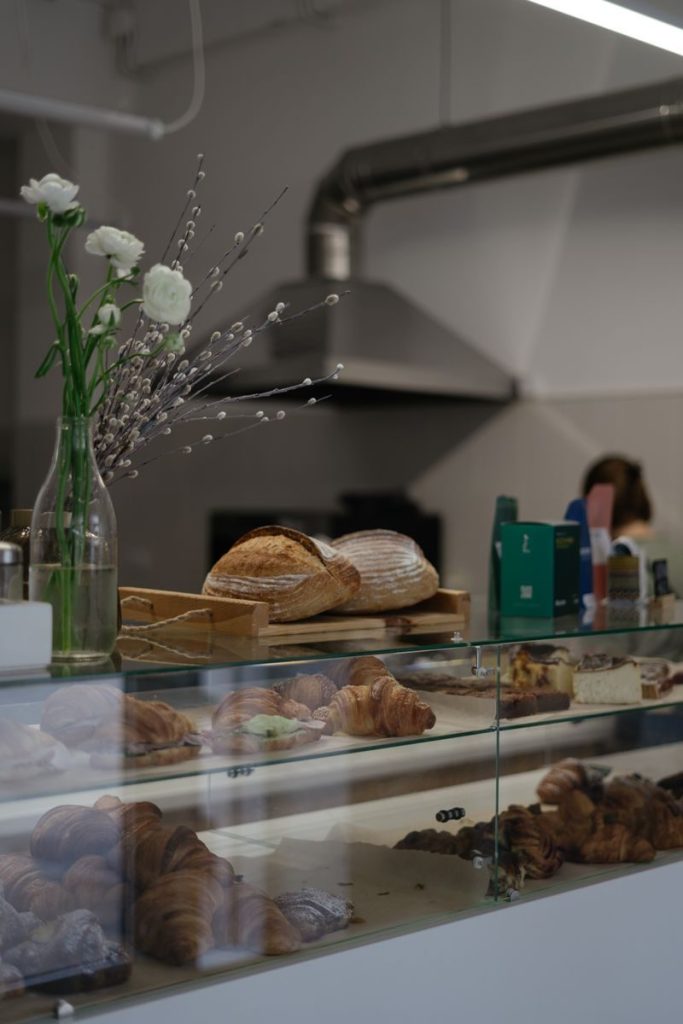
- Croffle (크로플) — croissant dough pressed in a waffle iron. Invented as a cafe item and now everywhere.
- Salt bread (소금빵) — buttery, faintly salty roll that took over Korean bakery cafes and has not let go.
- Grain lattes — misugaru and sweet corn lattes sit on menus next to the vanilla ones. Both are better than they sound.
Quick Reference
| Situation | What to do |
|---|---|
| Walking in | Counter first, seat second |
| Waiting | Take the buzzer, collect it yourself |
| Group of three | Three drinks, not one shared |
| Want water | Self bar, not the staff |
| Want it hot | Say “hot” out loud |
| Leaving | Tray to the return station |
| Tipping | No |
One Last Thing
If you only remember one line from this: the transaction ends at the counter, and everything after it is yours. You picked the seat, you carried the drink, you cleared the table. Nobody is managing your visit, which is exactly why nobody is ending it either.
It is the same underlying arrangement as eating in a Korean restaurant, where the service is attentive but never hovering, and it runs through Korean table manners more broadly. Do your own small part, and the space is yours for as long as you want it.
For cafe districts worth a detour, the Korea Tourism Organization maps out neighborhoods like Yeonnam-dong and Seongsu-dong that are built almost entirely around them.