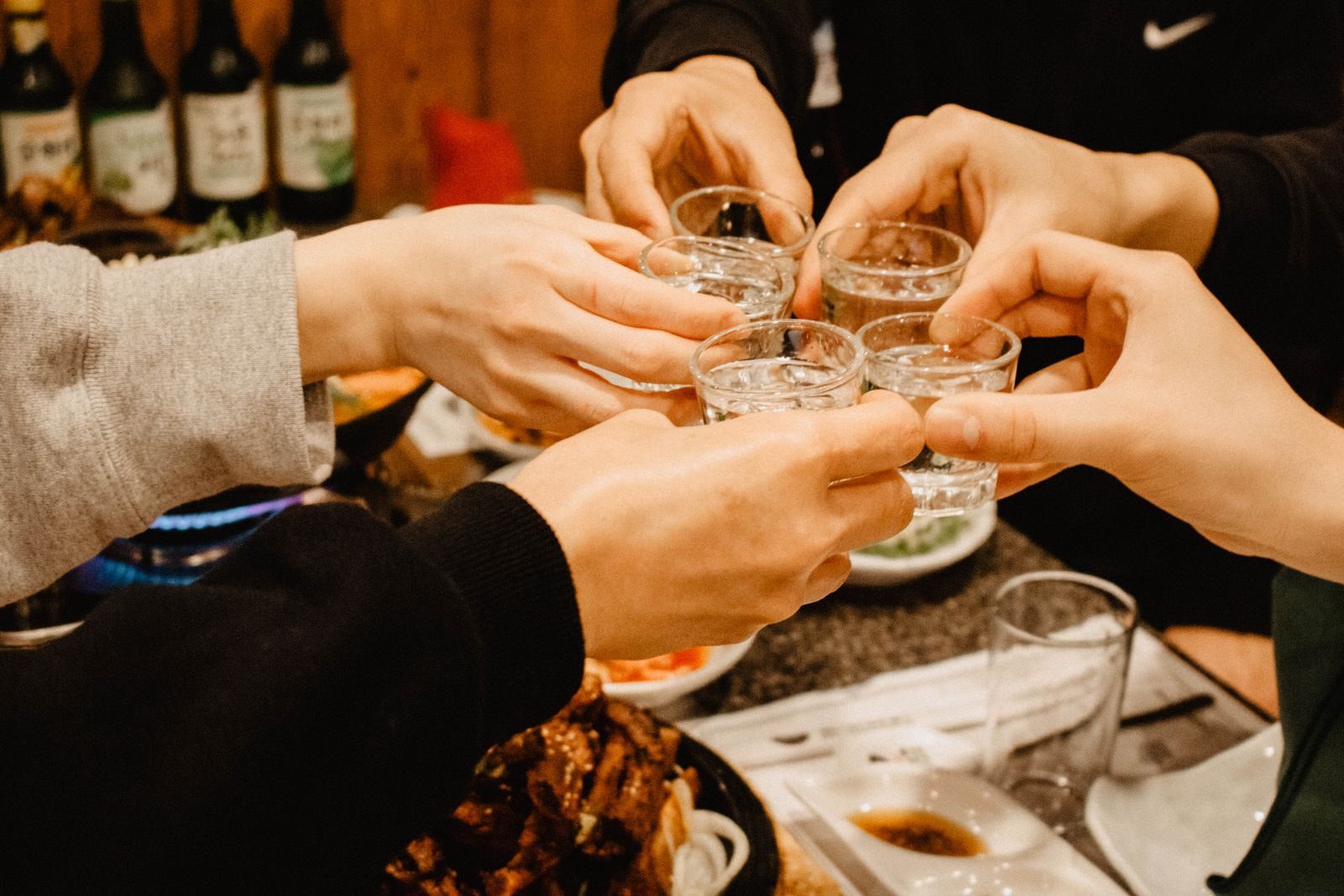
Korean drinking etiquette has more structure than almost any other social ritual you will encounter here. There are rules about who pours, which hand you use, which direction you face, and when you are allowed to stop.
Most guides present this as charming tradition. It is also, for many Koreans, a source of genuine workplace stress — and knowing how to decline gracefully is more useful than knowing how to participate.
The Core Rules
Who counts as senior in these situations is explained in Korean age and titles.
Never pour your own
The foundation of the whole system. You pour for others; someone pours for you. Watch your neighbour’s glass and fill it when it empties. Yours will be filled in turn.
Pouring your own drink is called jajak (자작), and while nobody will scold you for it, it quietly signals that the people around you are not paying attention. In a group that cares about such things, that is mildly embarrassing for them rather than for you.
Two hands, in both directions
When pouring for someone older or senior: right hand on the bottle, left hand supporting your right forearm or resting near the bottle’s base.
When receiving from someone older: hold the glass with both hands, or right hand on the glass with left hand touching your right forearm.
Among people of similar age this relaxes completely — one hand is fine, and standing on ceremony with a close friend looks odd rather than polite.
The same gesture appears throughout Korean life. More in why Koreans use two hands.
Turn away to drink
When drinking in front of someone significantly senior, turn your head away from them and shield the glass slightly with your free hand. The gesture is old and its original logic is roughly that consuming alcohol in a superior’s direct view is too casual.
This is the rule foreign visitors tend to enjoy most, and Koreans notice when someone does it unprompted.
Do not let a senior person’s glass sit empty
Attentiveness is the actual currency here. Keeping an eye on the glasses around you — particularly those of the oldest people present — is the thing that reads as good manners. The specific hand positions matter less than the noticing.
The Part Guides Leave Out: How to Stop
Here is what most articles about Korean drinking culture will not tell you, and what you are far more likely to need.
Korean drinking rounds have momentum. Glasses are refilled continuously, the group moves together, and there is real social pressure — especially in work settings — to keep pace. This pressure is heaviest on junior employees, and it is a recognised problem rather than a quaint custom. Korean workplaces have shifted considerably on this in recent years, and refusing is far more acceptable than it was a decade ago.
What actually works
- Leave your glass full. This is the most effective technique and requires no confrontation. An empty glass invites a refill; a full one does not. Sip slowly and let it sit.
- Accept the pour, then leave it. Refusing the pour itself is more socially awkward than not drinking what was poured. Take it with two hands, thank them, and set it down.
- State a reason once, clearly. Driving, medication, an early start, or simply that you do not drink. A stated reason is generally respected. Repeating it apologetically every round is worse than saying it once firmly.
- Order something else. Joining with a soft drink is normal and increasingly common. You are still part of the round.
If you do not drink alcohol at all, say so early rather than midway through. It is understood, and Korean groups will usually make sure something non-alcoholic is on the table.
What Gets Drunk
| Drink | What it is |
|---|---|
| Soju (소주) | Clear distilled spirit, typically 16–20% now. Served cold in small glasses, drunk in company rather than sipped alone |
| Maekju (맥주) | Beer. Usually lager, often ordered alongside soju rather than instead of it |
| Makgeolli (막걸리) | Cloudy unfiltered rice wine, around 6%. Lightly sweet and fizzy, served in bowls, associated with rain and with savoury pancakes |
| Somaek (소맥) | Soju and beer mixed. Ubiquitous, and the ratio is a subject of genuine debate |
Drinking is nearly always accompanied by food. The word anju (안주) means specifically food eaten with alcohol, and ordering drinks without any is unusual. Fried chicken with beer is common enough to have its own portmanteau, chimaek.

The Structure of an Evening
Korean drinking nights often move in stages, each at a different venue. The word for these is cha (차), meaning round or course.
- Il-cha (1차) — dinner with drinks. A restaurant, usually grilled meat or stew. Everyone attends.
- I-cha (2차) — a bar, a pub, or a noraebang. Attendance thins.
- Sam-cha (3차) — later, smaller, and entirely optional.
Leaving after the first round is completely acceptable and increasingly the norm. Say goodbye properly rather than slipping away, and that is the whole obligation.
Company dinners
A hoesik (회식) is a work dinner, and it occupies an ambiguous space between social event and unpaid overtime. Historically attendance was effectively mandatory and drinking heavily was part of it. This has changed substantially — younger employees push back, companies have policies, and the practice has shrunk considerably since the pandemic. It has not disappeared.
If you work in Korea, the useful thing to understand is that the first round is largely expected and everything after it is not.
Two Things Not to Do
Do not pour for yourself while pouring for others. Fill everyone else’s glass and leave yours; someone will get it.
Do not refuse the very first drink from a senior person outright. If you do not want to drink it, accept the glass with two hands and set it down. The acceptance is the social act; the drinking is optional.
A Note on Safety
Soju goes down easily and its strength is easy to underestimate, particularly mixed with beer. Korea has strict drink-driving laws with a low blood alcohol threshold and severe penalties, and public transport runs late in most cities.
Korean drinking culture also has a well-documented downside. Alcohol consumption here is high by international standards and the social pressure described above contributes to it. Participating in the rituals is not the same as matching anyone’s pace, and nobody worth drinking with will hold that against you.
The Short Version
- Pour for others, never yourself.
- Two hands with anyone older, both giving and receiving.
- Turn away when drinking in front of a senior person.
- A full glass will not be refilled — this is your control switch.
These customs sit within a broader set of conventions around age, seating, and shared food. Our guide to Korean table manners covers the rest of what happens at the table.
For what to eat alongside all this, see samgyeopsal, the pork belly grilled at the table that anchors most Korean drinking dinners. More in the K-Culture section.
Business relationships in Korea often start with a card exchange before they ever reach the table — Korean business card etiquette covers the handoff that happens before the first drink is poured.