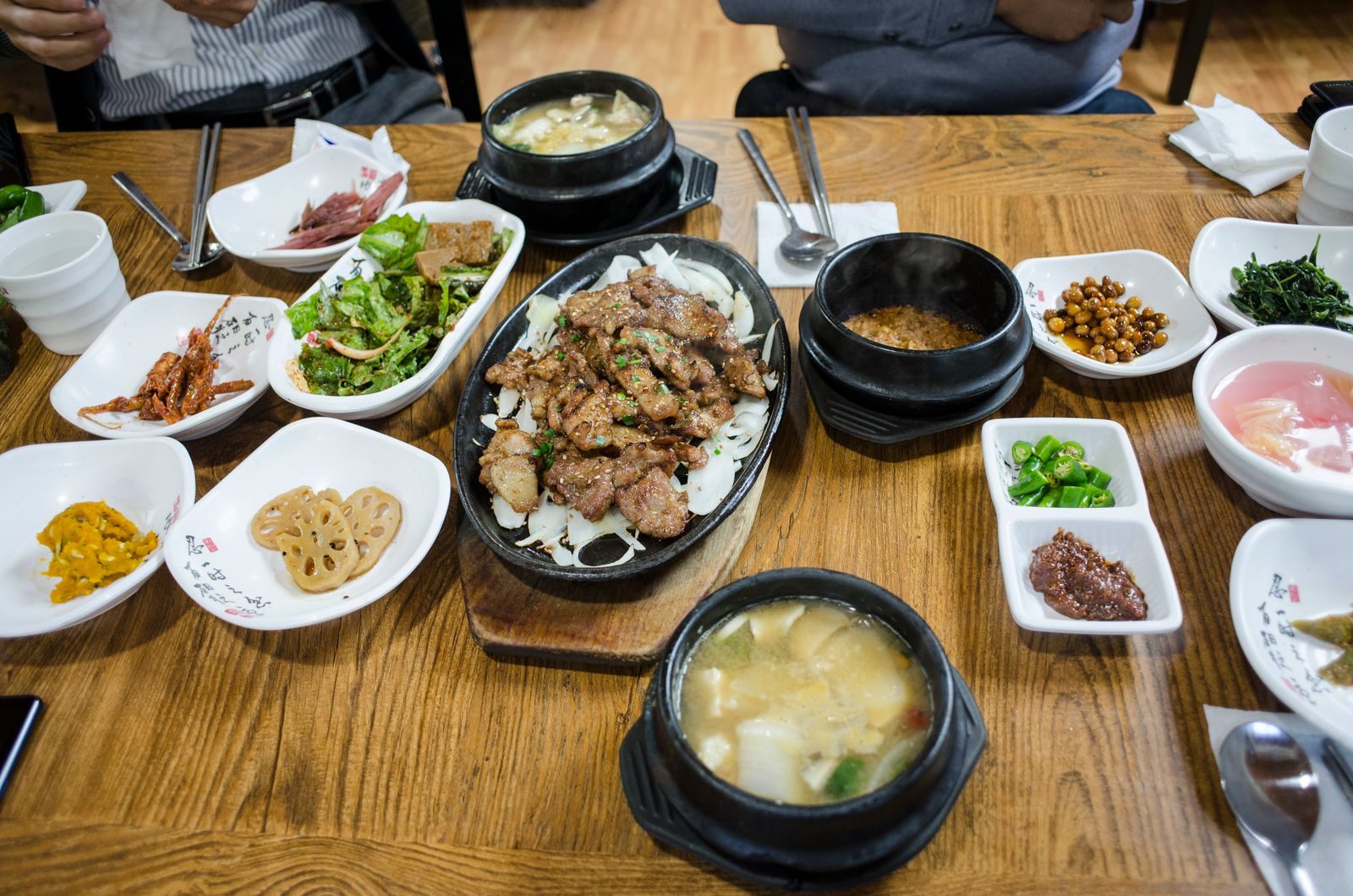
Search for Korean table manners and you will find lists of twenty or thirty rules, presented as though breaking any one of them would cause offence. This is not how it works, and following such a list will make you look stranger than not following it.
The truth is that a handful of things genuinely matter, most things do not, and Koreans expect almost nothing from foreign guests anyway. Here is what actually counts, and why.
The Underlying Logic
Many traditional restaurants have floor seating, which means shoes come off before you sit — see why Koreans remove their shoes.
Before the rules, the principle they come from. Almost every Korean table custom traces back to two ideas.
The meal is shared, not divided. Dishes sit in the middle and everyone reaches into the same bowls. There is no concept of “your portion” beyond the rice and soup in front of you. This is why anything that treats food as private property feels wrong.
Age creates a sequence. Not a hierarchy of worth — a sequence of action. The oldest person at the table does things first, and everyone else follows. Once you understand this, half the rules stop needing memorisation.
How that sequence is determined, and what people call each other because of it, is covered in Korean age and titles.

The Things That Actually Matter
1. Wait for the eldest person to begin
This is the one rule that is genuinely non-negotiable. Do not lift your spoon until the most senior person at the table has lifted theirs.
In practice you rarely have to judge this yourself — someone will say deuseyo (드세요), “please eat,” and that is your signal. If you are eating with people your own age, this dissolves entirely and everyone just starts.
2. Use two hands when receiving from someone older
When an older person hands you something — a glass, a dish, anything — take it with both hands, or with your right hand while your left touches your right forearm. The second version is what most Koreans actually do, and it looks less formal.
This extends well beyond the table. Business cards, money, gifts, documents. If you learn one physical habit from this article, make it this one. It reads as respect in a way that requires no language ability at all.
Where this applies beyond the table — business cards, gifts, payment — is covered in why Koreans use two hands.
3. Do not lift your rice bowl
This is the rule that trips up visitors familiar with Japan or China, where lifting the bowl is normal or even expected. In Korea the rice bowl stays on the table and you bring the spoon to your mouth.
The historical reason is that Korean rice bowls were traditionally metal — brass, and later stainless steel — and got too hot to hold comfortably. The custom outlived the reason, as customs do.
4. Turn away when drinking with someone much older
If you are drinking soju or beer with someone significantly senior — a boss, a friend’s parent, an older relative — turn your head away from them as you drink, and shield the glass slightly with your hand.
This one has more genuine social weight than most people expect, and it is also the one that foreign visitors most enjoy once they get used to it. Among people of similar age it is not observed at all.
5. Never pour your own drink
You pour for others, and someone pours for you. If your neighbour’s glass is empty, fill it. If yours is empty, wait — someone will notice. Pouring your own is not offensive exactly, but it signals that the people around you are not paying attention, which is mildly embarrassing for them.
When pouring for someone older, use two hands: right hand on the bottle, left hand supporting your right forearm or the bottle’s base.
The full set of drinking conventions, including how to decline politely, is covered in Korean drinking etiquette.
The Things Nobody Cares About
Now the other half, which most guides will not tell you.
Chopstick technique. Nobody expects you to be good at it. Korean chopsticks are metal, flat, and harder than the wooden kind. Struggling is normal and often endearing. Ask for a fork if you need one — restaurants have them.
Slurping. Fine. Noodles and soup are frequently eaten audibly. This is not the strict rule it is in some cultures, but it is certainly not a violation.
Finishing everything. Not required. Leaving food is normal and does not imply criticism. Side dishes in particular are refilled free and are not meant to be finished.
Elbows, seating posture, hands under the table. No equivalent conventions. Sit however is comfortable.
Double-dipping into shared dishes. This is what everyone does. There is no separate serving utensil in most casual settings — you eat directly from the communal bowl with your own chopsticks. Some restaurants provide serving spoons, and younger Koreans increasingly use them, but the traditional practice is exactly what it looks like.
Two Rules About Chopsticks Worth Knowing
These are less about manners than about superstition, but they produce a real reaction.
Do not stand chopsticks upright in rice. This mimics incense burning at a memorial rite for the dead, and it genuinely unsettles people. Rest them across your bowl or on the table instead.
Do not pass food chopstick-to-chopstick. Same reason — it resembles a funerary practice. Put the food on a plate and let the other person pick it up.
Neither is a manners rule in the ordinary sense. They are closer to the Western reluctance to walk under ladders, except more consistently observed.
The Spoon and Chopstick Division
Korea is unusual among chopstick-using cultures in that the spoon does most of the work. This confuses people who arrive expecting chopsticks to be primary.
| Utensil | Used for |
|---|---|
| Spoon (숟가락) | Rice, soup, stew, anything liquid |
| Chopsticks (젓가락) | Side dishes, meat, noodles, anything solid |
The convention is to hold one at a time rather than both at once — spoon down before picking up chopsticks. This is genuinely observed, though nobody will comment if you forget. The pair together is called sujeo (수저), a word that exists precisely because they function as a set.
Eating Out: What to Expect
Side dishes arrive unordered and cost nothing. A meal comes with several small plates called banchan — kimchi, seasoned vegetables, whatever the restaurant makes. They are included, refillable, and asking for more is completely normal.
Water is self-service. Most casual restaurants have a water dispenser and stacked cups near the entrance. Nobody will bring it to you.
Call the staff. Saying jeogiyo (저기요) across the room, or pressing the call button on the table, is how ordering works. Waiting quietly to be noticed can mean waiting a long time. This feels rude to many Western visitors and is entirely normal here.
Splitting the bill is uncommon. One person usually pays for the whole table — often the eldest, or whoever suggested the meal — and the others reciprocate on another occasion. Younger Koreans split more readily than they used to, but the default at a mixed-age table is still one payer.
No tipping. None. Not in restaurants, not in taxis, not for delivery. Attempting it creates confusion rather than gratitude.
If You Only Remember Three Things
- Wait for the eldest person to start eating.
- Use two hands when receiving something from someone older.
- Pour for others, never for yourself.
That covers nearly everything that carries real social weight. The rest is detail, and Koreans are consistently generous about foreign guests getting details wrong. The effort is what registers, not the accuracy.
What to eat once you are seated is a larger question — start with our guides to samgyeopsal, the shared-grill pork that is the centrepiece of most Korean social meals, or doenjang-jjigae, the soybean paste stew that appears on almost every table. More in the Korean Food section, and more on Korean customs and daily life in K-Culture.
For the practical side of eating out, see Korean restaurant etiquette.
The same instinct — read the room, defer to who needs it more — shows up on public transit too. Our guide to Korean subway and bus etiquette covers the priority seats and why locals leave them empty even on a packed train.
The same care around presentation shows up when you’re the one bringing something to the table — Korean gift giving etiquette covers what’s worth avoiding as a gift entirely.