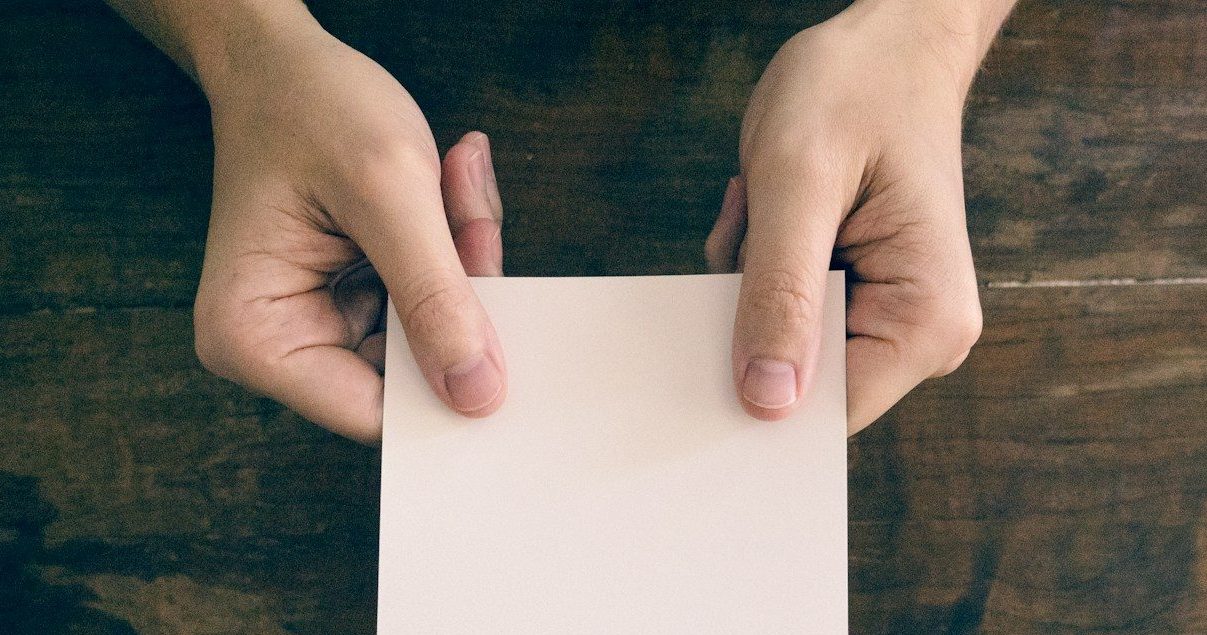
Watch a Korean hand something to someone older and you will notice it: both hands on the object, or one hand giving while the other touches the giving arm. It happens with glasses, money, business cards, documents, phones, anything.
Foreign visitors usually learn this as a rule to imitate. It is worth understanding why Koreans use two hands instead, because the gesture follows a logic that explains a great deal about how Korean society marks respect — and because doing it in the wrong situations looks as odd as not doing it at all.
The Basic Rule
Use both hands when giving to or receiving from someone older or senior to you. That is the whole rule. Everything else is detail.
In practice there are two acceptable forms:
- Both hands on the object. The full version. Used for anything with weight or significance — a gift, a document, a business card.
- Right hand on the object, left hand touching your right forearm or wrist. The everyday version, and what most Koreans actually do most of the time. Slightly less formal, appropriate almost everywhere.
The second form exists because you often need one hand free. It carries essentially the same meaning and nobody will read it as a lesser gesture.
Working out who is senior is its own subject — see Korean age and titles.
Where It Comes From
The gesture has a formal ancestor with a name: gongsu (공수, 拱手), the posture of standing or sitting with both hands joined in front of the body. It is the base position for bowing, for greeting elders, and for ceremonial occasions.
Traditional practice specifies which hand goes on top, and it differs by gender: men place the left hand over the right, women the right over the left. The reasoning is drawn from yin-yang correspondence, with left associated with east and yang, right with west and yin.
There is also an inversion that most Koreans under forty do not know. At funerals and mourning observances the positions reverse — men right over left, women left over right. Ancestral memorial rites are not counted as mourning occasions, so the ordinary positions apply there.
You will not be expected to know any of this. It is included because it shows that the casual two-handed gesture you see at a convenience store counter is the worn-down remnant of a much more specified system.
Where It Actually Matters
Business cards
This is the highest-stakes context, and the one where getting it wrong registers most clearly.
Offer your card with both hands, text facing the recipient so they can read it without turning it. Receive theirs with both hands. Then — and this is the part people miss — actually look at it for a moment before putting it away. Reading the card is part of the exchange.
Do not write on a card in front of the person who gave it to you, and do not put it straight into a back pocket. In a meeting, cards typically stay on the table in front of you until the meeting ends, arranged in the seating order of the people who gave them.

Money and payment
Handing cash or a card to a shop assistant with two hands is common, though not obligatory, and is more consistently observed when the assistant is older. Receiving change the same way is normal.
You will notice many Koreans placing money on the counter tray instead. That is fine too and carries no disrespect.
Drinks
Covered in more detail in our guide to Korean drinking etiquette, but the short version: pour with two hands for anyone older, receive with two hands, and never fill your own glass.
Gifts
Both hands, always. Also worth knowing: Koreans frequently do not open a gift in front of the giver, and the recipient may set it aside without comment. This is not indifference — opening immediately can read as focusing on the object rather than the gesture. Younger Koreans increasingly do open gifts on the spot, so read the room.
Documents and objects at work
Passing a report, a pen, a phone, a set of keys to a senior colleague — two hands, or the forearm-touch version. This is the single habit that most reliably marks a foreign employee as someone paying attention.
When Not to Use It
Here is what the rule lists leave out. Using two hands everywhere makes you look stiff, not polite.
With people your own age or younger. Handing a friend a drink with both hands is odd. It creates distance rather than showing respect, and among close friends it can read as sarcastic.
With children. Never necessary.
In casual service transactions where the staff are clearly younger. One hand is normal.
When it is physically awkward. Carrying bags, holding a phone, standing on a moving bus — nobody expects contortion. Use one hand.
The gesture communicates something specific: I recognise that you are senior to me in this situation. Directed at someone who is not senior to you, that statement does not make sense, which is why it lands strangely.
The clearest professional version of this gesture is the business card exchange — Korean business card etiquette turns the two-handed handoff into its own small sequence, from presentation to never pocketing the card too soon.
The Bow That Goes With It
Two hands rarely travels alone. It usually comes with a slight bow — a nod from the neck and a small bend at the waist, not the deep formal bow you see in period dramas.
| Situation | What to do |
|---|---|
| Passing someone in a hallway | Brief nod |
| Greeting a colleague | Nod with slight waist bend |
| Meeting someone senior for the first time | Fuller bow from the waist, roughly 30 degrees |
| Thanking someone for something significant | Fuller bow, sometimes repeated |
Handshakes are also common in business settings, often combined with a bow. If a Korean offers a handshake, take it with your right hand and support your right forearm with your left — the same two-hand logic applied to a Western gesture.
Why This Is Worth Learning
Most etiquette advice for visitors is optional. This one is not, in the sense that it costs nothing, requires no vocabulary, and is noticed immediately.
Korean social interaction is organised around relative seniority in a way that has no direct English equivalent — it shapes verb endings, seating, who pours, who pays, who speaks first. Foreign visitors cannot participate in most of that system without the language. The two-hand gesture is the one piece that transfers completely.
The question of why Koreans use two hands has a simple answer in the end: it is the one respect marker that works without language. You will get it wrong sometimes. Nobody minds. The attempt is legible on its own.
The Short Version
- Two hands when giving to or receiving from anyone older or senior.
- Right hand on the object with left hand touching your forearm is equally acceptable.
- Business cards deserve the full version — and read the card before putting it away.
- Skip it entirely with friends and people younger than you.
This sits inside a wider set of conventions around age, seating, and shared food — our guide to Korean table manners covers what happens once everyone is seated. More on Korean customs and daily life in the K-Culture section.
Gift-giving carries its own extra layer of rules on top of the two-handed gesture — Korean gift giving etiquette covers what not to bring and why.
The clearest formal example of this gesture might be handing over money at a wedding or funeral — Korean wedding and funeral money etiquette covers the envelope rules that go with it.