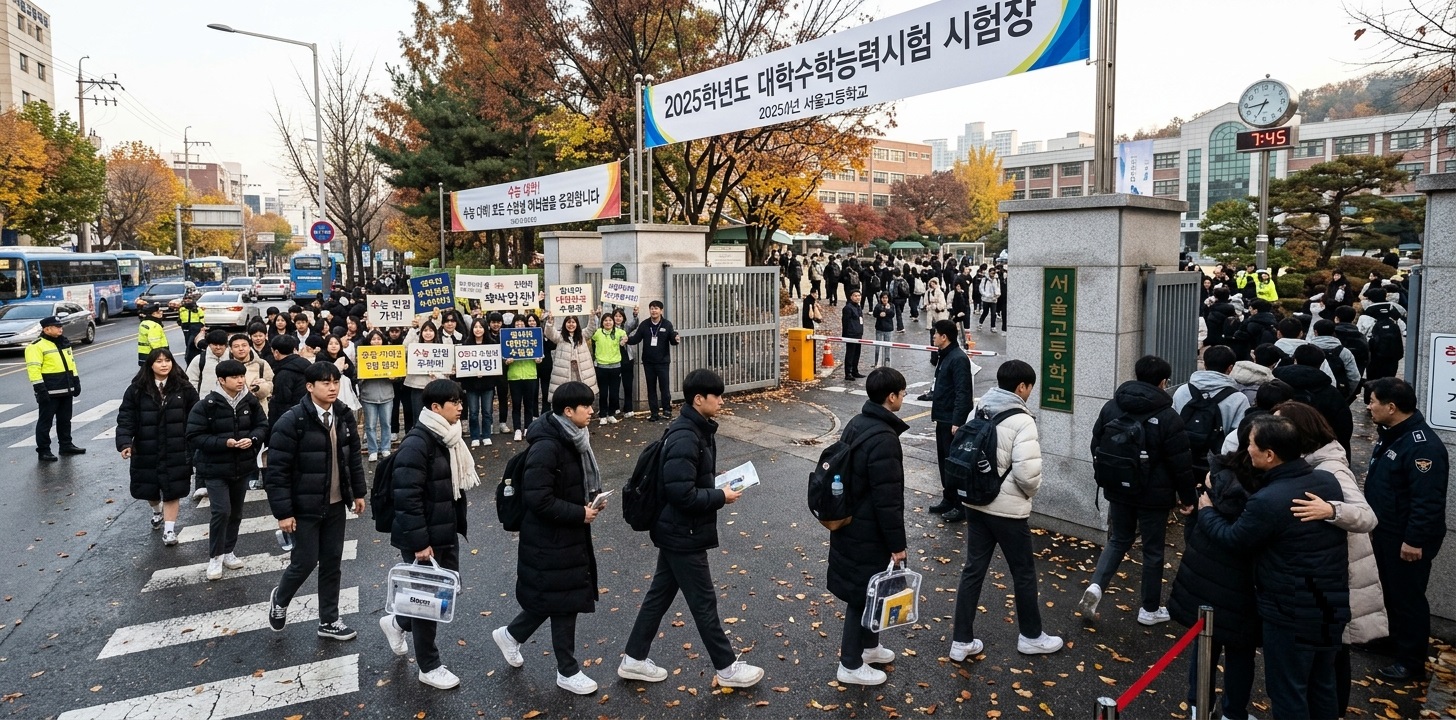
Suneung is the one day a year when an entire country rearranges itself around a single exam. Planes stop taking off. Offices open an hour late. The stock market waits. Police officers on motorbikes race late students to their test sites, and younger students stand outside school gates in the cold, cheering for seniors they may never have met.
This year, the exam falls on Thursday, November 19, 2026. If you are in Korea that day, you will feel it, even if you never set foot near a school. This guide explains what Suneung is, why it carries so much weight, what changes across the country on exam day, and the small rituals Korean families keep around it.
A quick note on where I stand. I drive a school shuttle for a living, so I see students every day, but I am not a teacher or a parent of a test-taker this year. Much of what follows comes from official announcements and Korean news coverage, put together for readers who want the full picture in one place.
What Is Suneung?
Suneung (수능) is short for Daehak Suhak Neungnyeok Siheom (대학수학능력시험), the College Scholastic Ability Test, often shortened to CSAT in English. It is Korea’s national university entrance exam, written by the Korea Institute for Curriculum and Evaluation (KICE) under the Ministry of Education, and taken on the same day by everyone in the country.
The exam usually falls on the third Thursday of November. It runs as a single, very long day. For regular test-takers, the first session begins at 8:40 a.m. and the last one ends at 5:45 p.m., and everyone must be seated in their exam room by 8:10 a.m. Students with approved accommodations, such as those with severe visual impairments, can keep writing late into the evening.
The test covers several areas:
- Korean language
- Mathematics
- English, including a listening section
- Korean history, which is mandatory
- Inquiry subjects in social studies, science, or vocational fields
- Second foreign language or Classical Chinese, which is optional
The Korean history rule surprises many people. Students can choose which other sections to sit, but anyone who skips Korean history has their entire score invalidated. No history, no results at all.
Why One Exam Matters So Much
To outsiders, the national reaction to Suneung can look extreme. To understand it, you need to see how much rides on this one day.
Korean society places enormous weight on which university a person attends. A degree from a top school is widely seen as shaping job prospects, social standing, and even marriage prospects. Many Korean students spend years preparing, often attending private academies called hagwon (학원) late into the night after regular school.
Suneung is not the only route into university. Many students are admitted through the early admission track, called susi (수시), which looks at school records and other materials. But even many of those students need to reach minimum Suneung grades to keep their offers, and the regular admission track, jeongsi (정시), relies heavily on Suneung scores. One morning of nerves can undo years of work, and every family knows it.
The 2026 Exam in Numbers
According to KICE, 551,864 people applied to sit this year’s exam, a slight drop of about 2,300 from last year as the number of high school students continues to shrink.
The bigger story is who those applicants are. A growing share are not current high school seniors but graduates taking the exam again, whom Koreans call N-su-saeng (N수생), roughly “Nth-attempt students.” This year they number around 196,000, about 35.6 percent of all applicants, the largest number in over two decades according to Korean admissions analysts.
Part of the reason is timing. This is expected to be the last Suneung under the current exam structure. A redesigned exam system takes effect from the 2028 admissions cycle, so many graduates see this year as their final chance to try again under rules they already know.
Key dates for this year:
| Event | Date |
|---|---|
| Applications | August 24 to September 4, 2026 |
| Admission tickets handed out | November 18, 2026, the day before the exam |
| Exam day | Thursday, November 19, 2026 |
| Scores released | December 11, 2026 |
What Changes Across Korea on Exam Day
This is the part that fascinates foreign visitors. Every year, the national government coordinates a list of measures so that nothing disturbs the test-takers. The exact plan for 2026 is usually confirmed closer to the date, but the pattern has been consistent for years.
Offices and Markets Open Late
On exam morning, public offices push their start time back from 9 a.m. to 10 a.m. or later, and the government asks private companies to do the same. The goal is simple: keep the roads and subways clear for students heading to their test sites.
The financial world follows. The Korea Exchange opens the stock market one hour late, at 10 a.m., and closes it an hour later than usual. Banks and the foreign exchange market shift their hours too. Korea’s markets are among the most closely watched in Asia, and they still pause for a high school exam.
More Trains, Fewer Cars
Subways in the Seoul area run more trains during the morning rush, and the busy window is stretched wider than usual. Cars are not allowed within about 200 meters of test sites, so parents drop their children off and the students walk the last stretch on foot. If you ride the subway that morning, you may notice it is calmer than usual, and if you have read my guide to Korean subway etiquette, you will know Koreans take quiet on trains seriously even on ordinary days.
Police Escorts for Late Students
Every year, Korean news shows the same scenes: a panicked student who overslept or went to the wrong school, picked up by a police patrol car or motorbike and rushed to the right gate just before it closes. Police and local government vehicles are stationed along major routes to help, and these rescues have become one of the most familiar images of exam day.
The Sky Goes Quiet
The most famous measure involves the English listening test, held in the early afternoon. During that window, aircraft across the country are not allowed to take off or land. Last year, the Ministry of Land, Infrastructure and Transport halted flights for 35 minutes around the listening section, from 1:05 to 1:40 p.m., which affected about 140 domestic and international flights. Planes already in the air were told to hold above 3 kilometers. Drones are banned too.
Military training that makes noise, such as artillery practice, also stops. Buses and trains near exam sites slow down, drivers are asked not to use their horns, and construction sites and events nearby are asked to keep the noise down. If you are flying in or out of Korea on exam day, check your departure time carefully. It may have moved.
Exam Day Rituals and Superstitions
Beyond the government measures, Suneung has a whole culture of small traditions. Some are sweet, some are funny, and almost all of them involve food or wordplay.
Sticky Gifts: Yeot and Chapssal-tteok
In the days before the exam, students receive gifts of yeot (엿), a chewy traditional taffy, and chapssal-tteok (찹쌀떡), sticky rice cakes. The logic is a pun. In Korean, the verb for “to stick,” butda (붙다), is also used to mean passing an exam. A sticky snack means your name will “stick” to the university acceptance list.
Other gifts follow the same playful logic. Forks suggest picking the right answers, since the verb for stabbing with a fork, jjikda (찍다), is also slang for guessing correctly. Rolls of toilet paper suggest that problems will “unravel” smoothly, because the word for unrolling, pulda (풀다), also means solving. In the weeks before the exam, you will see these items packaged as Suneung gift sets in shops and even in Korean convenience stores. Gift-giving in Korea always carries meaning, and I explain more of that in my guide to Korean gift-giving etiquette.
The Food Nobody Serves
There is also food to avoid. Miyeokguk (미역국), seaweed soup, is a comforting dish that Koreans traditionally eat on birthdays. But seaweed is slippery, and in Korean slang, “eating seaweed soup” means failing an exam. No parent serves it in the days before Suneung.
On the day itself, many parents pack a home-made lunch, called dosirak (도시락), and it is usually simple and gentle on the stomach. The aim is to avoid anything that might cause trouble halfway through a nine-hour day.
Cheering at the Gates
Early on exam morning, younger students from local high schools gather outside test sites with signs, drums, and snacks to cheer on the seniors as they arrive. Some teachers come too, handing out warm drinks and handshakes. The scene changes from year to year depending on safety rules, and education offices have at times asked schools to keep it calm, but the spirit of sending the seniors off with support remains.
Parents in Prayer
While the students write, many parents spend the day at Buddhist temples or churches, praying until the final bell. Korean news crews film these scenes every year. Rows of mothers and fathers bowing or holding their hands together, sometimes with a photo of their child or a copy of the admission ticket, have become another lasting image of the day.
The Suneung Cold
Koreans even have a name for the weather: suneung hanpa (수능 한파), the “Suneung cold snap.” It is a widely held belief that the temperature drops sharply around exam day. Whether or not the weather really follows the exam, students bundle up, and the Korea Meteorological Administration publishes weather forecasts for test sites ahead of the day.
For Younger Students, a Day Off
Because high schools are used as test sites, most first and second year high school students do not have regular classes on Suneung day. For them, it is a strange, quiet holiday, and many spend at least part of it thinking about the fact that their own turn is coming.
For people like me who work around the school calendar, Suneung is one of those dates that shapes the whole week. The day before, students collect their admission tickets and visit their assigned test sites to check the room and the route, so the rhythm of the school day changes even before the exam begins.
After the Final Bell
When the last session ends at 5:45 p.m., the mood flips. Students pour out of the gates into the arms of waiting parents, some crying with relief and some crying for other reasons. That evening and in the weeks that follow, many businesses offer Suneung discounts to anyone who shows their exam admission ticket, from movie theaters and restaurants to clothing stores and hair salons.
Answer keys are released soon after the exam, so many students mark their own answers that night and already know roughly how they did. Official scores arrive on December 11. After that, the real work of university applications begins, and many students start the long process of deciding whether to accept their results or try again next year.
Why Suneung Is Worth Understanding
It is easy to describe Suneung only through its pressure, and the pressure is real. Korea has been debating for decades how to make university admissions fairer and less stressful, and the redesign coming in 2028 is the latest chapter in that conversation.
But Suneung also shows something else about Korea. On one Thursday in November, an entire country agrees to slow down for its eighteen-year-olds. Airlines rewrite their schedules. Police officers become taxi drivers. Strangers hand out warm drinks at school gates. Whatever you think of the exam itself, that collective care is remarkable, and it says a lot about how seriously Korean society takes the future of its young people.
Quick Answers
When is Suneung in 2026?
Thursday, November 19, 2026. Scores are released on December 11, 2026.
Do flights really stop during Suneung?
Yes. During the English listening test in the early afternoon, takeoffs and landings across the country are halted for about half an hour. Check your flight time if you are traveling that day.
Can foreigners take Suneung?
The exam is designed for admission to Korean universities, and applications follow Korean education office procedures, including in-person registration for some applicants. Most international students enter Korean universities through separate admission routes instead.
What should visitors do on Suneung day?
Expect calmer morning streets and late-opening offices and banks. Avoid honking or making noise near schools, especially in the early afternoon, and if you see students heading to exam sites, a quiet “hwaiting” (화이팅), the Korean word for good luck, will always be welcome.
Sources: Ministry of Education, Korea Institute for Curriculum and Evaluation, Ministry of Land, Infrastructure and Transport, Korea Exchange, and Korean news reports.