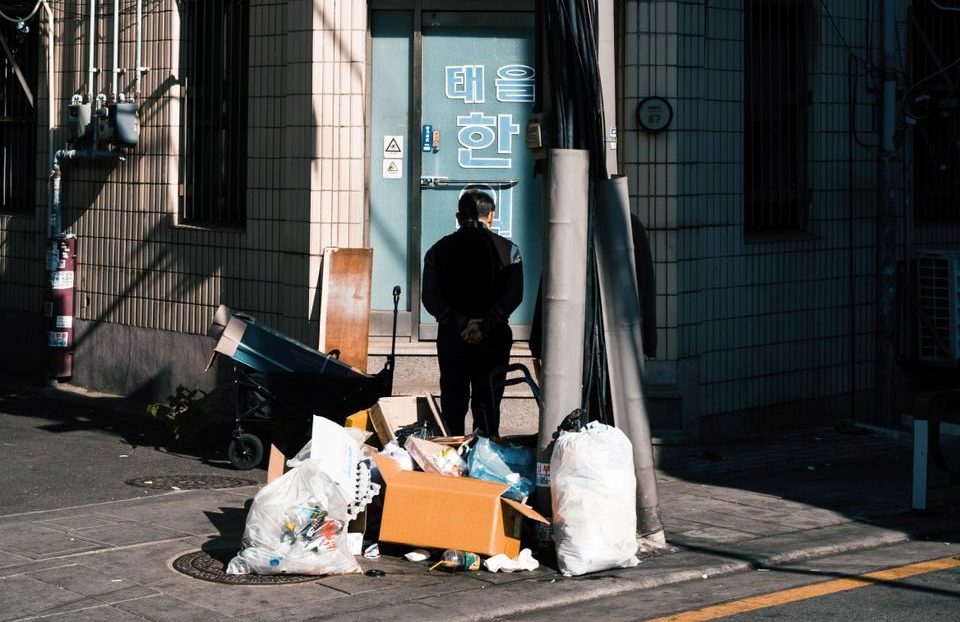
Bulky waste disposal in Korea works nothing like the bulk pickup day most Western residents grew up with. There is no fixed Tuesday when the city takes whatever you drag to the curb. Anything large has to be paid for first, and then it has to carry proof that you paid.
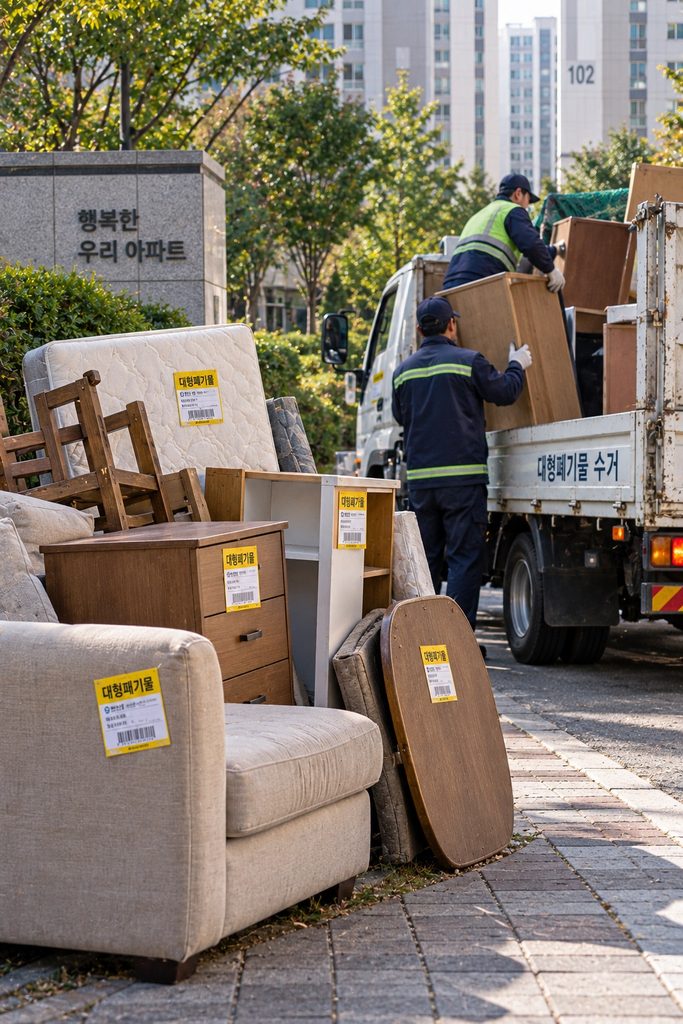
That proof is a sticker. Until it is stuck to your sofa, nobody is coming for it.
I live in a detached house in Incheon and have been through this more times than I would like. What follows is how it actually works where I live, plus the one thing you need to understand before you copy any of it: the details change from district to district. Prices, colors, where you buy the sticker, whether you can apply online — none of that is standardized nationwide. The general shape is similar. The specifics are local.
What counts as bulky waste in Korea
Korean households sort daily trash into food waste, recycling, and general waste, and general waste goes into paid volume-based bags. If you have not run into that system yet, our guide to Korean waste separation covers it in detail.
Bulky waste, called daehyeong pyegimul (대형폐기물), is what does not fit in those bags. Furniture, mattresses, desks, shelving, large appliances, and the awkward pile of junk that turns up when you empty a closet. If you cannot tie it shut in a standard bag, assume it falls into this category.
How items are grouped, and which group costs what, is decided locally. Your district may split things differently than mine does.
Why you cannot just leave it on the curb
You can physically put a wardrobe outside your gate. It will simply stay there.
Collection crews look for the sticker, and if there is no sticker they leave the item and mark it — a note telling you that payment is required before it will be taken. So the failure mode here is not a dramatic fine on day one. It is your wardrobe sitting in the rain for a week while your neighbors walk past it.
| What many expect | How it works in Korea |
|---|---|
| Scheduled pickup day | You arrange it when you need it |
| Free or billed with utilities | Paid per item, upfront |
| Put it out and forget it | Proof of payment must be visible on the item |
How the sticker system works where I live
Buying the sticker
I go to my local jumin senteo (주민센터), the community service center for my neighborhood. Older residents still call it dongsamuso (동사무소), and both names refer to the same place, so do not be confused if you hear either.
The conversation is shorter than newcomers expect. I say I am throwing out a piece of furniture and need a sticker, then give a rough size with my hands or in plain words. That is genuinely it.
Nobody measures anything. I have never been asked to bring exact dimensions, and I have never been asked for ID. The size bracket I describe determines which sticker I get, and the price is printed on the sticker itself. In my district different categories come in different colors, which makes it easy to see at a glance whether something outside has been paid for.
This is the part that surprises foreign residents most. Dealing with a Korean government office sounds like it should involve forms and proof. For this particular errand, it does not.
Attaching it and putting the item out
The sticker goes on the item somewhere clearly visible, then the item goes out in front of the house. A small collection truck comes around and takes it. In my experience it is usually gone within a couple of days, though I would not treat that as a promise — collection schedules are set locally and vary.
For something genuinely large, calling the district office directly is worth the two minutes. A phone call gets your address onto the route for a vehicle that can actually handle the load, rather than leaving you hoping the regular truck has room.
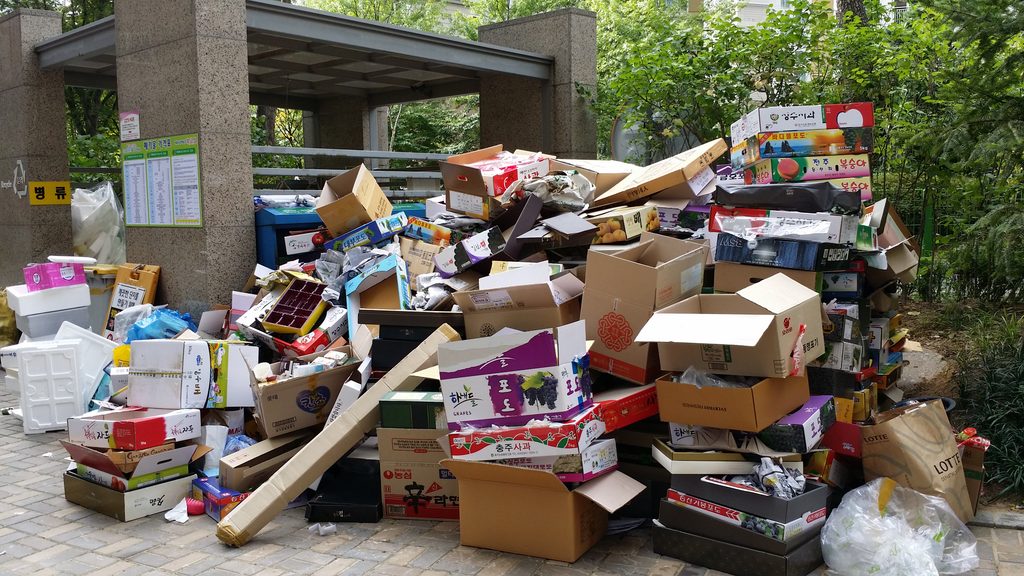
Photo Source :한국저작권위원회 서창녕
Detached house, villa, or apartment — who you deal with
Where you live changes who you talk to, and this is where a lot of online advice quietly assumes everyone lives the same way.
In a detached house, the errand is yours. You buy the sticker, you attach it, you put the item out front.
In an apartment complex, the building’s management office is usually involved and there is typically a designated spot for large items rather than your own doorway. I do not live in one, so I am not going to describe a process I have not been through. Ask your management office, or read the notices posted in your building’s lobby and elevator — that is where instructions for your specific complex appear. If the relationship between residents and the management office is new to you, our guides to Korean apartments and how management fees work will make the structure clearer.
Villas and multi-family buildings fall somewhere in between, depending on whether the building has any management at all.
How to find the rules for your own district
This is the most useful skill in this entire article, because it is the part that does not expire.
- Ask at your neighborhood community service center. They handle this daily and can tell you where stickers are sold in your area — in some districts that is the office itself, in others it is designated shops nearby.
- Check your district office website. Many publish item-by-item fee tables. Some districts let you report the item online and pay without visiting anyone; others expect you in person. Do not assume yours does either until you look.
- Read the notices in your building. For apartments and villas, building-specific instructions almost always get posted physically.
- Ask a neighbor. Unglamorous, and faster than any of the above.
Government services are indexed through the national portal at gov.kr, though bulky waste is administered locally, so your own district office is the authority that matters. Be prepared for Korean-language interfaces — this is one of those errands where translation apps earn their keep.
What actually goes wrong, and how forgiving the system is
The most common mistake is buying a sticker for a smaller size bracket than the item really needs. In my experience, crews usually take it anyway. When the gap is large, they leave the item with a note saying the correct sticker is required, and you go buy the difference.
A sticker that gets a little weather-beaten is generally fine too, as long as it is still clearly visible. Remember that this system is run by people making practical judgments, not by a machine scanning barcodes.
None of that is permission to underpay on purpose. It is context, so that you do not panic over a slightly wrinkled sticker or a guess that was off by a few centimeters. Describe the item honestly and the rest tends to sort itself out.
The mistakes that actually cost you are different: putting an item out with no sticker at all, or leaving something in a spot your building has not designated for it.
Before you throw it away
Bulky waste comes up most often during a move, and if that is your situation, our guide to moving in Korea covers the rest of the day you are about to have.
Two things worth doing first. Korean secondhand apps are heavily used and local — furniture in usable condition often finds a taker nearby within a day, and you skip the sticker entirely. And when you collect moving quotes, ask directly whether disposal of unwanted items can be included. Some companies will handle it; the answer depends on the company, so ask rather than assume.
The short version
Report and pay first, attach the proof, then put the item out. That sequence holds across the country. Everything underneath it — the price, the color, the counter you buy it from, whether an app exists — belongs to your district.
So learn the shape from this article, then spend five minutes confirming the details where you actually live. It is a small errand that feels intimidating exactly once.