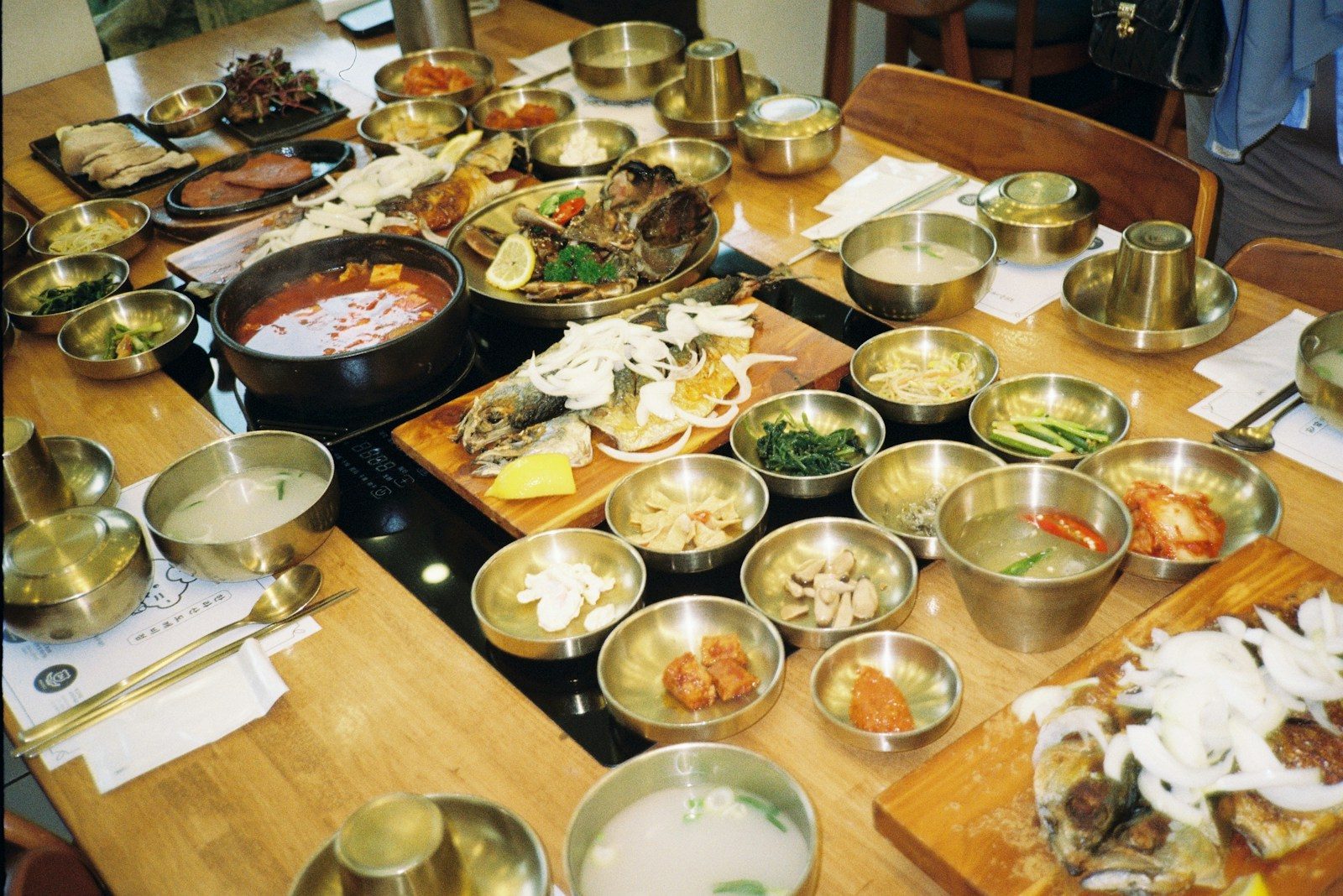
How Koreans eat at home looks almost nothing like the Korean food that reaches the rest of the world. The grill in the middle of the table, the tongs, the sizzle — that is a night out. It is real, it is enjoyable, and it is not what Tuesday dinner looks like.
Tuesday dinner is a pot of stew, rice, and whatever side dishes are already in the fridge. Nobody photographs it.
I live in Incheon and eat the way most people around me do. What follows is the ordinary version — what gets cooked at home, what gets bought half-made, what gets left to restaurants, and the one idea underneath all of it that rarely gets explained to foreign readers.
The default meal
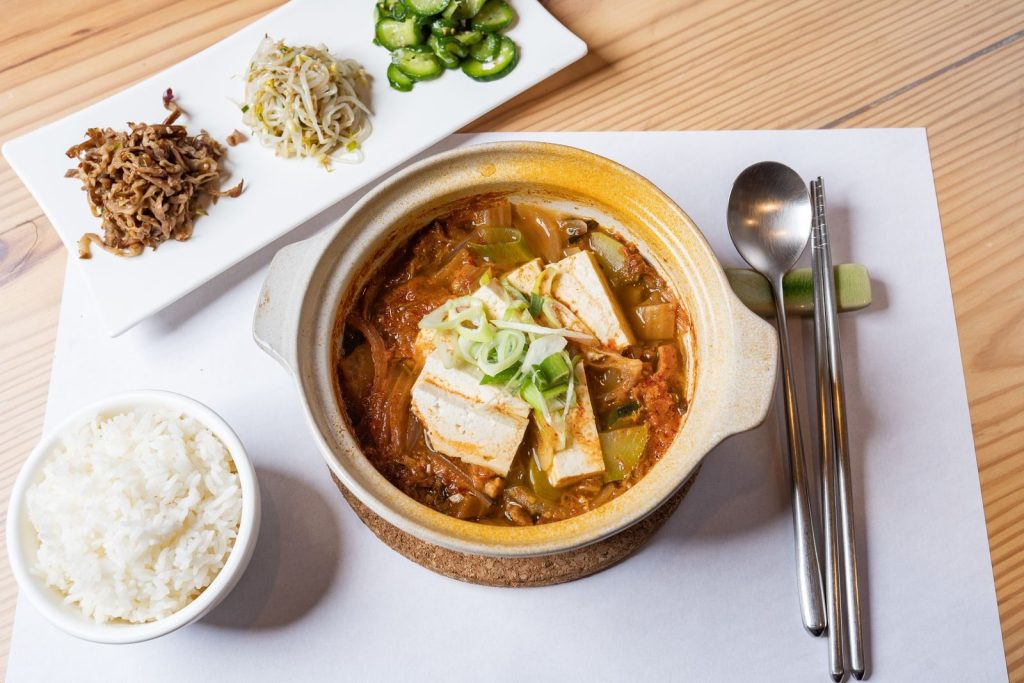
A Korean home meal has a fixed shape. Rice, something wet, and side dishes. The wet thing changes daily; the structure does not.
Most often that wet thing is a jjigae (찌개) — a thick, aggressively seasoned stew served in the pot it was cooked in, placed at the center for everyone to spoon from. Three turn up more than any others:
- Doenjang jjigae — fermented soybean paste, deeply savory, the most everyday of the three
- Kimchi jjigae — made with kimchi that has gone sour, which is the point rather than a problem
- Sundubu jjigae — soft curdled tofu, silky, usually with chili
These are weeknight food. They take one pot, they use ingredients already in the house, and nobody treats making one as cooking in any serious sense. A Korean adult produces a doenjang jjigae the way an Italian one produces pasta — without a recipe and without thinking about it.
Bibimbap belongs to the same category, though it gets marketed abroad as a signature dish. At home it is closer to a solution: rice, whatever vegetable side dishes are sitting in the fridge, gochujang, a spoon of sesame oil, mixed together. It exists because Korean households accumulate banchan faster than they get eaten.
The side dishes deserve more attention than they usually get, because they are what makes this structure work at all. A household keeps five or six of them going at any time — seasoned spinach, braised soybeans, pickled radish, dried anchovies, and kimchi in several forms. They are made in batches, they last, and they are not remade for each meal. This is why a Korean dinner can be assembled in the time it takes to boil a stew: most of the table already exists.
Much of the kimchi in Korean fridges still comes from one big day in late autumn. I explain how that works in my guide to kimjang, Korea’s winter kimchi-making season.
It also explains something visitors find puzzling, which is that side dishes are refilled for free at restaurants. They are not a generous extra. They are infrastructure, the same way bread is in some cuisines, and charging for them would make about as much sense as charging for cutlery.
The rice matters more than it appears to as well. It is not a side to the stew; the stew is a side to it. Korean has a verb for eating a meal that is built on the word for cooked rice, and the whole table is arranged around getting rice from a bowl into a mouth with something salty attached. Once you see the meal that way, the intense seasoning of a jjigae makes sense — it is not meant to be eaten on its own, and tasting one straight from the pot will strike most foreigners as far too strong.
The middle ground nobody mentions
Between cooking from scratch and going out, there is a third mode that has quietly become enormous.
Supermarkets sell meal kits — everything portioned, sauce included, ready to go into a pot. Restaurants sell their own food packaged for takeaway so you can finish it at home. Delivery apps cover almost everything else.
Split my own eating roughly in half between cooking and not cooking, and the not-cooking half is mostly this middle ground rather than sitting in restaurants.
Restaurant takeaway works differently here than the word suggests. A place will hand over the components of a dish rather than a finished bowl — the ingredients, the sauce, sometimes the broth separately — so that you boil it at your own table and eat it at the right temperature. For stews in particular this is the norm, because a jjigae that has travelled twenty minutes in a sealed container is a worse jjigae, and everyone knows it.
Delivery apps then cover what neither of the other options does. Their reach is wider than most newcomers expect: not only fried chicken and pizza but ordinary soups, stews, and full rice-and-side-dish sets, available at hours when nothing is open. For single-person households, which now make up a very large share of Korean homes, this middle ground is not a convenience layer on top of cooking. It is most of how they eat.
Why budae jjigae moved home
Budae jjigae (부대찌개) is the clearest example of the shift. It used to be something you went out for. Now most people I know make it at home, and the reason is not thrift.
It is that the dish is almost impossible to get wrong. Ham, sausage, instant ramen noodles, assorted additions, and a packet of seasoning — assemble, add water, boil. The result lands above average with no skill involved. Supermarkets now sell the whole combination as a set, which removed the last reason to leave the house for it.
Cost is a genuine factor for some households, and meal kits are the economical choice. But budae jjigae went home because it survives being made by anyone.
What stays in restaurants, and why
Some dishes never made that move. Samgyetang (삼계탕), whole young chicken simmered with ginseng and rice, and chueotang (추어탕), a thick ground-loach soup, are both sold packaged at any large supermarket. I still eat them at restaurants, and so does almost everyone I know.
The reason is the broth. These dishes are judged entirely on it — whether it is rich, nutty, properly reduced, cooked long enough to be thick rather than merely hot. A packaged version is fine. A good restaurant version is not comparable.
So people are specific about where they eat them. Not “let’s get samgyetang” but “let’s go to the place that does it well,” sometimes crossing the city to do it. The same person who happily assembles budae jjigae from a supermarket box will drive across town for chueotang.
That distinction is the practical rule: if technique is the whole dish, Koreans outsource it.
The rule holds surprisingly well across the whole cuisine. Grilled meat is outsourced because the equipment is better — a proper charcoal grill and extraction hood beat anything in a home kitchen, and the smoke has to go somewhere. Cold noodles are outsourced because the broth takes a day. Anything requiring a stock simmered for hours is outsourced. Anything that is fundamentally assembly stays home.
This is also why Korean restaurant culture is so heavily specialized. A samgyetang restaurant sells samgyetang. It does not also sell bibimbap and pork cutlet, because its entire claim is that it does one long-simmered thing better than you could. Broad menus signal the opposite, and Koreans read them accordingly — a place with forty items is somewhere you eat because it is close, not because it is good.
For a foreign resident the practical takeaway is to trust the narrow menu. A shop with six items on the wall and no English is usually the better bet, and the fact that it has survived on those six items in a country with this much restaurant competition is itself the review.
Food as body maintenance
Here is the idea underneath all of it, and the one that most often goes unexplained.
Koreans routinely eat specific dishes for what they are understood to do to the body, not only for taste. The word is bosin (보신) — roughly, restoring or fortifying yourself. It is not alternative medicine and it is not a health-food movement. It is a completely ordinary way of thinking about dinner.
Samgyetang is the classic case. Hot chicken soup, eaten in the hottest weeks of the year, on the logic that heat restores what heat takes out of you. Foreign visitors usually find this backwards. Koreans find it obvious.
Chueotang works the same way, eaten when someone is run down or needs building back up. Even sundae guk, the blood sausage soup that turns up at cheap restaurants and on delivery apps at every hour, carries some of this — a heavy, warming bowl that is understood to put something back.
Why the broth logic makes sense
Once you know this, the restaurant preference stops looking like fussiness. If a bowl of soup is partly about doing your body good, then a thin, watery version has failed at its actual job. The richness is not a bonus. It is the function.
That is why people are willing to travel for a good bowl of chueotang and entirely relaxed about assembling budae jjigae from a box. One is maintenance. The other is dinner.
Samgyetang is not just a summer dish
It gets described abroad as summer food, and that is half right. Summer is when it is most associated — there are specific days in the hottest stretch of the year when restaurants fill up with people eating it.
But it is eaten year-round. Anyone feeling depleted, recovering from illness, or simply in need of something substantial will have it in November as readily as in August. The trigger is your condition, not the calendar.
What this means if you are living here
A few things follow if you have moved to Korea and are working out how to eat.
- Learn one jjigae. Doenjang is the most forgiving. One pot, and you have the Korean weeknight meal.
- Use the meal kit aisle. It is not a compromise and nobody treats it as one.
- Ask where, not what. For soup dishes, Koreans recommend specific restaurants rather than dishes. Take the recommendation seriously.
- Expect the question. If you mention feeling tired, someone will suggest a specific food. That is care, not a superstition being pushed on you.
If you are setting up a kitchen, the practicalities of moving are covered in our guide to moving in Korea, and Korean convenience stores fill the gaps on the days nobody cooks at all.
The short version
Korean BBQ is a night out. The everyday version is a pot of stew, rice, and side dishes that were already in the fridge — with a supermarket meal kit standing in when nobody feels like cooking, and a specific restaurant across town reserved for the dishes that only work when someone has spent all day on the broth.
Underneath it sits an assumption that food is partly in charge of how you feel. Not as a diet or a philosophy. Just as the reason someone suggests soup when you look tired.