
Buying trash bags in Korea is one of the first small surprises for anyone who moves here. You cannot grab any cheap roll of garbage bags from the supermarket shelf and use it for your household trash. Korea uses official bags, sold by your city or district, and the price of the bag is what you pay to get your garbage collected.
Once that idea clicks, the rest of the system makes sense. This guide explains why Korean trash bags cost money, where to buy them, which size to pick, how much they cost in different places, the special bags most newcomers have never heard of, and what to do with leftover bags when you move.
What Korean Trash Bags Are Called
In Korean, the official bags are called jongnyangje bongtu (종량제 봉투). Jongnyangje means “volume-based fee system,” and bongtu simply means “bag.” Most people shorten it to jongnyangje or just say “trash bag” (sseuregi bongtu, 쓰레기 봉투) at the store counter, and everyone knows what they mean.
Each bag is printed with the name of the city, county, or district that issued it, along with its size in liters. That printed name matters more than anything else on the bag, because it decides where you are allowed to use it.
Why Korean Trash Bags Cost Money
Korea started charging for household trash by volume in 1995. Before that, garbage fees were mostly fixed or bundled into other charges, so a household that threw away a mountain of trash paid about the same as one that threw away almost nothing. After pilot programs in 1994, the volume-based waste fee system went nationwide on January 1, 1995.
The idea is simple: the more you throw away, the more you pay. Instead of a monthly garbage bill, you pay upfront every time you buy a bag. The bag price covers collection, treatment, the cost of making the bag, and a small commission for the shop that sells it. Recyclables, by contrast, are collected free of charge, so every bottle or box you sort out properly is one less thing taking up space in a paid bag.
It worked. Seoul’s own policy records show household waste in the city dropping by about 11 percent in the first two years, while the recycling rate jumped from around 20 percent in 1994 to nearly 30 percent in 1995. Three decades later, the bags are such a normal part of life that most Koreans never think about them, until they move to a new district and their old bags no longer work.
In short: a Korean trash bag is not just a bag. It is a prepaid garbage collection ticket in the shape of a bag.
Where to Buy Trash Bags in Korea
Official trash bags are sold almost everywhere you buy groceries. The most common places are:
- Convenience stores such as the chain stores on nearly every corner
- Supermarkets and large discount marts
- Small neighborhood marts and corner shops
- Some stationery stores and hardware shops in residential areas
Here is the part that confuses visitors: the bags are often not on the shelf. In many convenience stores and small marts, they are kept behind the counter near the cash register. Simply ask the cashier. “Jongnyangje bongtu juseyo” (종량제 봉투 주세요), “Trash bags, please,” is enough, and the cashier will usually ask which size you want.
Bags are typically sold in bundles of 10 or 20, though many shops will sell a single bag if you ask. Because each bag already includes the government fee, you usually cannot use discount coupons or store points on them the way you would on ordinary products. If you are new to Korean corner shops, our guide to the Korean convenience store covers what else you can do at the counter, and our guide on how to send a package in Korea explains the parcel service most stores offer.
Bag Sizes and Which One to Choose
Sizes are measured in liters. Exact options depend on your district, but these are the sizes you will see most often for general household trash:
| Size | Good for |
|---|---|
| 5 L | A single person, a small studio, or a bathroom bin |
| 10 L | One or two people who sort recyclables carefully |
| 20 L | The everyday standard for most households |
| 50 L | Large families, cleaning days, or moving |
| 75 L | Big clean-outs; not sold in every district |
The 20-liter bag is the one most Koreans mean when they talk about “a trash bag,” and it is also the size used when news reports compare prices across the country. Very large 100-liter bags used to be common, but many local governments have stopped making them because the full bags were too heavy for sanitation workers to lift safely. Incheon, for example, dropped its 100-liter household bag in 2022.
Bigger is not automatically cheaper in a way that matters. Prices rise roughly in step with size, so a half-empty 50-liter bag sitting in your kitchen for two weeks costs you more and smells worse than a full 20-liter bag taken out on time. Most households do best by choosing a size they can fill within one or two collection days.
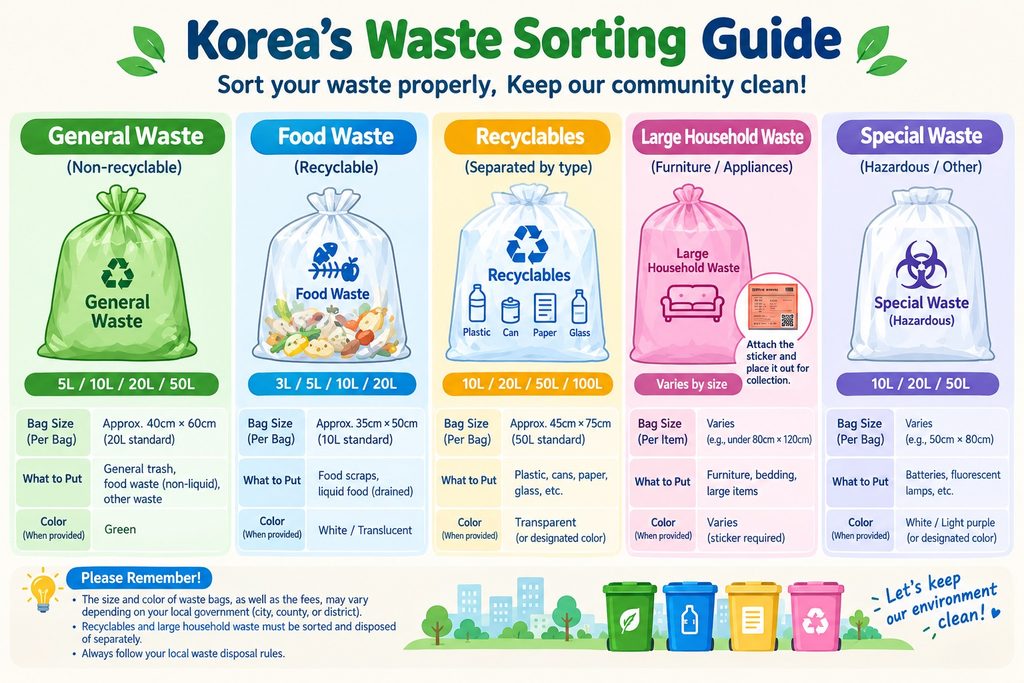
How Much Trash Bags Cost
There is no single national price. Every city, county, and district sets its own price by local ordinance, based on what it actually costs to collect and dispose of its trash. Prices can also change over time, so treat any number you read online, including the ones here, as a guide rather than a guarantee.
To give a real sense of the range, here are Incheon’s official prices for a 20-liter general household bag, as posted by the city for July 2026:
| Area in Incheon | 20 L bag |
|---|---|
| Ganghwa-gun, Jemulpo-gu, Yeongjong-gu, Seohae-gu, Geomdan-gu | 620 won |
| Michuhol-gu | 750 won |
| Yeonsu-gu, Namdong-gu, Bupyeong-gu, Gyeyang-gu, Ongjin-gun | 870 won |
That is a difference of 250 won for the same bag in the same city, depending only on which side of a district line you live on. In Michuhol-gu, for example, a 5-liter bag costs 210 won, a 10-liter bag 390 won, a 50-liter bag 1,850 won, and a 75-liter bag 2,780 won.
Other cities land in a similar range. Seoul has kept its 20-liter bag at around 490 won since 2017, which made headlines in 2025 because it is noticeably cheaper than bags in Busan, Incheon, or Gwangju, where city averages were reported at roughly 740 to 770 won. When Seoul first introduced the system in 1995, a 20-liter bag cost about 350 won. Rising disposal costs have pushed many local governments to consider increases, so do not be surprised if your district’s price goes up during your stay.
Even at the higher end, most households spend only a few thousand won a month on trash bags, especially if they recycle well. The bigger cost of getting it wrong is not the bag price but the fine for using the wrong bag, which is covered below.
The Different Kinds of Official Bags
The standard white or colored household bag is the one you will use most, but Korea has several other official bags. Knowing they exist will save you from stuffing the wrong thing into the wrong bag.
General household bags
These are the everyday bags for anything that cannot be recycled and is not food: used tissues, dirty wrappers, broken plastic toys, old toothbrushes, receipts, and similar items. Colors vary by district, but most are white or pale with printed text.
Reusable shopping-bag style
Some supermarkets and marts sell official trash bags with handles at the checkout. You carry your groceries home in it, then use the same bag for trash. The idea spread as Korea cut back on single-use plastic shopping bags. Incheon’s Ganghwa County, for instance, introduced a 20-liter reusable bag in 2016 at the same price as its regular bag. Where these are sold, they are a clever way to avoid paying for a plastic shopping bag you would throw away anyway.
Food waste bags
Leftover food never goes in a general trash bag. In areas that use bag-based food waste collection, there are separate, smaller food waste bags, usually in sizes from 2 to 20 liters. In Michuhol-gu, for example, a 2-liter food waste bag costs 120 won and a 5-liter bag 300 won. Apartment complexes often use card-operated food waste machines instead, so you may never need these bags at all. Our guide to food waste disposal in Korea explains what counts as food waste.
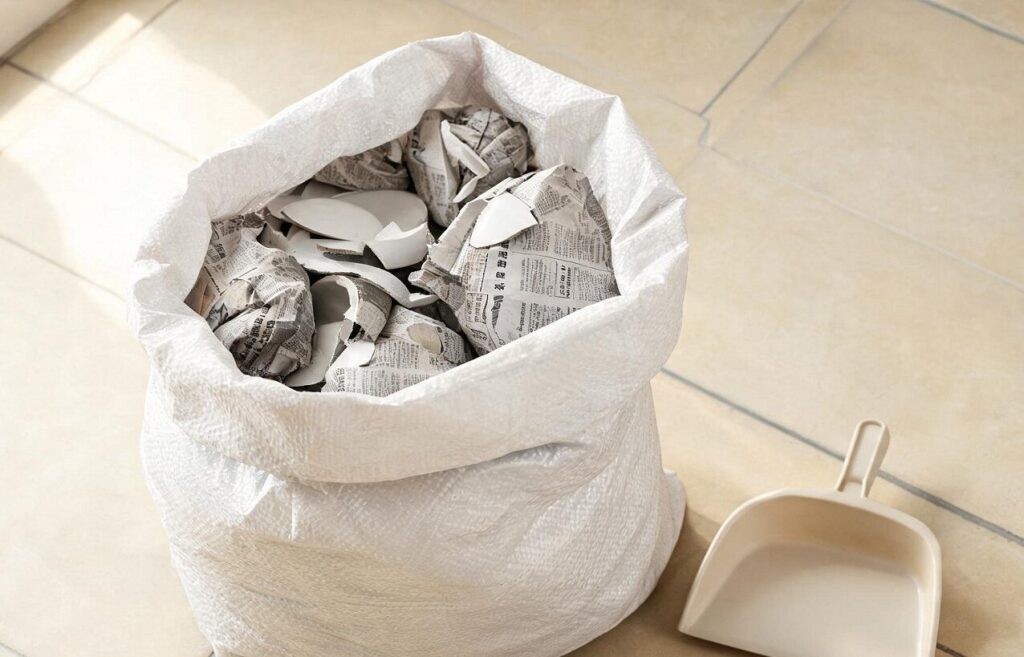
Sacks for non-combustible waste
Broken glass, shattered dishes, ceramic pots, small amounts of tile or rubble, and similar items cannot go in an ordinary trash bag. They can tear the bag and injure sanitation workers, and they cannot be burned at incinerators. Most districts sell a special heavy-duty sack, often called a madae (마대), for this kind of waste. Some sell it by liter size, others by weight. Ask at your community center or a nearby mart if you need one, and wrap sharp pieces in newspaper first.
Business bags
Shops, restaurants, and offices often use separate business-use bags with their own pricing. As a resident, you do not need these, but if you open a small business in Korea, check with your district about which bag applies to you.
Your Bags Only Work in Your District
This is the rule that catches people out most often. A bag printed with one district’s name is meant to be used in that district only. If you live in one district and buy bags at a shop near your workplace in another district, the collectors at home may not take them.
The reason is money, not bureaucracy. The fee built into the bag goes to the local government that collects your trash. A bag from the neighboring district has paid the wrong office, even if the bags look almost identical.
The safest habit is to buy trash bags at a shop near your home. Before buying, glance at the name printed on the bag, especially if you live close to a district border.
What to Do With Leftover Bags When You Move
If you move within the same district, nothing changes. Keep using your bags. If you move to a different district, policies vary widely, and it is worth asking before you throw anything away.
- Confirmation stickers. Many local governments let you bring leftover bags to your new community center (jumin senteo, 주민센터) after you register your new address. Staff may attach a sticker confirming that the bags can be used in the new area.
- Exchanges. Some areas will swap part or all of your old bags for new local ones.
- No exchange. In places that offer neither, the usual advice is to use up your bags before moving or give them to a neighbor who is staying.
Even with a confirmation sticker, your new area’s rules apply: its collection days, times, and sorting rules. If you are in the middle of a move, our guide to moving in Korea walks through the rest of the checklist, including what to do with furniture that will not fit in any bag.
How to Fill and Put Out Your Bag
Using the bag correctly is just as important as buying the right one. A few habits make life easier for you and for the collectors:
- Sort first. Take out recyclables, food waste, and anything sharp or bulky before you start filling the bag.
- Do not overstuff it. The bag should close properly. Many districts may refuse bags that are overfilled, taped shut with extra plastic on top, or wrapped in a second bag.
- Tie it securely. Most bags have side flaps or a drawstring designed for this.
- Put it out on the right day. Collection days and times are set locally. In neighborhoods of detached houses, bags usually go right in front of your own door or gate on collection evenings. In apartment complexes, there is normally a shared collection area that is open more often.
Small differences exist from one district to the next. If your building or street has a posted notice near the trash area, follow it over any general guide.
Fines for Using the Wrong Bag
Using an ordinary plastic bag instead of an official one, dumping trash without a bag, or mixing food waste into a general trash bag can all lead to fines. Amounts are set locally and depend on the type and frequency of the violation, but reporting has mentioned fines of up to 300,000 won for putting the wrong items in a volume-based bag.
In practice, a first small mistake often ends with your bag left behind and a warning sticker attached. Repeated dumping is what tends to bring real fines, and some neighborhoods use CCTV cameras near common dumping spots. Mail with your name and address in an illegally dumped bag is one of the quickest ways for officials to find the owner.
Common Mistakes Newcomers Make
- Buying bags from the wrong district. Always check the printed name.
- Using a supermarket plastic bag as a trash bag. Unless it is an official reusable bag, it does not count.
- Throwing recyclables in the paid bag. Plastic bottles, cans, cardboard, and vinyl packaging should be sorted out. They are collected free and take up space you paid for.
- Putting broken glass in a regular bag. It belongs in a non-combustible sack, wrapped safely.
- Leaving bags out on the wrong day. This is a common cause of neighbor complaints, even when the bag itself is correct.
Small Ways to Spend Less on Trash Bags
Because you pay by volume, most savings come from putting less into each bag:
- Sort recyclables carefully. This alone can cut the amount of paid trash by a large share.
- Flatten what you can. Squash soft packaging so it takes up less room in the bag.
- Keep food out. Food waste is heavy and wet, and it belongs in its own system anyway.
- Pick the right size. A small bag that fills up quickly is often cheaper and cleaner than a large bag that sits half-empty.
For a full picture of how general trash, recyclables, and food waste fit together, start with our overview of Korean waste separation. For sofas, mattresses, and other items too big for any bag, read our guide to bulky waste disposal in Korea. And before you stuff old clothes into a trash bag, check our guide to clothing bins in Korea, since wearable clothes have their own collection system.
Final Tips
Korean trash bags look like an odd extra expense at first, but they are really just your garbage bill paid in small pieces. Buy them near home, check the district name on the bag, choose a size you can fill quickly, and keep recyclables and food out of them.
After a few weeks, asking for jongnyangje bongtu at the counter will feel as routine as buying milk. And you may find yourself looking at overflowing curbside bins in other countries and wondering who is paying for all that trash.
Images in this post were created with AI.