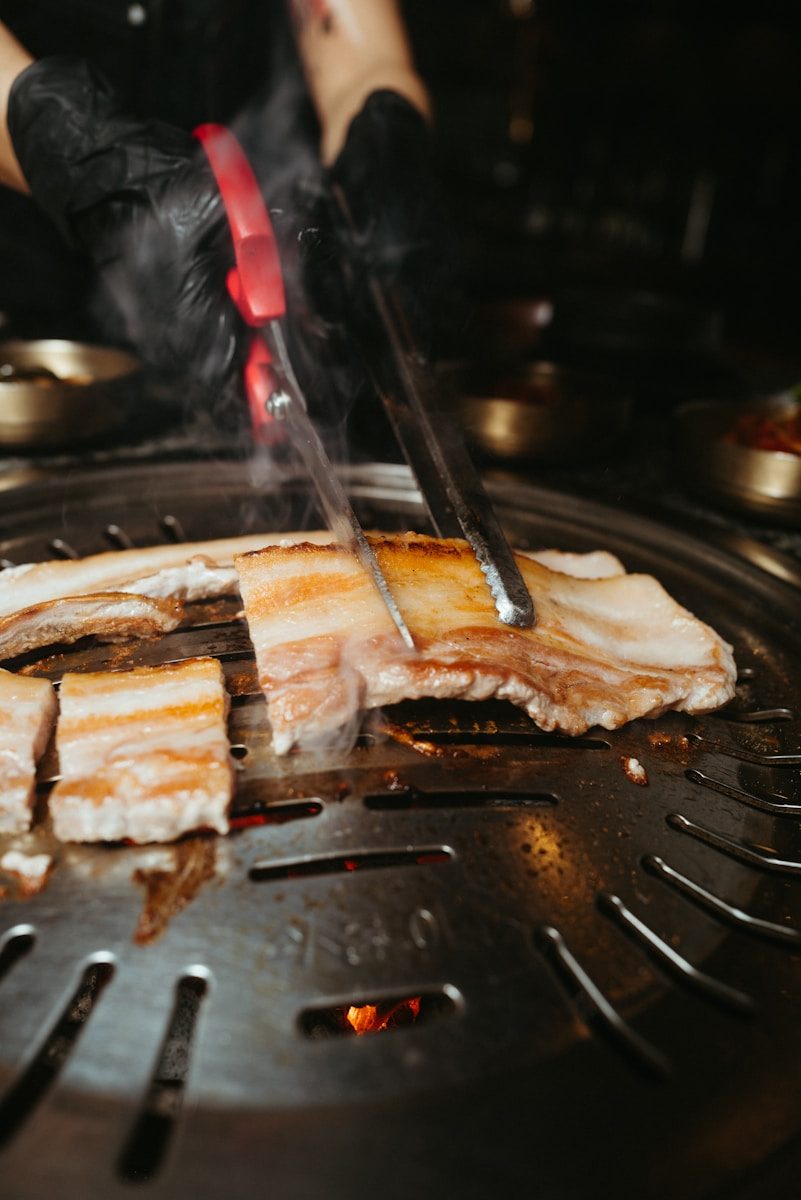
What is samgyeopsal? It is pork belly, and it is the meat Koreans eat more than any other. Not a special-occasion dish, not a tourist experience — the default answer to what is for dinner.
Most English-language writing about it describes one thing: a restaurant table with a grill in the middle, thick slabs sizzling away. That version is real. It is also maybe half of the story.
The other half depends on a single decision made before the meat ever reaches heat: how thick it was sliced. That one choice changes who can eat it, where it gets cooked, and what the meal feels like.
Thick-cut: the version you already know
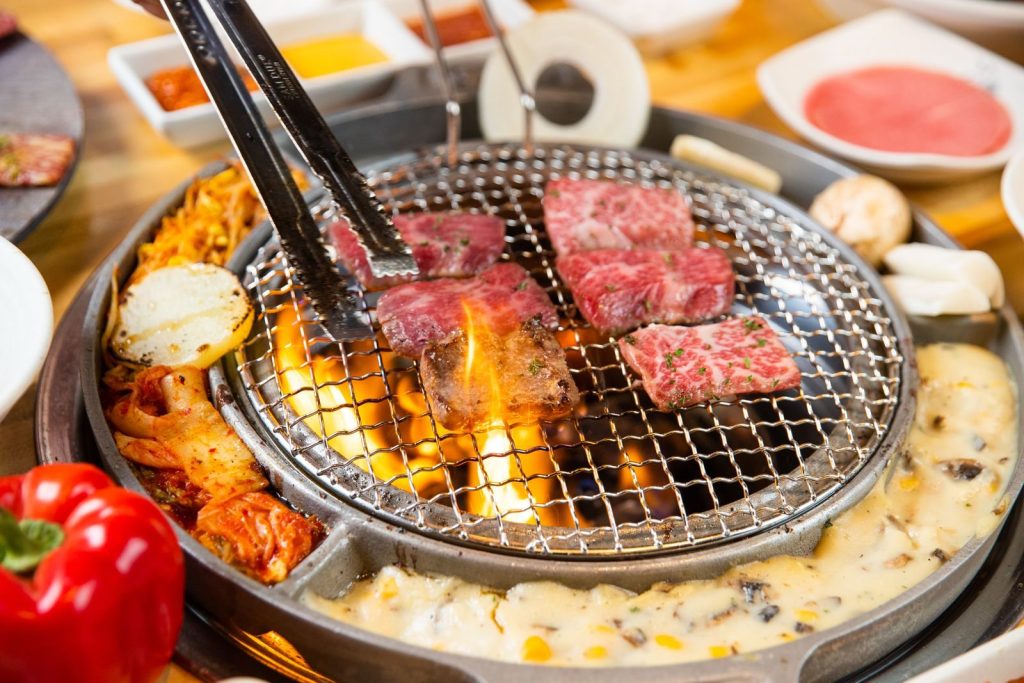
Thick samgyeopsal arrives as substantial strips, sometimes a centimeter or more. It is cooked over a pan, a cast-iron lid, or charcoal, and it is cut into bite-sized pieces with scissors, while it cooks.
The scissors surprise people. There is no carving, no knife and fork. Someone at the table picks up kitchen shears and snips the meat directly on the hot surface. It is normal, it is efficient, and whoever is closest to the grill usually takes on the job without being asked.
This version is for people who want something to chew. The fat renders, the outside crisps, and each piece has real resistance to it.
Nothing is marinated. That is worth stating plainly, because most Western readers arrive expecting sauce. Korean barbecue advertising abroad leans heavily on galbi, which is marinated, and people carry that assumption over. Samgyeopsal is raw pork belly and heat. Everything else happens after it comes off the grill.
The fat is the point, not a flaw to be trimmed. As it renders it pools on the cooking surface, and the kimchi, garlic, and onion placed around the edges cook in it. By the time the meat is ready, the side items have absorbed the fat and become part of the meal rather than accompaniments to it. Grilled kimchi in particular is something visitors rarely anticipate and often end up preferring to the raw version.
There is also a rhythm to it that no menu explains. Meat goes on in batches, never all at once. Someone monitors the grill, turns pieces, cuts them, and pushes cooked ones toward whoever is eating slowest. Nobody is assigned this. It falls to whoever is closest, or youngest, or simply paying attention, and doing it without being asked reads as ordinary courtesy rather than service.
Where thick-cut gets cooked
Restaurants, yes. But some of the best versions happen nowhere near one.
Koreans grill pork belly while camping. In the yard at home. Over charcoal at a jeongja (정자), the open pavilion you find beside farmland, after a morning of work in the fields. The smoke, the folding table, the hot lid balanced over coals — for a lot of people that is the memory attached to this food, not a restaurant at all.
The cast-iron lid deserves explaining. A sotdanji lid — the heavy domed cover from a traditional rice cauldron — gets flipped upside down and set over the coals. The curve means fat runs down toward the rim instead of pooling in the middle, and the iron holds heat far better than any thin pan. Households that no longer cook rice that way still keep the lid for exactly this.
These outdoor meals are unhurried in a way restaurant meals are not. There is no time limit on the table and no queue waiting for it. People eat, stop, talk, put more meat on, and stretch a single meal across an afternoon. When Koreans say they want samgyeopsal, this is frequently the version they mean, even if what they end up doing is going to a restaurant.
Thin-cut: daepae samgyeopsal
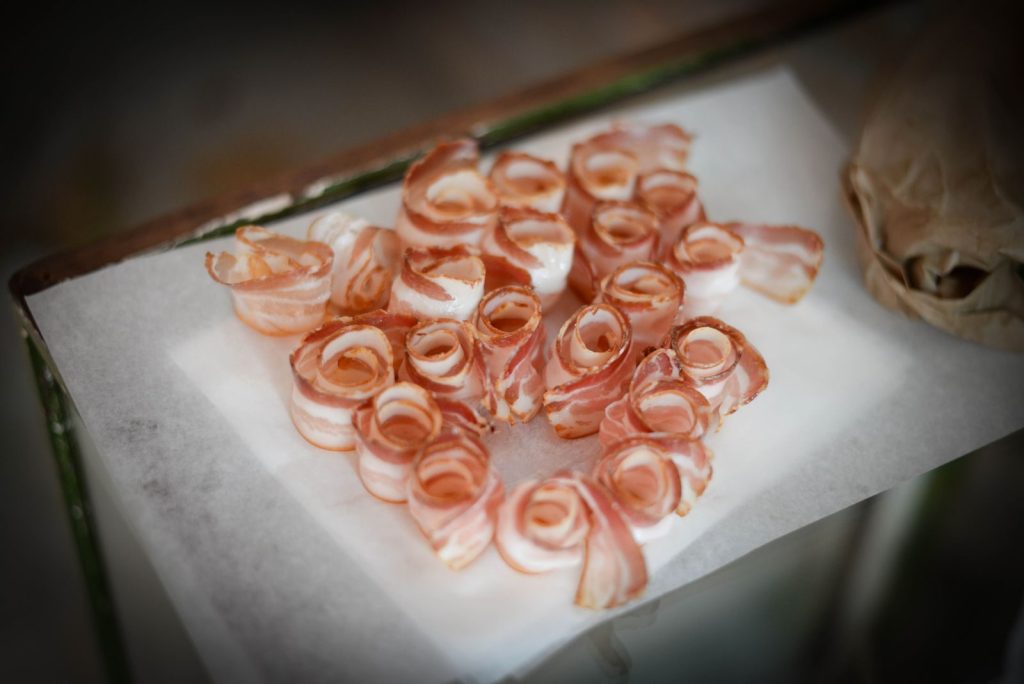
Daepae samgyeopsal (대패삼겹살) is pork belly shaved thin enough that the slices curl. The name comes from daepae, a carpenter’s plane — the tool that shaves wood into ribbons. That is exactly what the meat looks like.
It cooks in seconds and comes off the heat soft rather than chewy, closer to a sheet of paper than a steak. Butchers sell it pre-sliced and packaged, so it is a straightforward thing to buy and cook at home, and plenty of restaurants build their whole menu around it.
Who it is actually for
This is the part that rarely makes it into English guides.
Some people simply prefer the softer texture. But thin-cut also matters for older diners whose teeth are no longer up to thick pork belly. Daepae samgyeopsal lets a grandparent sit at the same grill, eating the same food, with no separate dish and no accommodation made on their behalf.
Korean meals are shared from communal plates, and a family that could not eat the same meat together would be a real loss. Thin-cut quietly solves that.
| Thick-cut | Daepae | |
|---|---|---|
| Texture | Chewy, substantial | Soft, delicate |
| Cooking | Minutes, cut with scissors | Seconds, curls up |
| Best for | Wanting something to chew | Soft texture, older diners |
What stays the same either way
Thick or thin, the meat is not the whole meal. It is the center of an assembly job that happens at the table.
- Lettuce as the wrapper, held flat in one palm
- Ssamjang (쌈장), a thick soybean-and-chili paste, dabbed on
- Garlic, often grilled alongside the meat until it mellows
- Perilla leaves and other greens, layered in for a herbal, slightly bitter edge
- Vegetables and banchan from the shared dishes on the table
You build a wrap, you close it, you eat it in one bite. Not two. Committing to the single bite is the part visitors get wrong most often, and doing it properly is a small but real social signal.
Overfilling is the usual mistake. A wrap that cannot be closed and eaten cleanly is too full, and there is no graceful recovery once it starts falling apart in your hand. Two pieces of meat, a dab of ssamjang, a sliver of garlic, and you are done. Restraint produces a better bite than ambition does.
The meal also has a defined ending. Once the meat is finished, the table usually moves to something starchy — naengmyeon, cold buckwheat noodles, or fried rice cooked directly on the grill surface with the remaining fat and bits of kimchi. It is not dessert and it is not an afterthought. Skipping it leaves Korean diners feeling the meal stopped rather than finished.
Alcohol is the other constant. Soju is the default pairing, and pouring works by its own rules — you fill other people’s glasses rather than your own, and you hold the bottle with both hands for someone older. Our guide to Korean drinking etiquette covers the specifics, which are worth knowing before the first bottle arrives rather than after.
If the array of small side dishes is unfamiliar territory, our guide to banchan explains how they work, and Korean restaurant etiquette covers the rest of the table.
How to order it
Pronounce it roughly sam-gyeop-sal — three even syllables, no stress on any one of them. Sam means three, gyeop means layer: three-layer meat, describing the bands of fat and lean.
For the thin version, dae-pae sam-gyeop-sal. Saying it correctly will not surprise anyone, but it will get you exactly what you want.
Restaurants usually sell by weight, often for a minimum of two servings. Eating alone is possible but not what the format is built for.
Why this matters
Samgyeopsal is not Korea’s most refined dish or its oldest. It is the most ordinary one, which is a different kind of importance.
It works on a restaurant grill, on a camping stove, on a cast-iron lid in a yard, and on a pavilion bench after farm work. It works for someone who wants to chew and for someone who no longer can. That range is the reason it turns up everywhere — and the reason the single image of a restaurant grill only gets you halfway.