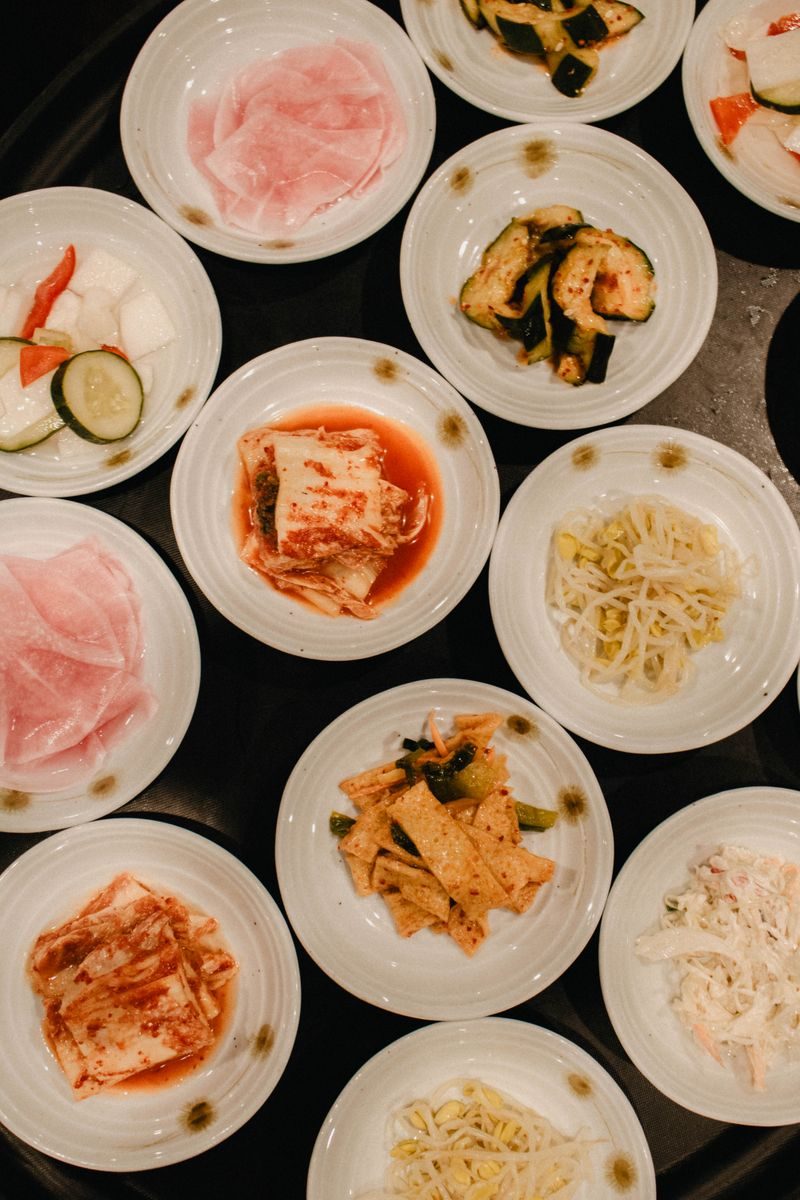
You sit down at a Korean restaurant, order one dish, and within two minutes the table is covered in small plates you did not ask for. Six of them. Sometimes twelve. Nobody explains what they are.
These are banchan, and the first thing worth knowing is that they are free, refillable, and not a starter course. They are the meal — or rather, the meal does not exist without them.
What Banchan Actually Are
Banchan (반찬) means, roughly, “accompanying dishes.” The Korean meal is structured as rice plus soup plus banchan, and the banchan are not optional garnish — they are how the rice becomes edible. Korean rice is deliberately plain. It is a neutral base that the side dishes flavour, bite by bite.
This explains something that confuses visitors: why the portions are so small. You are not meant to eat a whole plate of any one thing. You take a piece, eat some rice, take something else. The plates last the whole meal because you are cycling through them.
They are shared, and they are free
Banchan sit in the middle of the table and everyone reaches into the same plates. There is no individual portion. If a dish runs out, you ask for more — say jeogiyo (저기요) and point, or ask for ribeun (리필). Refills cost nothing.
Leaving banchan uneaten is completely normal and implies no criticism. Restaurants expect it.
Banchan refills are free — here’s how Korean restaurants actually work.
The Ones You Will Meet Constantly
| Dish | What it is |
|---|---|
| Baechu kimchi (배추김치) | The cabbage kimchi. Appears at essentially every meal. |
| Kkakdugi (깍두기) | Cubed radish kimchi. Crunchier, often served with soup dishes. |
| Sigeumchi namul (시금치나물) | Blanched spinach with sesame oil and garlic. Mild, green, everywhere. |
| Kongnamul muchim (콩나물무침) | Seasoned soybean sprouts. Crunchy, slightly nutty. |
| Myeolchi bokkeum (멸치볶음) | Stir-fried dried anchovies, often with nuts. Sweet, salty, intensely savoury. |
| Gyeranmari (계란말이) | Rolled omelette. The one children reach for first. |
| Dubu jorim (두부조림) | Braised tofu in soy sauce and chilli. |
| Gamja jorim (감자조림) | Braised potatoes, sweet and glossy. |
The category as a whole is called namul (나물) when the dish is a seasoned vegetable — blanched, squeezed dry, dressed with sesame oil, garlic, and salt. This treatment is applied to an enormous range of plants: spinach, bellflower root, fernbrake, bean sprouts, radish greens, seaweed.
Why So Many?
The pattern comes from the traditional Korean table setting, which was formally counted. A bansang (반상) was described by how many banchan it carried, excluding rice, soup, kimchi, and sauces.
- 3-cheop (3첩) — an ordinary household meal
- 5-cheop (5첩) — a comfortable household
- 7-cheop or 9-cheop — the yangban class, the scholar-official elite
- 12-cheop (12첩) — the royal table, called surasang
The counting system is largely historical now, but its logic survives: a good table is a full table, and generosity is expressed by variety rather than volume.
There is a practical origin too. Korean winters are long and the growing season is short, so vegetables were preserved — salted, fermented, dried, pickled — and eaten in small quantities across many months. Banchan is what a preservation culture looks like on a plate.

Banchan by Setting
At a stew or soup restaurant
Order doenjang-jjigae or any single-bowl dish and you will get rice, the stew, and a modest spread — kimchi, one or two namul, maybe a braised item. Four to six plates is typical. This is the setting where banchan does the most work, because the stew is intense and the sides are what keep the meal balanced.
At a barbecue restaurant
The banchan changes character entirely. Grilled meat comes with lettuce and perilla leaves for wrapping, raw garlic and green chilli, ssamjang dipping paste, and often kimchi meant to be cooked on the grill alongside the meat. Our guide to samgyeopsal covers how the wrapping works.
Here the sides are functional rather than decorative — you are assembling each bite, and the banchan are components.
At a home
Korean households keep banchan in the refrigerator in stacked containers and bring out whatever is there. Many families buy them ready-made from banchan shops or supermarket counters, which is entirely normal and carries no stigma.
Things Visitors Get Wrong
Eating a whole plate of one thing. Possible, but you have misunderstood the format. Spread out.
Assuming they cost money. They do not, at any ordinary restaurant. Refills are free too.
Waiting for a serving spoon. Sometimes provided, often not. Reaching in with your own chopsticks is standard practice, though younger Koreans increasingly use serving utensils when they are available.
Treating them as appetisers. They arrive first because they need no cooking, not because they come first in sequence. Do not clear them before the main dish arrives.
Expecting them to be identical everywhere. Banchan is where restaurants show personality. Two places serving the same stew will have completely different tables.
A Note for Vegetarians
Banchan looks vegetarian and frequently is not. Anchovy stock, fish sauce, and salted shrimp are foundational Korean seasonings, and most kimchi contains fermented seafood. Namul dishes are more often plant-only but not reliably so.
If this matters to you, the phrase is chaesikjuuija-yeyo (채식주의자예요) — “I am vegetarian” — though be aware that the concept is understood less consistently than in some countries, and temple cuisine restaurants are a more dependable option than asking for modifications.
The Point of All Those Plates
A Korean table is deliberately not a plate of food with a border around it. It is a set of things to combine, in whatever order you like, at whatever ratio suits you. Two people eating the same meal will construct entirely different sequences of bites.
That is the actual reason for the format, and once you eat that way rather than working through dishes one at a time, the whole structure makes sense.
How the table works socially — who starts, who pours, what to do with your spoon — is covered in our guide to Korean table manners. More dishes in the Korean Food section.
These side dishes are also the reason a Korean fridge always has something to work with. See how Koreans eat at home for how they fit into an ordinary weeknight meal.
The kimchi on most Korean tables traditionally comes from kimjang, the late-autumn custom of making a whole winter’s supply in one go.