
The Korean games in Squid Game are all real. Not one of them was invented for the show. Ddakji, jegichagi, gonggi, spinning tops — Korean children have played all of these for generations, and some of us were still playing them in schoolyards in the 1990s.
What English-language explainers usually get wrong is not the rules. It’s everything around them: what these games are actually called, when Koreans play them, and which parts of the show are pure invention.
The Games Are Real. The Pentathlon Is Not.
Start with the biggest misunderstanding. Season 2’s “Six-Legged Pentathlon” is presented as a single competition made of five mini-games. Plenty of English articles describe it as though it were a traditional Korean event.
It isn’t. No such competition exists in Korea. The five games inside it are real and individually well known, but bundling them into a timed relay with your legs tied together was written for the show. A Korean watching that scene recognizes five separate childhood games stitched into something new.
The same applies to the glass bridge and the marble round’s setting. Real games, invented framing.
Season 1: Two Games Everyone Now Recognizes
Ddakji (딱지)
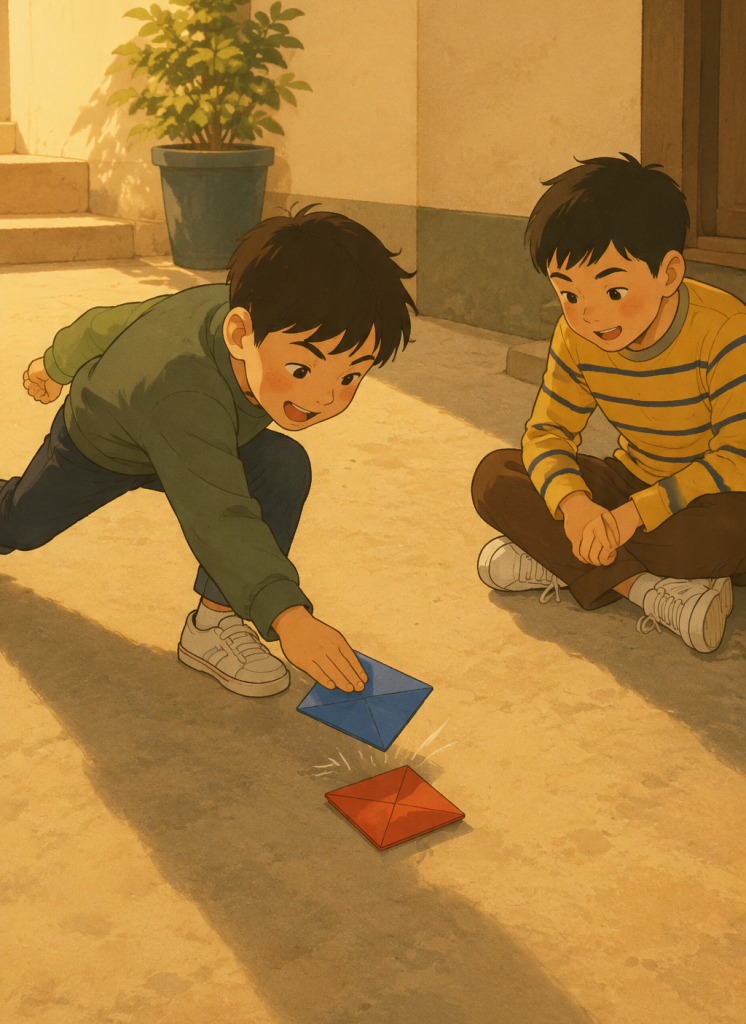
The folded paper tile game the Salesman plays in the subway. You throw your tile at your opponent’s tile on the ground and try to flip it over. If it flips, you win it.
The show gets the technique right — the downward throwing angle matters more than strength. What it skips is that ddakji was a currency system as much as a game. Winning tiles meant accumulating them, and a thick stack was a status symbol among boys.
For step-by-step folding instructions and the throws that actually flip tiles, see my full guide on how to play ddakji.
Mugunghwa Kkochi Pieotseumnida (무궁화 꽃이 피었습니다)
Known in English as Red Light, Green Light. The Korean version is not a translation of it — the phrase means “the hibiscus flower has bloomed,” and it functions as a timer rather than a command. You move while it’s being chanted and freeze when it ends.
That difference matters. In the English version, the caller controls two states. In the Korean version, the length of the chant is the whole game — a fast chant is a weapon. More on the phrase and the real playground version here.
Season 2: The Five Games Inside the Pentathlon
The pentathlon runs in a fixed order: ddakji, flying stone, gonggi, spinning top, jegi. Four of the five are covered in detail elsewhere on this site. The fifth is the one nobody explains.
Biseokchigi (비석치기) — the “Flying Stone”
Netflix’s own guide calls it Flying Stone. So does nearly every English article. None of them mention that its Korean name is biseokchigi, and that biseok means tombstone.
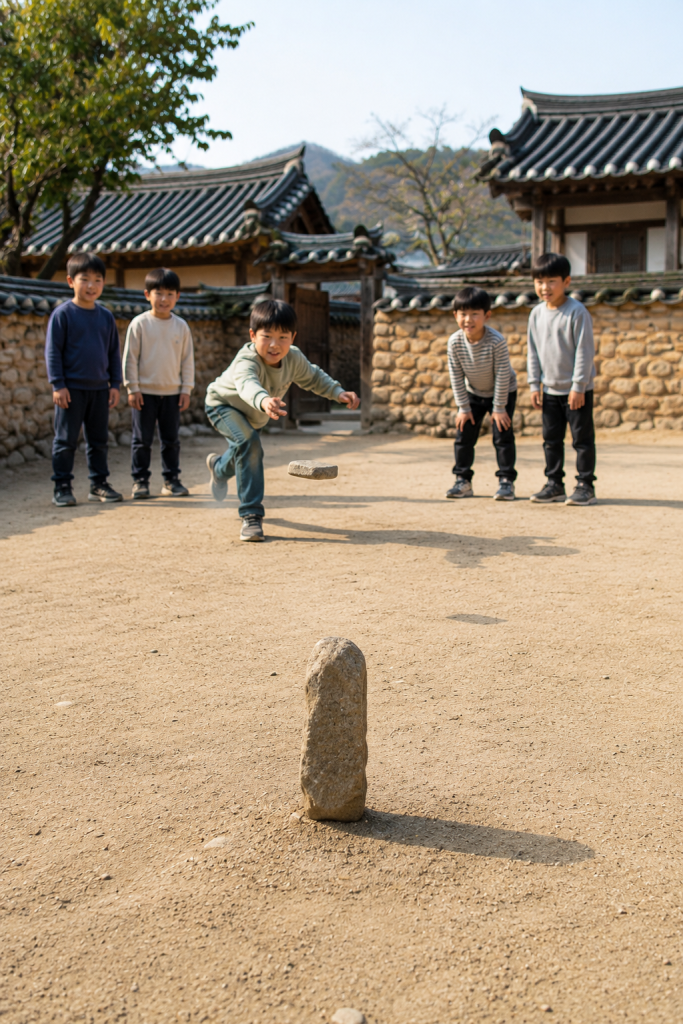
That’s not a coincidence or a dark joke. You stand a flat stone upright on the ground and knock it down by throwing another stone at it. The upright stone looks like a small grave marker, and that’s exactly what Koreans named it after. The show’s prop — a small standing slab marked with symbols — is faithful to this.
The real game has levels. You start by throwing from a standing position, then progress to harder methods: holding the stone between your knees and hopping over, balancing it on your foot, on your shoulder, on your head. A full round is a physical obstacle course. The show only shows the easiest level.
Gonggi (공기)
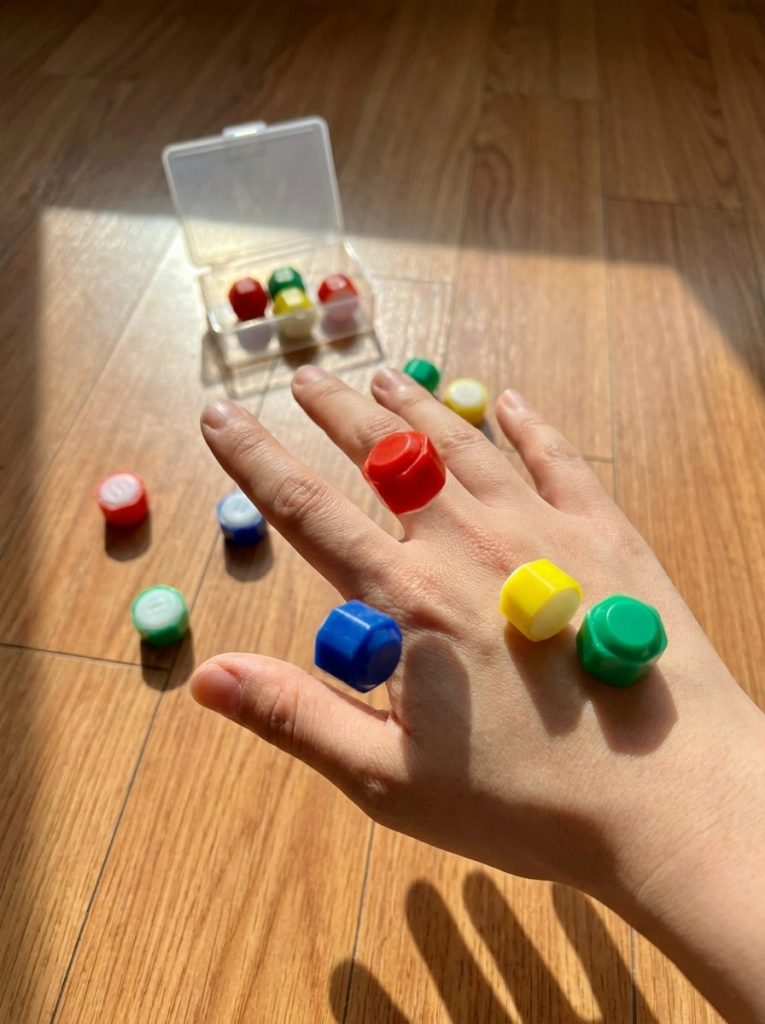
Five small stones, tossed and caught in increasingly difficult patterns, ending with a catch on the back of the hand. Closest Western equivalent is jacks.
Of all the games in Squid Game, this is the one Korean children still play the most. Plastic gonggi sets cost about a dollar at any stationery shop, and you will see them in real classrooms today.
Paengi Chigi (팽이치기)
A wooden top kept spinning by whipping it with a cloth-tipped stick. Not the string-launch spinner most Western readers picture — the whip is the entire point, and a skilled player can keep a top going almost indefinitely.
This was a winter game, played on frozen ground and ice because a hard surface holds the spin. More on the top, the whip, and why winter mattered.
Jegichagi (제기차기)
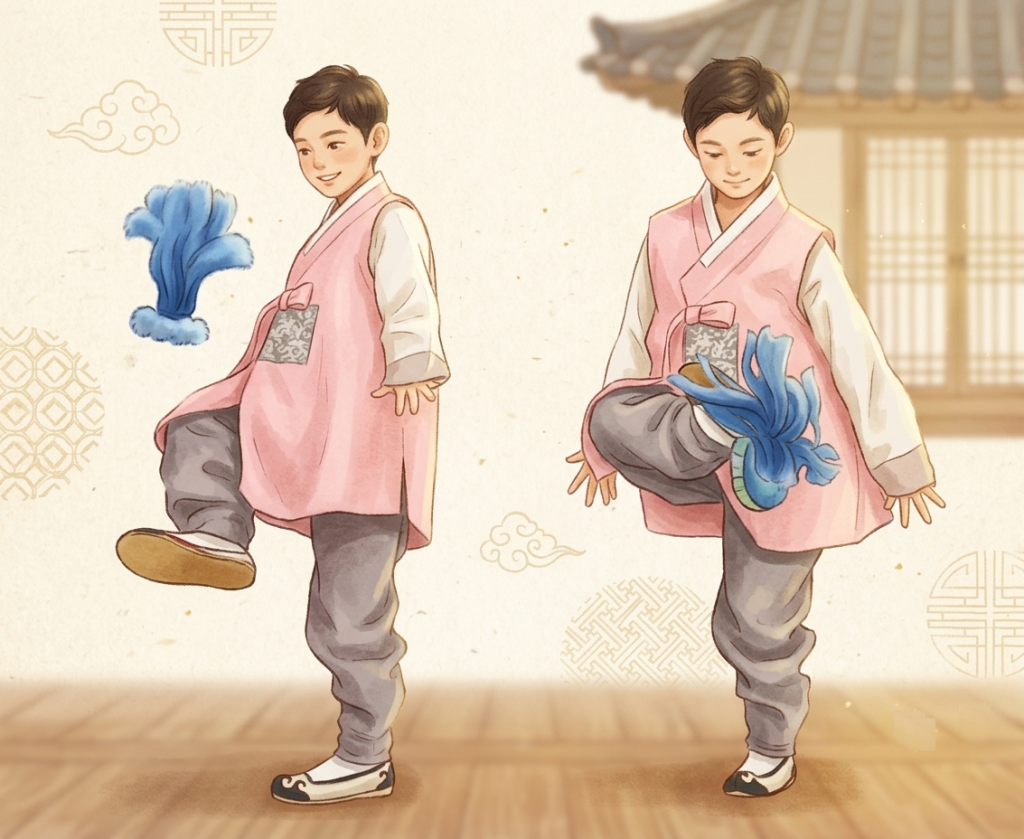
A weighted shuttlecock kept in the air with the inside of your foot. English coverage almost always calls it “Korean hacky sack,” which gets the idea across but misses the object — a jegi has a heavy core, usually a coin, so it drops fast and straight rather than floating.
Also a winter game, for a practical reason: it keeps you warm. Kids counted every kick out loud, and the one who kept the jegi up the longest won.
What the Show Flattens: Seasons
Watching the pentathlon, you would think the Korean games in Squid Game all belong together. To a Korean, they don’t — they belong to different times of year.
- Winter — jegichagi and paengi chigi. Both are outdoor games that generate heat or need frozen ground.
- Warm months — biseokchigi and ddakji, played on dirt and pavement.
- Any season — gonggi, because it works indoors on a classroom floor.
Traditional Korean games were tied to the agricultural calendar, and the biggest ones clustered around holidays. Yutnori, for example, is a Lunar New Year game played by whole families rather than children alone — which is why it never appeared in Squid Game despite being the most widely played traditional game in the country.
One More Thing: Dalgona Is Not a Game
The honeycomb candy round is the most imitated scene from Season 1, and it is the one thing on this list that isn’t a traditional game at all.
Dalgona (달고나), also called ppopgi, is a street snack from the 1970s and 80s — melted sugar with a pinch of baking soda, pressed flat and stamped with a shape. The challenge of extracting the shape intact was a vendor’s promotion, not a folk game. If you did it, you got a second one free.
It’s worth separating because the other games are centuries old. Dalgona is roughly fifty.
Which of These Do Korean Kids Still Play?
Honestly, most of them are fading. Smartphones did to Korean playground games what they did everywhere else.
Gonggi is the clear survivor — cheap, indoor, and quick enough to fit into a ten-minute break. Ddakji has had a genuine revival since Squid Game aired, and you can now buy pre-made sets that would have been considered cheating when I was a child.
Jegichagi and paengi chigi mostly appear at school events and folk village demonstrations. Biseokchigi is the rarest of all; a Korean under thirty may know the name without ever having played it.
Where to Try Them
Most Korean folk villages and traditional culture centers keep a play area with jegi, tops, and ddakji available to visitors, and staff will usually show you the technique if you ask. The Korean Folk Village in Yongin and the National Folk Museum of Korea in Seoul both run hands-on programs.
The cheaper option: gonggi stones and a jegi cost almost nothing at any Korean stationery shop or online. They travel well, and they’re the two games you can practice alone.
The games in Squid Game were not chosen for their difficulty. They were chosen because nearly every Korean adult has played them, which is exactly what makes their use in the show unsettling.