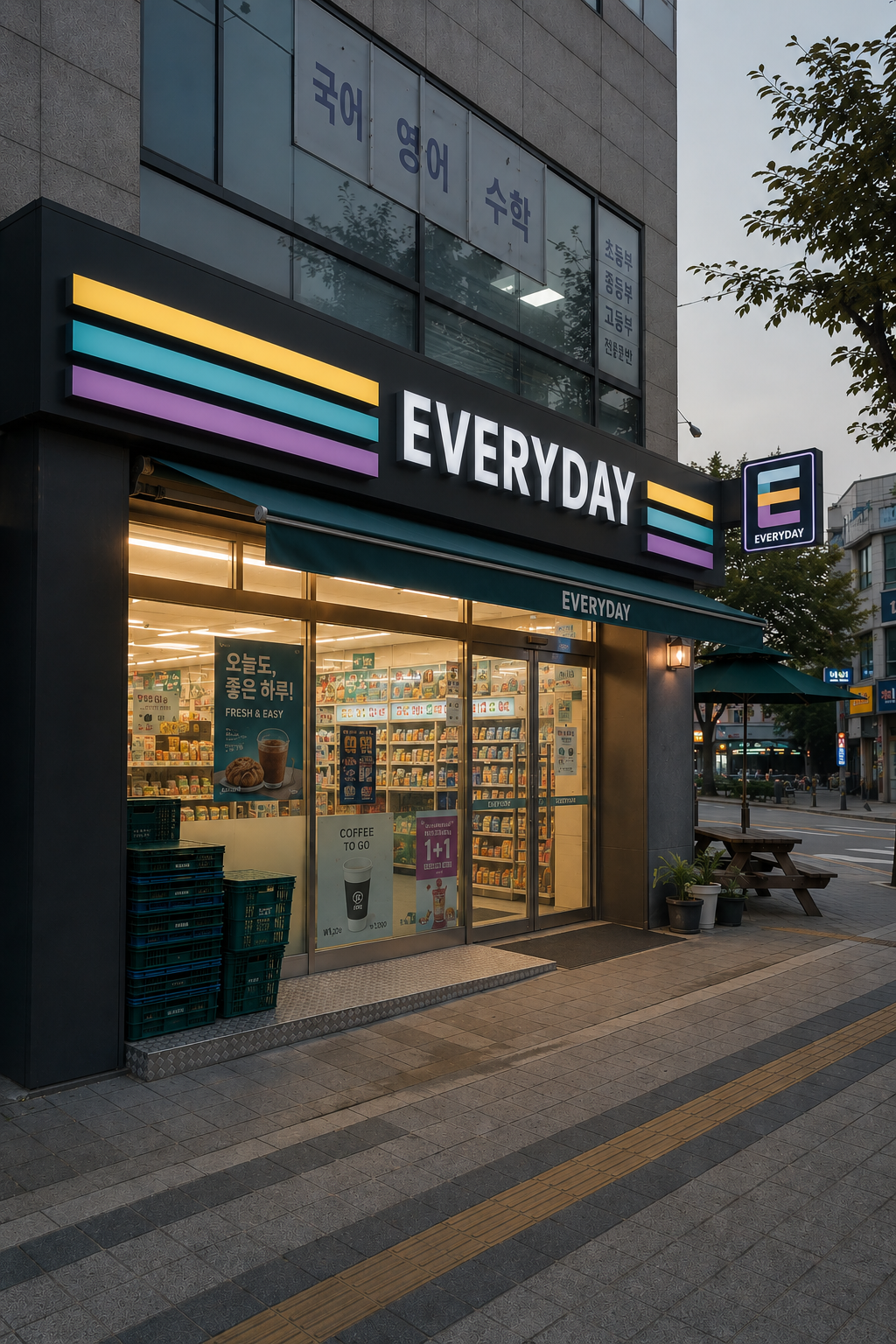
Korean convenience stores are not the same category of business as convenience stores in most countries. They are closer to a combination of a small grocer, a fast food counter, a cafe, a parcel office, and a place people genuinely eat meals — often at a counter by the window, at two in the morning.
There are roughly 55,000 of them in a country of 51 million people. In dense parts of Seoul you can stand at one intersection and see three. Understanding how to use them properly is one of the more useful things a visitor can learn.
The Four Chains
CU, GS25, 7-Eleven, and Emart24 dominate, and the differences between them are smaller than any Korean will admit. Each has its own exclusive products, and people develop preferences accordingly — a particular chain’s sandwich, another’s coffee.
For a visitor the practical difference is negligible. Whichever one is closest is the right one.
Yes, You Can Eat There
This is the part that surprises people most. Most Korean convenience stores have a seating area — a counter along the window, sometimes tables, sometimes an outdoor bench. It is not a grudging accommodation. It is expected use.
There will be a microwave, a hot water dispenser for instant noodles, and often a machine that boils water for you. Chopsticks, spoons, and hot sauce packets sit in a basket somewhere near them. All of it is free and self-service.
You buy your food, heat it yourself, eat it there, and clear your own tray into the bins provided. Nobody will serve you and nobody will hurry you along.
What to Actually Buy
Gimbap and Triangle Gimbap
The triangular rice parcel wrapped in seaweed — samgak gimbap (삼각김밥) — is the single most Korean thing in the store. Tuna mayo is the default and outsells everything else by a wide margin.
The wrapper has numbered tabs and a specific opening sequence printed on it, designed to keep the seaweed dry and crisp until the moment you eat. Pull tab 1 around the middle, then tabs 2 and 3 to slide the plastic out from either side. Doing it wrong tears the seaweed, and everyone does it wrong the first time.
Full rolls of gimbap are also sold in the chilled case, usually cheaper and less carefully made than at a dedicated shop, but perfectly good.
Ramyeon
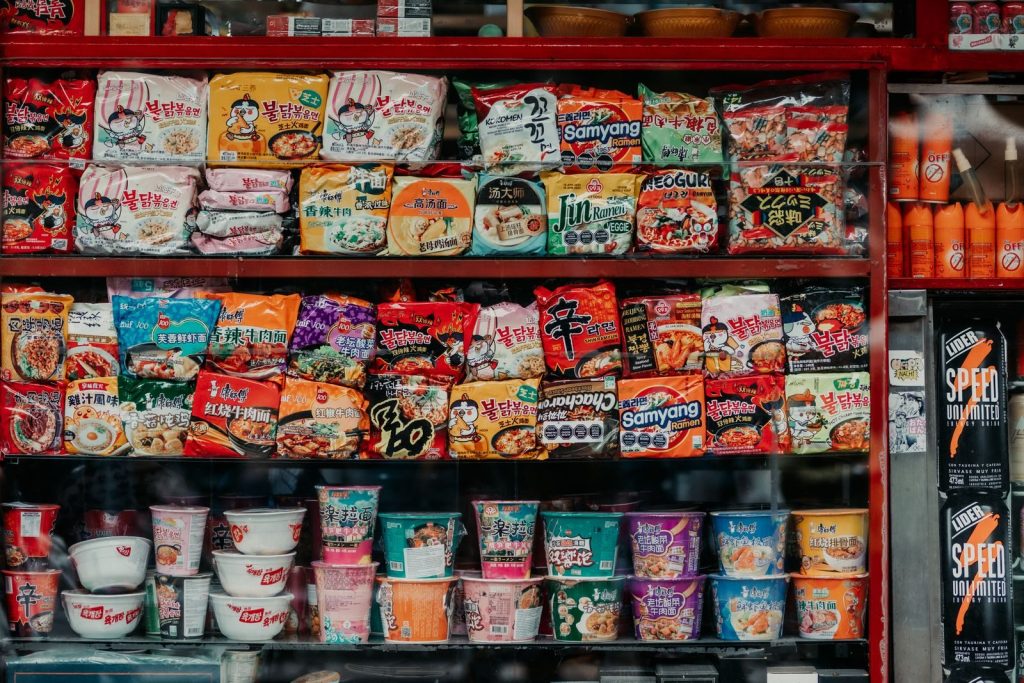
Instant noodles at the store are cheaper than almost any other hot meal in Korea, and the setup is built for them. Some locations have a dedicated ramyeon machine that fills the cup with boiling water at the press of a button.
The standard local upgrade is to add a triangle gimbap on the side, and to crack an egg in if the store sells them singly. Many do.
Dosirak
Dosirak (도시락) are boxed meals — rice, a main protein, and several side dishes in one compartmented tray. Roughly the price of a coffee in most Western cities, microwaved in ninety seconds, and genuinely a full meal.
These are what Korean office workers and students actually eat when they are short on time or money. Quality varies by chain and by how recently the delivery arrived; check the date sticker.
The Rest
- Hotbar — a fish cake sausage on a stick, sold hot near the register.
- Steamed buns — jjinppang and pizza buns, in a heated glass case in winter.
- Banana milk — the round-bottomed bottle is a national institution, and there is no Korean childhood without it.
- Instant coffee — cheap machine coffee at most locations, plus canned and bottled options.
- Soju and beer — sold at all hours, and legal to drink at the outdoor tables.
The 1+1 System
Shelf tags marked 1+1 mean buy one, get one free. 2+1 means buy two, get three. These run constantly and rotate weekly.
Two things worth knowing. The free item must be the identical product, not a different flavor of the same brand — though some promotions allow swaps within a range, and the tag will say so. And if you only want one, you still pay the same price, so take the second one even if you have to give it away.
Each chain runs an app that stacks additional discounts on top of these, but for a short visit it is not worth the signup friction.
Things You Did Not Know You Could Do There
- Send and receive parcels. Convenience store delivery pickup is standard in Korea, and cheaper than door-to-door.
- Withdraw cash. ATMs are in nearly every store, though foreign card acceptance varies — machines marked “Global” are your best bet.
- Charge a transit card. Top up your T-money at the counter with cash.
- Buy concert and event tickets. Through the in-store kiosk, though the interface is Korean-only.
- Pay utility bills. With a barcoded invoice.
Practical Notes
Almost all are 24 hours, though a growing number of locations in quieter areas now close overnight due to labor costs. The door will say.
Bags cost money. Korea charges for plastic bags at retail, usually 50 to 100 won. You will be asked; if you say nothing you will not get one.
Cards work everywhere, including for a single 700-won item. Nobody will look at you strangely for it.
Alcohol requires ID if you look under 30, and foreign ID is accepted — a passport works, a photo of your passport does not.
They are also where you buy official rubbish bags. Korea sells volume-based waste bags through convenience stores, and they are valid only in the district that issued them — see our guide to Korean waste separation.
Why It Works
The Korean convenience store makes sense as a product of very high density, very long working hours, and a large population of people living alone. When your commute is long, your apartment is small, and you get home at eleven, a store downstairs that sells a hot meal for four dollars and lets you eat it there is not a convenience. It is infrastructure.
That is also why the food is better than it has any right to be. These stores are competing for people who eat there several times a week, not for tourists buying a snack.
If you are eating your way through Korea, spend one meal in a convenience store. Not as a novelty — as the thing a lot of Koreans are actually doing at that hour. For the sit-down version, see how Korean restaurants work.
Convenience store seating solves a quick meal, but for anything longer — a two-hour conversation, an afternoon of work — the default is a cafe instead. The unwritten rules there are different, and Korean cafe culture has its own ordering sequence worth knowing before you walk in.
Convenience store ovens have quietly become the modern successor to the old drum cart — Korean street roasted sweet potato covers where that shift came from and why the texture still isn’t quite the same.
Bungeoppang has quietly joined the lineup too — bungeoppang covers why the street cart version is disappearing while the convenience store version keeps showing up.
Convenience stores aren’t the only source of cheap, fast Korean food — street carts sell snacks like Korean egg bread for about the same price, and hotter.