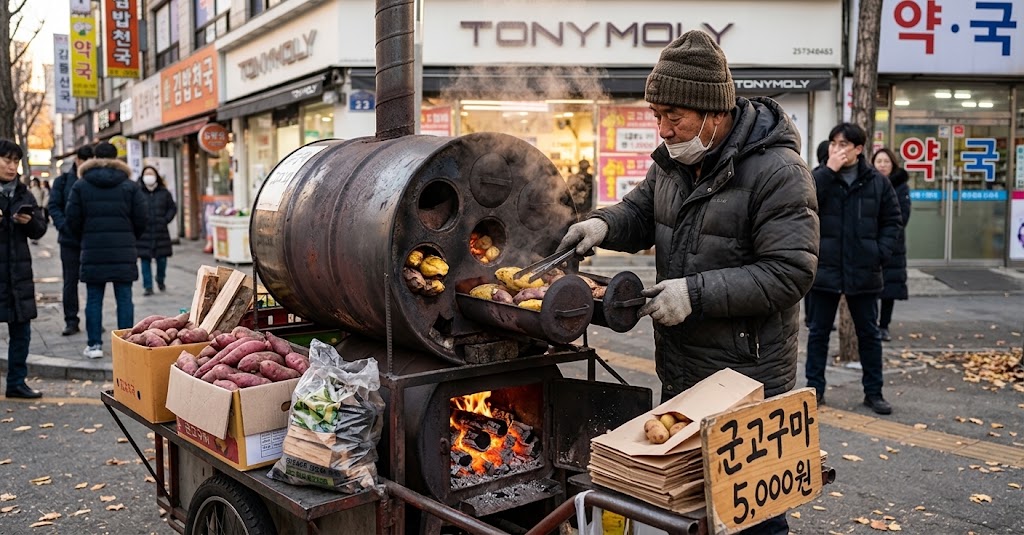
The smell reaches you before the cart does — something between caramel and woodsmoke, drifting from a rusted oil drum punched with holes and mounted on a wheeled cart. I remember passing one as a kid, an old man tending a fire inside the drum, and stopping just to breathe it in. Korean street roasted sweet potato, gun-goguma, has always been as much about that smell as the sweet potato itself.
The Drum, Not the Oven
The classic setup is a repurposed oil drum, punched with air holes and fitted with a small door, mounted on a hand cart (리어카) so the whole operation can move. Inside, wood or charcoal burns slowly, and the sweet potatoes sit on a rack above or beside the fire rather than directly in it — closer to slow indirect heat than a grill.
That slowness is the whole point. Roasting draws moisture out of the sweet potato rather than steaming or boiling it in, which is why a properly drum-roasted sweet potato turns sticky and intensely sweet at the center, closer to candy than to a baked potato. It’s also why the drum-cart version has a different texture than the ones sold in convenience store ovens today, even when the same variety of sweet potato is used.
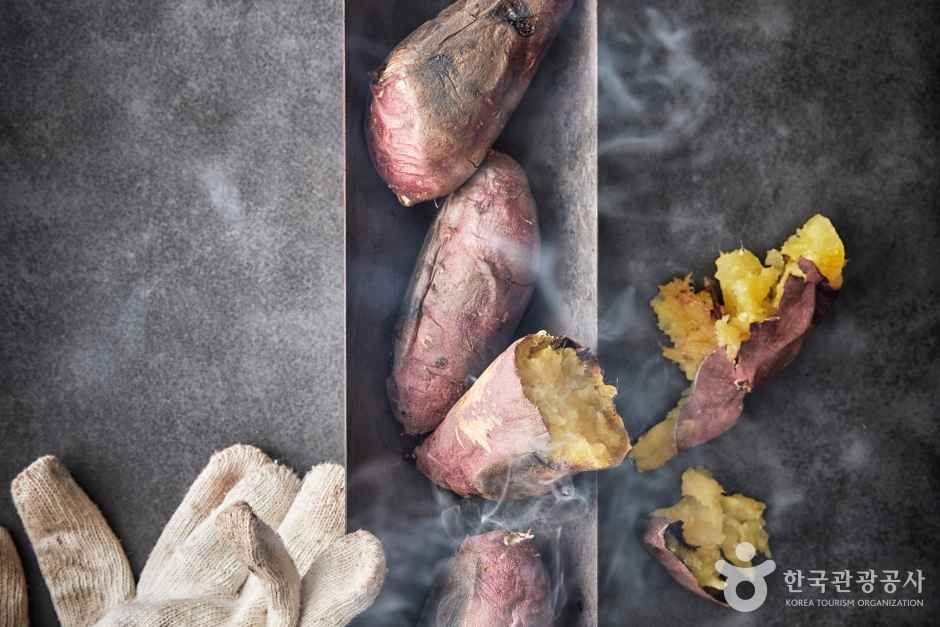
Source: ⓒKorea Tourism Contents Lab-Alex Bundo
Who Used to Sell It
Ask almost any Korean who grew up before the 2000s about this, and two images come up side by side. One is an older vendor doing hard, low-margin work through the coldest months out of real necessity — the image I grew up with, watching a grandfather-aged man tending the fire. The other is university students on winter break, who saw the drum cart as a cheap way into a season of decent, low-capital income — buying a drum and a cart, setting up on a corner, and treating it as a short, profitable side hustle rather than a fallback.
Both were common at the same time. It wasn’t purely a symbol of hardship, even though that’s the association most people reach for first.
Why Winter, Specifically
Sweet potatoes actually get sweeter as the weather turns cold — the starches convert to sugar more as the temperature drops, which is part of why gun-goguma is strictly a cold-weather food rather than a year-round snack. Combine that with a hot, sticky treat being far more appealing on a freezing street than in summer heat, and the seasonal nature of the business isn’t really a marketing choice. It’s baked into the ingredient itself.
Alongside bungeoppang (fish-shaped pastries) and hotteok (sweet filled pancakes), roasted sweet potato rounds out the trio of street snacks that mark the start of a Korean winter almost as reliably as the first cold snap does.
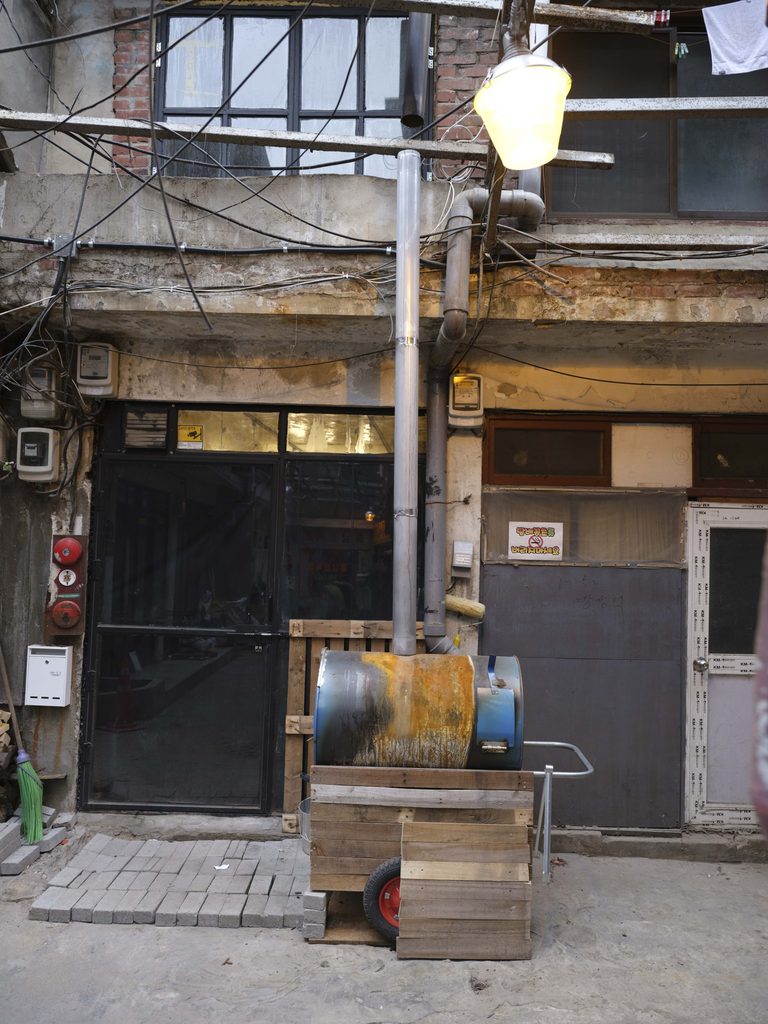
Photo: [한기에] via 공유마당 (CC BY 4.0).
What’s Changed
What’s actually changed isn’t who runs the cart — it’s whether the math still works. Sweet potato prices have climbed sharply in recent years, and vendors who’ve stuck with it report thin margins or outright losses once fuel and time are factored in. Drum manufacturers have felt it too: businesses that once sold dozens of carts each winter now struggle to move a handful, a fairly direct sign of how much the street version has shrunk.
The oven-and-roasting-stone method common in convenience stores today survives partly because it doesn’t depend on a single vendor standing outside in the cold making the economics work. The drum cart, when you do spot one, is closer to a holdout than a growth business.
Where to Find One Today
Traditional markets and older residential neighborhoods are still your best bet — the kind of streets where a single vendor sets up in the same spot every winter, rather than a rotating cart. Failing that, most convenience stores now sell oven-roasted sweet potatoes year-round, though the texture and that drum-roasted stickiness won’t quite be the same.
If gun-goguma is the smell of a Korean winter street, bungeoppang is the sound of one — the sizzle of batter hitting a fish-shaped mold is just as unmistakable, and just as seasonal.
Winter street food’s other classic is fish-shaped rather than root-shaped — bungeoppang has its own IMF-era origin story and its own modern squeeze.
Sweet potatoes aren’t the only thing keeping Koreans warm in winter — Korean egg bread is the other cart snack you’ll see everywhere from October through March.