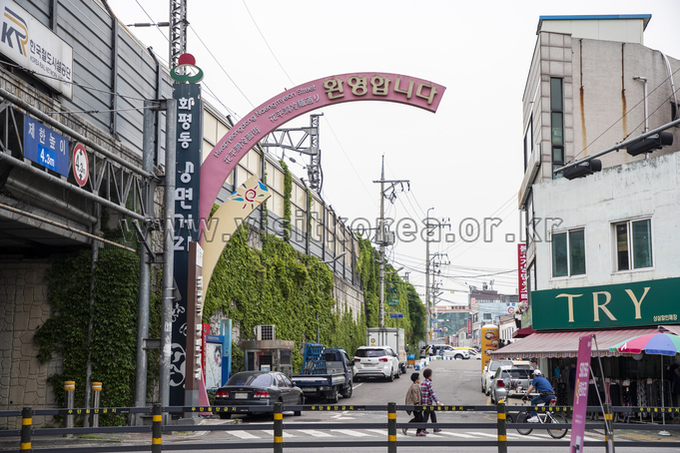
Ask anyone who grew up in Incheon about a bowl of naengmyeon the size of a wash basin, and they’ll know exactly what you mean without needing an explanation. I ate at Hwapyeong-dong naengmyeon street myself, years ago now — the memory that’s stuck isn’t the taste so much as the sheer size of the bowl arriving at the table, wide enough that it genuinely looked like something you’d wash your face in.
Where the “Wash Basin” Name Comes From
The street’s nickname, sesutdaeya naengmyeon (세숫대야 냉면) — literally “wash-basin naengmyeon” — isn’t a marketing gimmick. It describes the bowl with total accuracy. A wash basin, in the older Korean sense, is a wide metal bowl used for washing your face before running water reached every home, and the naengmyeon bowls here are built on roughly that same scale — reportedly close to 30 centimeters across at the shop where it started.
This isn’t how naengmyeon has traditionally been served anywhere else in Korea. The oversized bowl is a Hwapyeong-dong invention, and one specific to this neighborhood’s history.
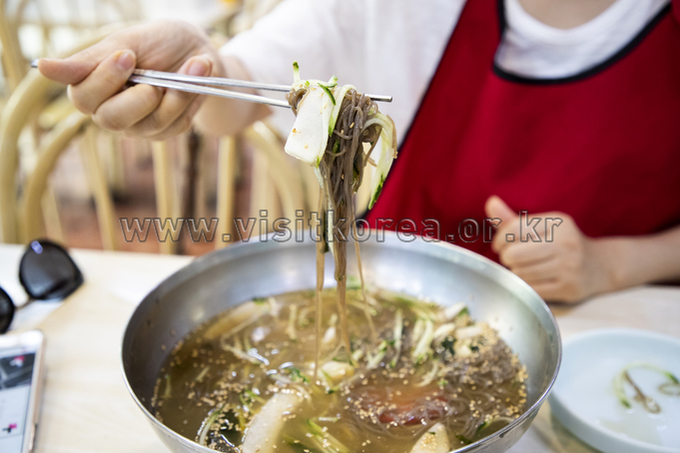
Photos: Korea Tourism Organization (KOGL Type 1).
The Story Behind the Bowl
Hwapyeong-dong and the neighboring district of Hwasu-dong grew up as worker housing for the factories and docks that lined this part of Incheon from the postwar years into the early 1990s — heavy industry names like Korea Machinery and Hyundai Steel had operations nearby, and the workers who lived here were doing hard physical labor on modest wages.
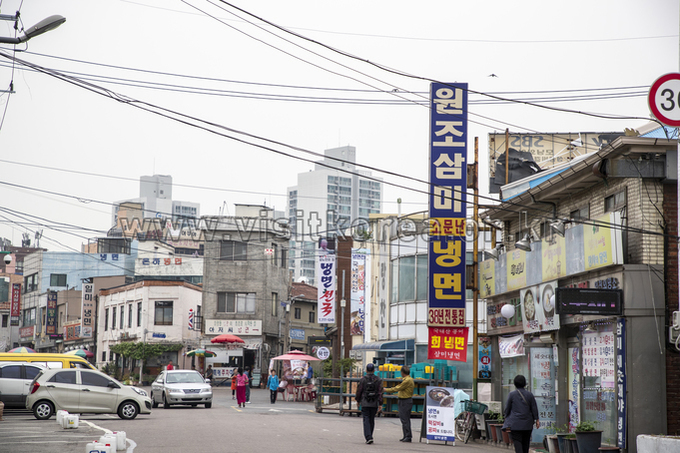
The street’s naengmyeon shops trace back to the 1970s, when a shop now known as “Ajeossi Naengmyeon” started serving noodles near the rail line. Factory workers, hungry after long shifts, kept asking for extra noodles on top of their order. Rather than charging more for refills, the shop’s owner eventually built a wider bowl and simply served a bigger portion from the start — generosity solved with tableware rather than a price increase. Other naengmyeon shops opened nearby using the same idea, and the street grew around that one decision.
Some shops today have taken it further, offering unlimited noodle refills on top of the already oversized bowl — a modern twist on the same instinct that started the place.
Not Just a Novelty
It would be easy to write this off as a photo-op gimmick, and plenty of visitors do treat it that way now. But the size of the bowl only makes sense once you know who it was originally for: people doing physically demanding work who needed real calories, not a dainty presentation. The oversized bowl was never about spectacle. It was about making sure a factory worker’s lunch actually filled them up.
That context is largely what’s missing from the version of this story that circulates as a quirky “have you seen this” photo online. The bowl is famous nationwide in Korea specifically because of the story behind it, not despite it.
Getting There
The street sits a short walk from Dongincheon Station — the same station covered in more depth in our guide to Dongincheon Station, which sits at the center of this whole cluster of old Incheon neighborhoods. From Exit 4, head in the direction of Incheon Station and the naengmyeon shops appear within a few minutes on foot.
It sits close enough to Sinpo International Market and Incheon Chinatown that all three fit into a single afternoon of walking, if you want to cover the old port district in one visit.
What to Expect
Naengmyeon is a cold, chewy buckwheat noodle dish, traditionally served in a tangy iced broth or with a spicy sauce depending on the style. What’s different here isn’t the recipe — it’s entirely the scale. Come with an appetite, or better yet, come with someone to split a bowl with, because a single order here is built for the kind of hunger that follows an eight-hour shift, not a light lunch.
The street is at its best in summer, when the cold broth actually makes sense against Incheon’s heat, though the shops run year-round.
Why This Street Is Worth the Detour
Hwapyeong-dong doesn’t have a landmark gate or a mural street to photograph. What it has is a specific, well-documented piece of working-class Incheon history sitting quietly a few minutes from a subway exit, still serving the same oversized bowl it invented decades ago. If you’ve spent the morning at Chinatown’s more polished, tourist-facing streets, this is the version of Incheon that grew up around a shipyard instead of a gate.
It’s the kind of place every long-time Incheon resident already knows about, and almost no one outside the city has heard of — which, if you’re the kind of traveler drawn to Hidden Korea over the postcard version, is exactly the point.
Both streets share the same working-class winter economy — Korean street roasted sweet potato covers the other classic cold-weather hustle, the drum cart, and why it’s disappearing faster than the noodle bowls are.
Bungeoppang and gun-goguma share the same worn economics as this street’s oversized bowls — bungeoppang is the other classic cold-weather hustle now getting harder to find.
Both places share the same unglamorous, working-class character — Moraenae Market covers another corner of Incheon that grew up serving its own neighborhood rather than visitors.