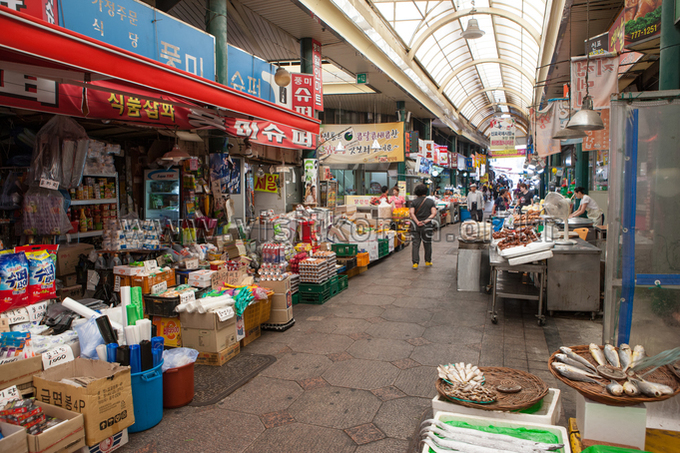
Sinpo International Market has a claim most Korean markets cannot make: two dishes that are now sold in every corner of the country were either invented here or made famous here.
One of them was an accident. The other was a small shop’s idea that spread nationwide without anyone planning it. Neither is marked with a plaque, and the market makes almost no fuss about either.
That is the character of the place. It sits in Jung-gu, Incheon, a ten-minute walk from Chinatown, and it has been feeding this part of the city for well over a century.
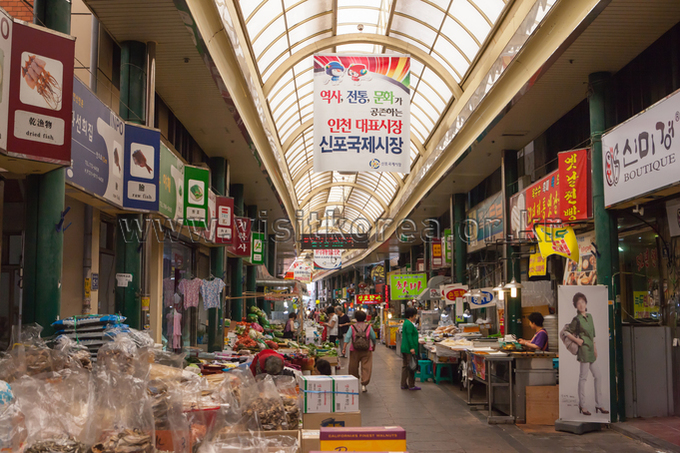
Photo: Korea Tourism Organization (KOGL Type 1)
Why It Is Called “International”
The name is not marketing. It is history.
When Jemulpo — the old name for this port — opened to foreign trade in 1883, Incheon filled up with people who were not Korean. Chinese merchants, Japanese traders, Western missionaries and diplomats all settled within a few streets of each other, and all of them needed to eat.
Chinese farmers began growing vegetables on the outskirts and selling them here. The market grew around that trade, serving a customer base that spoke several languages before most Koreans had ever met a foreigner. The word gukje (국제), meaning international, stuck.
Very little of that is visible now. What remains is the location — a market that grew up around a port rather than a village, which is why it sits where it does.
The Noodle That Was a Mistake
Jjolmyeon (쫄면) is a cold noodle dish: thick, chewy wheat noodles under a fiercely red-orange sauce, served with shredded cabbage, cucumber, bean sprouts, and half a boiled egg. You mix it yourself until everything is coated.
The origin story, widely credited to a noodle factory in Incheon in the early 1970s, is that the noodles came out wrong. A machine was set incorrectly and produced strands far thicker and chewier than the intended naengmyeon. Rather than throw the batch out, it was passed to a nearby restaurant, which served it cold with a spicy sauce.
The texture is the entire point. Jjol describes exactly that springy resistance, and the dish is named after it. What was a defect became the selling point.
Whether every detail of that account holds up is debated, but Incheon’s claim to the dish is not seriously contested, and this is the part of the city where it started.
Sinpo Dakgangjeong
The other export is dakgangjeong (닭강정) — bite-sized fried chicken tossed in a sticky sweet-and-spicy glaze, usually with peanuts.
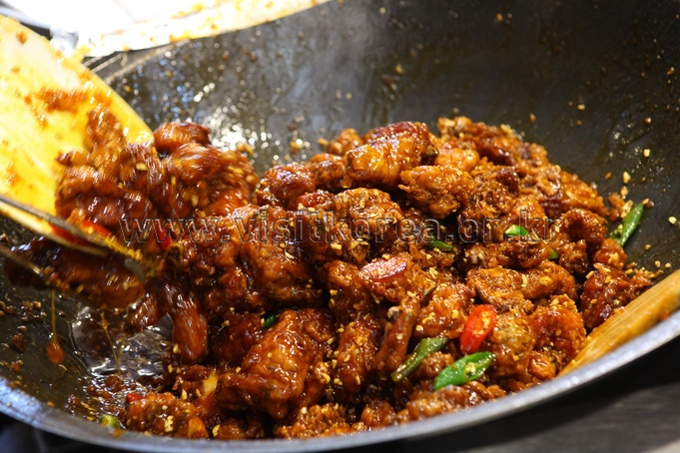
Photo: Korea Tourism Organization (KOGL Type 1)
It is not the same thing as Korean fried chicken served with beer. Dakgangjeong is boneless, heavily glazed, and eaten cold as often as hot, which is why it travels well and why it is sold by the box rather than the plate. The Sinpo version became well known enough that the market’s name now functions as a shorthand for the style.
Expect a queue at the busiest stalls, especially on weekends. The chicken is fried in advance and glazed to order, so the line moves faster than it looks.
Gonggalppang, the Bread That Is Mostly Air
Gonggalppang (공갈빵) is a flat, palm-sized round of baked dough with a caramelized sugar layer inside — and almost nothing else. The dough puffs up in the oven and stays hollow.
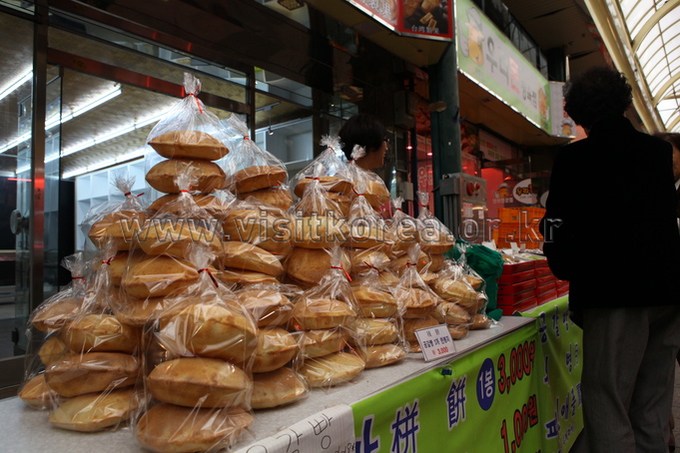
Photo: Korea Tourism Organization (KOGL Type 1)
The name translates roughly as “bluff bread” or “lie bread,” because it looks substantial and turns out to be a shell. It arrived with Chinese bakers, which makes sense given how close Chinatown is, and it is the kind of snack that exists mostly in old market districts now.
Eat it immediately. It goes soft within the hour.
What Else Is There
Beyond the three famous items, this is a working market rather than a food theme park:
- Mandu — steamed and fried dumplings, sold by the tray
- Tteokbokki — the market version tends to be soupier than the chain version, and worth trying alongside the standard tteokbokki you’ll find elsewhere
- Prepared side dishes — tubs of seasoned vegetables, braised things, and pickles sold by weight
- Produce, fish, and butchers — the part tourists walk past, and the reason locals actually come
- Fried snacks — squid, sweet potato, vegetable fritters, sold hot from the pan
Bring cash. Cards work at most stalls now, but small vendors are quicker with cash and some will round down for it.
This Was the Center of the City
Sinpo Market is quiet enough now that it is easy to miss what it used to be. In the 1980s and early 1990s, this district was where Incheon went out.
The market and the streets around it held the clothing shops teenagers saved up for, the record stores, the cinemas, and the nightlife. If you were young in Incheon in that era, you came here on a Saturday, and the whole city seemed to be doing the same.
Most of that has drained away. Retail moved to Songdo and Bupyeong, young people followed, and the old downtown thinned out. What is left is a market that still works, still draws visitors from outside the city, and carries the slightly worn feeling of somewhere that used to be the main event.
That is not a sad story so much as an ordinary one. Every Korean city has a district this happened to. Sinpo is just unusually easy to read, because the market survived while everything around it changed.
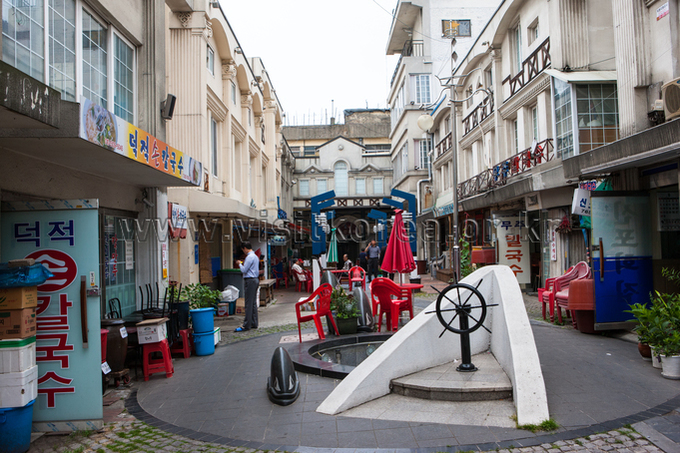
Photo: Korea Tourism Organization (KOGL Type 1)
Going With Chinatown
Almost nobody visits Sinpo Market alone, and that is the right instinct. Within about fifteen minutes on foot you have:
- Incheon Chinatown — the only official Chinatown in Korea, and where jjajangmyeon was invented
- Jayu Park — a hillside park above the port with a view over the container terminals
- The Open Port district — Japanese-era bank buildings and colonial architecture, preserved along a few blocks
Half a day covers all four comfortably. The market is the eating stop; Chinatown is the sitting-down-for-a-meal stop.
Everything Within Walking Distance
Sinpo Market is the eating stop in a cluster of things you can cover on foot in half a day.
The Open Port district. Walk past the back of the market and the streets change. This area was the Japanese settlement after the port opened, and a number of the buildings survive — banks, offices, and merchant houses in a Japanese colonial style you will not see much elsewhere in Korea. Several are now small museums. It is a short, strange few blocks.
Incheon Chinatown. Keep going in the same direction and you reach the only official Chinatown in Korea, where jjajangmyeon was invented. Ten minutes on foot from the market.
Jayu Park. Uphill from the market is Jayu Park — literally “Freedom Park” — with a view over the port and the container terminals below. The statue of General Douglas MacArthur stands here, commemorating the 1950 Incheon Landing during the Korean War, which took place in these waters.
The geography does the work for you. Market, colonial district, Chinatown, and park sit in a rough line, and you can walk the whole thing without planning a route.
Getting There
Getting There: Two Ways In
Take Seoul Subway Line 1 to Dongincheon Station and leave through Exit 1 — the only exit on the south side of the tracks. The market is about a ten-minute walk southwest, signposted in Korean and English once you are in the neighborhood.
Above ground
Leave through Exit 2 or Exit 3, cross the road, and walk straight ahead. About ten minutes. Simple, and you get to see the neighborhood on the way.
Underground — the better option
Do not leave the station at all. From the ticket gates, follow the signs into the Dongincheon underground arcade, which runs continuously from the station all the way to the market. Walk the length of it and come out at Sinpo Underground Arcade Exit 28. You emerge directly at the market entrance.
This matters in July and in January. The walk is entirely climate-controlled, it is lined with shops the whole way, and it puts you at the front door rather than three streets away. Nobody tells visitors this because nobody thinks to.
Once you are out of Exit 28, the famous dakgangjeong shops are visible almost immediately — you do not have to hunt for them. Past those, the gonggalppang bakers, then clothing stalls, then the ordinary market of produce, fish, and side dishes.
When to Go
| Time | What it’s like |
|---|---|
| Weekday morning | Quiet. Produce and fish at their best |
| Weekday afternoon | Best balance — stalls open, no queues |
| Weekend afternoon | Busiest. Expect lines for dakgangjeong |
| Evening | Many stalls close earlier than you’d expect |
Individual vendors set their own hours and many close one day a month. Check before making a special trip for one specific stall.
Worth It?
If you have three days in Korea, no. This is not a substitute for anything in Seoul.
If you are staying longer, or you land at Incheon Airport with time before your onward train, or you want to eat two dishes in the place they came from — then yes. And the cluster is what makes it worth the hour: a market, a colonial quarter, a Chinatown, and a hilltop park, all inside a fifteen-minute walk of each other.
Come out of Exit 28, eat the chicken first, and work outward from there.
For more of this side of the city, Bupyeong Station and its underground arcade and Juan Station’s food alley work on the same principle at different scales.
Incheon Chinatown is about fifteen minutes west on foot, and it pairs well with a market visit in either order. Our guide to Incheon Chinatown covers what to eat there and why the neighborhood is not what most visitors expect.
The station at the other end of the underground arcade is worth an hour on its own. Within ten minutes of Dongincheon Station you’ll find the first Methodist church built in Korea, the oldest cinema in the country, and a red brick cathedral from 1897.
For a market of a completely different kind, Sorae Port on the southern edge of Incheon sells seafood straight off the boats — though prices there are negotiated rather than posted.
If wash-basin-sized portions sound like your kind of excess, Hwapyeong-dong’s naengmyeon street is a short walk from here and worth adding to the same afternoon.
If Sinpo shows the more polished, visitor-facing side of an Incheon market, Moraenae Market is the version locals actually shop at.
After eating, walk off the dakgangjeong with a climb up the hill behind the old port. Jayu Park, Korea’s first Western-style park, is a short walk away and has one of the best views of the harbor in the city.