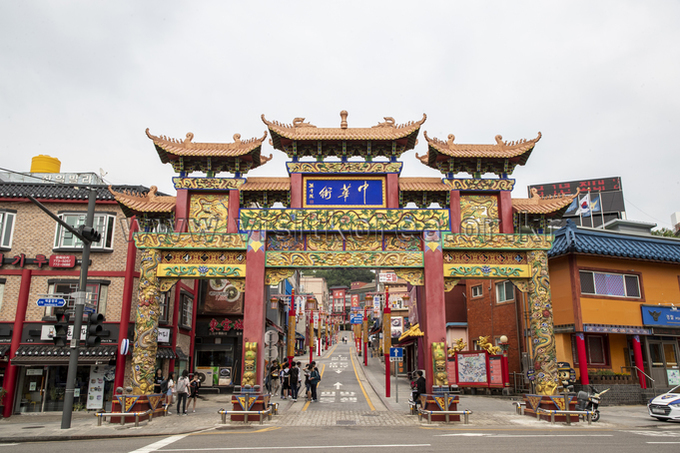
Most foreign visitors to Korea skip Incheon Chinatown for a simple reason: a Chinatown in Korea sounds redundant. If you have already seen the ones in San Francisco or London, why spend an hour on the subway for a smaller version?
That logic misses what this place actually is. Incheon Chinatown is not an outpost of China. It is the neighborhood where Chinese immigrants became Korean, and where they invented the single most-eaten noodle dish in the country. Almost nobody who lives here now is Chinese. That is not a disappointment — it is the whole story.
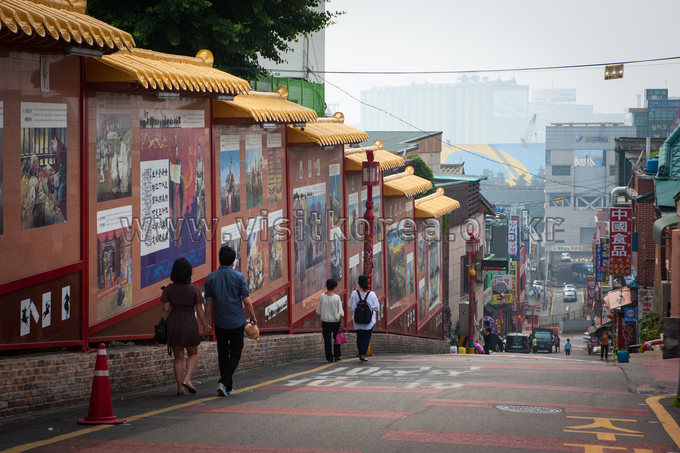
Photo: Korea Tourism Organization / Kim Ji-ho (KOGL Type 1)
What Incheon Chinatown Actually Is
Incheon opened as a treaty port in 1883. Japan established a settlement that year, and Qing China established one the following year, on the hillside just above the harbor. Chinese merchants and laborers from Shandong arrived, and for a few decades the district was genuinely Chinese — shops, schools, a consulate, families.
Then the community shrank. Through the mid-twentieth century, economic restrictions on foreign residents pushed many families to emigrate to Taiwan, Hong Kong, and the United States. The ones who stayed became hwagyo (화교) — ethnic Chinese who have lived in Korea for three or four generations, speak Korean as a first language, and in many cases have never lived in China.
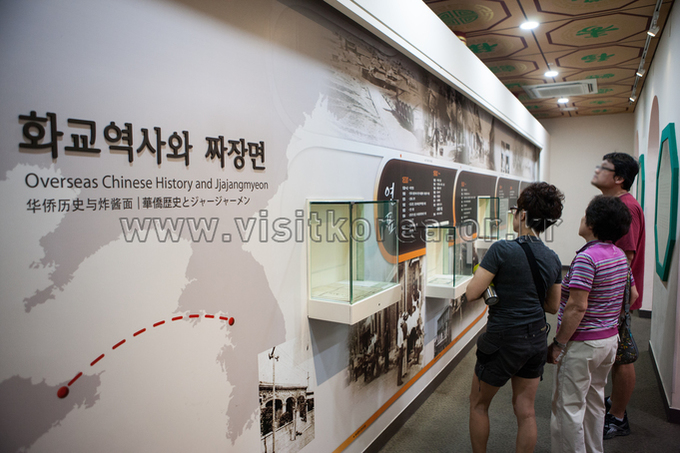
Photo: Korea Tourism Organization / Kim Ji-ho (KOGL Type 1)
So when you walk through the paifang gate today, you are not walking into a Chinese neighborhood. You are walking into a Korean neighborhood built by people whose great-grandparents came from Shandong. The signage is bilingual, the food is Korean-Chinese, and the crowd on any given Saturday is overwhelmingly Korean families on a day trip.
The Dish That Was Invented Here
Jjajangmyeon (짜장면) is wheat noodles under a thick black sauce made from fermented soybean paste, pork, and onion. It is the default cheap meal of Korean life — moving day, payday, the thing you order when nobody wants to decide.
It is not Chinese food. This is the part English-language guides usually get wrong. There is a Shandong dish called zhajiangmian that shares an ancestor, but the Korean version — sweeter, glossier, made with caramel-darkened chunjang — was developed here in Incheon for dock workers, and it does not exist in China in this form. Ordering it in Beijing will not get you what you had in Incheon.
The restaurant credited with it was Gonghwachun (공화춘), which opened in the mid-1900s and served the harbor for decades. It closed in 1983. The original brick building was designated a registered cultural heritage property in 2006, and in 2012 it reopened as the Jjajangmyeon Museum. Businesses using the Gonghwachun name in Chinatown today are separate operations — worth knowing before you assume the sign means you are eating in the original.
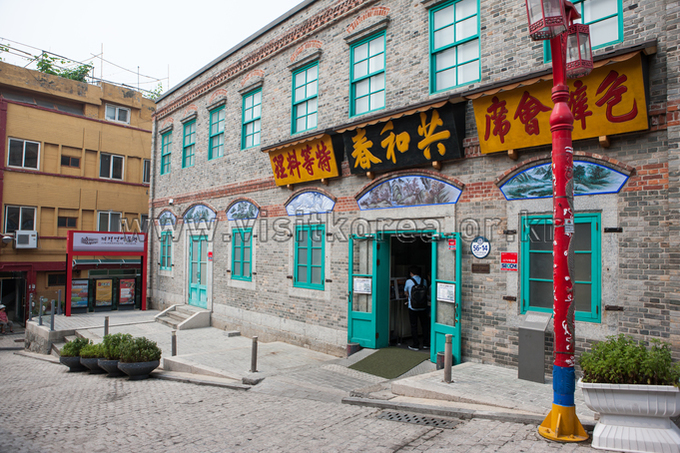
Photo: Korea Tourism Organization / Kim Ji-ho (KOGL Type 1)
Walking It: What You Will Actually See
The neighborhood is small. From the gate to the far end is maybe fifteen minutes at a slow pace, and it is all uphill, which surprises people. The main street is lined with two- and three-story buildings in red and gold, most of them restaurants, and the smell that carries down the hill is frying oil and caramelizing soybean paste.
Two things are worth slowing down for. The first is Samgukji Mural Street, a long painted wall retelling Romance of the Three Kingdoms panel by panel, with Korean captions. The second is the boundary stairway between the old Qing and Japanese settlements — a stone staircase where the lanterns on the left side are Chinese in style and the ones on the right are Japanese, because the two concessions met exactly there. A statue of Confucius sits at the top. It is the clearest physical trace of the 1880s left in the city.
Weekends are crowded in a specific way: slow-moving family groups, queues outside the better-known restaurants, and a lot of people photographing the gate. A weekday morning is a completely different neighborhood.
What to Eat Besides Jjajangmyeon
Have the noodles — that is the point of coming. But do not stop there.
- Jjamppong (짬뽕) — the red, seafood-heavy noodle soup that shares every menu with jjajangmyeon. Order one of each if there are two of you and swap halfway.
- Tangsuyuk (탕수육) — fried pork in sweet-and-sour sauce. Koreans argue endlessly about whether the sauce should be poured over or served on the side. Both camps are wrong; it does not matter.
- Hwadeok mandu (화덕만두) — buns baked against the wall of a clay oven rather than steamed. Crisp outside, and sold from street-facing counters.
- Gonggalppang (공갈빵) — a flat round pastry that is almost entirely hollow. It shatters when you bite it. Children love it; adults find it slightly absurd.
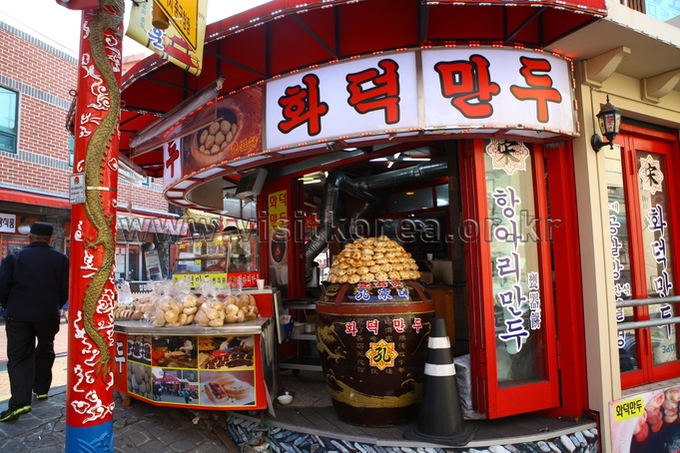
Photo: Korea Tourism Organization / Lee Beom-su (KOGL Type 1)
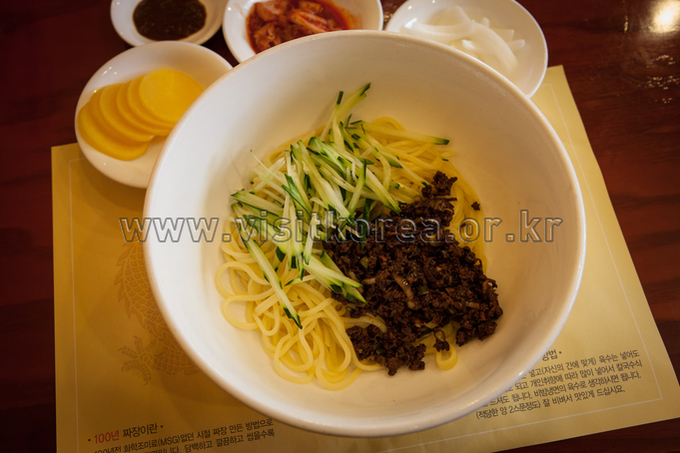
Photo: Korea Tourism Organization / Kim Ji-ho (KOGL Type 1)
If you want a sit-down meal, note that Korean-Chinese restaurants run on the same conventions as any other Korean restaurant — shared dishes, the call button on the table, water you pour yourself. Our guide to Korean restaurant etiquette covers what to expect.
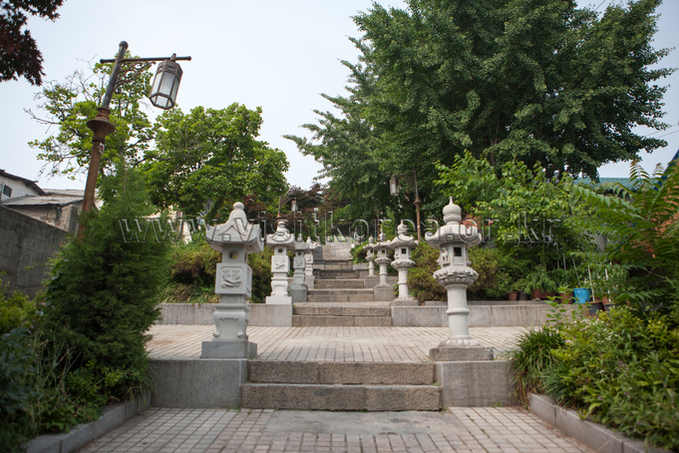
Photo: Korea Tourism Organization / Kim Ji-ho (KOGL Type 1)
What Is Right Next Door
The mistake is treating Chinatown as a destination in itself. It is one corner of a walkable historic district, and the rest of it is better than the gate.
Jayu Park sits directly above the boundary stairway. Established in 1888, it is generally described as Korea’s first Western-style park, and it looks down over the container terminals and the Yellow Sea. It is a short but genuinely steep climb. Our guide to Jayu Park covers the MacArthur statue, the view, and what the park meant to locals growing up here.
The Open Port district begins on the eastern side of the stairs — early twentieth-century bank and consulate buildings, several now small museums.
Songwol-dong Fairy Tale Village is a residential lane a few minutes north, repainted with storybook murals. It is aimed squarely at families and photo-takers, and it knows it.
Sinpo International Market is about a fifteen-minute walk east, and it is where I would send you for the second half of the day. Different food, fewer tourists, and the place jjolmyeon was invented. We covered it in detail in our guide to Sinpo International Market.
How to Get There
Incheon Chinatown is easier to reach than its distance suggests, because it sits at the end of a single subway line and requires no transfers from most of western Seoul.
Take Line 1 to Incheon Station — the last stop on the line — and leave through Exit 1. The paifang gate is directly across the road, roughly thirty seconds from the turnstiles. There is no walking to do and nothing to find. From Seoul Station the ride is a little over an hour.
Incheon Station is also served by the Suin-Bundang Line, which is useful if you are coming from the eastern side of the metropolitan area. If you are unfamiliar with how the line works, our guide to Incheon Subway Line 1 explains the branches and where they split.
Before You Go
- Go on a weekday if you can. Saturday afternoon is the peak of the peak.
- Wear shoes you can climb in. The neighborhood and the park are both on a hill.
- Check opening hours in advance. Museum and restaurant hours change, and several places close one weekday a month.
- Bring a card, but carry some cash. Cards work almost everywhere; a few street counters are faster with cash.
Why It Is Worth the Hour
Incheon Chinatown will not overwhelm you. It is six or seven streets on a hillside, and you can see all of it in an afternoon. What it offers is something the bigger Chinatowns cannot: a place where you can stand on a staircase that used to be an international border, eat a dish that was invented two hundred meters away, and understand that it became Korean somewhere along the way.
That is a more interesting hour than most things you can do in Seoul with the same hour.
Official visitor information for the district is available from the Incheon Jung-gu tourism office.
That expertise travelled. When the colonial government built the salt farm at Sorae Port in the 1930s, much of the construction was carried out by Chinese salt-making technicians drawn from this community.
For a rougher, working-class version of old Incheon just a few minutes further out, Hwapyeong-dong’s naengmyeon street tells a very different story than Chinatown’s gate and murals.
For a market with none of the tour-group polish, Moraenae Market sits further out in Namdong-gu and has stayed a working neighborhood fixture for over 40 years.
Incheon Station also leads the other way — see our guide to Wolmido, the seaside strip with the rides, the ferry pier, and a traditional garden almost nobody walks to.