Jjimjilbang etiquette confuses most first-time visitors, and the confusion usually starts at the front door — with your shoes.
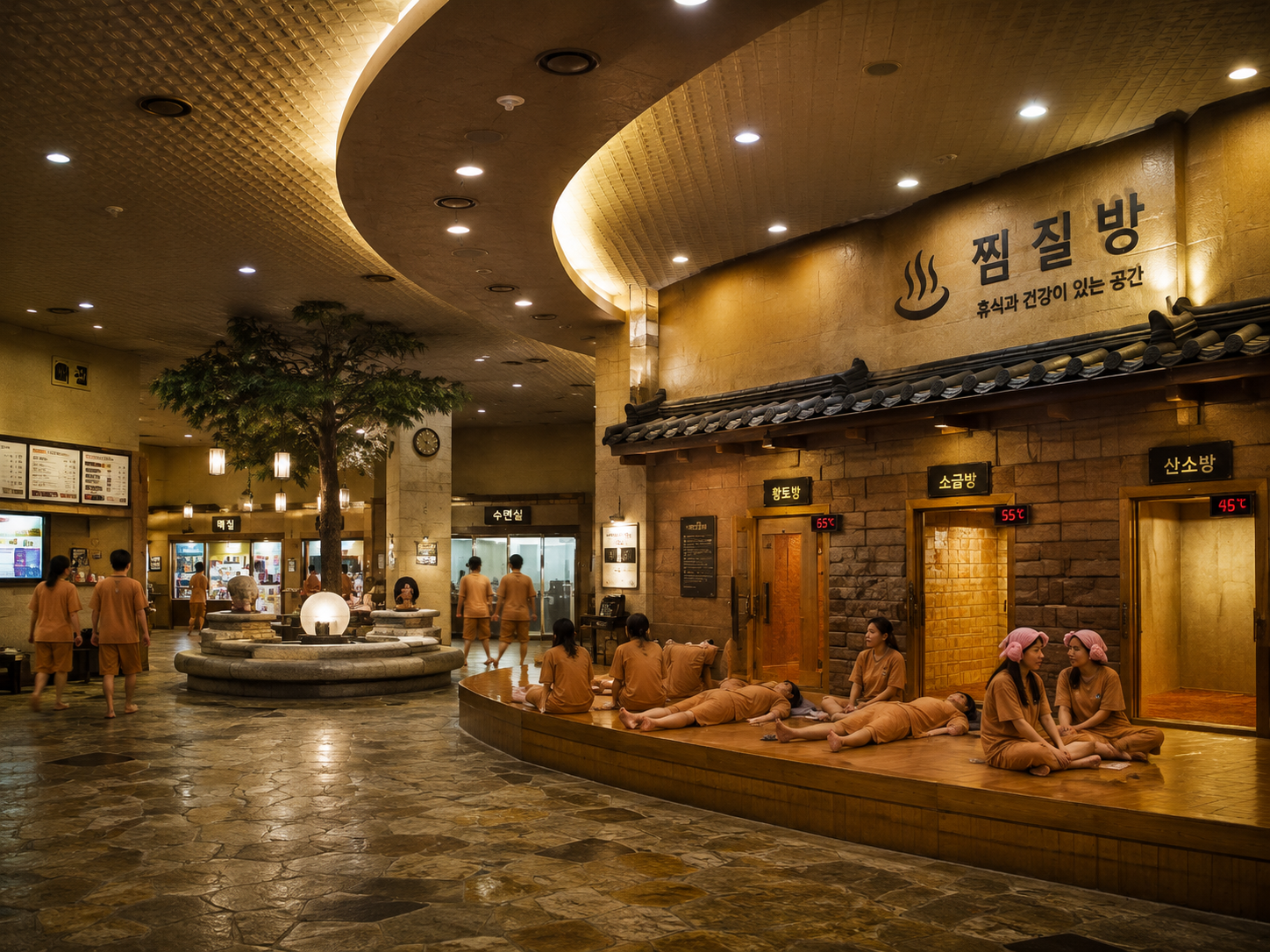
A jjimjilbang (찜질방) is not one room. It is two completely different spaces sold under one ticket, and almost every mistake foreign visitors make comes from not knowing which space they are standing in. One half is a nude, gender-separated wet bath. The other half is a fully clothed, mixed-gender heated floor where families nap, watch TV, and eat boiled eggs. Once you can tell those two apart, everything else is simple.
I grew up going to these places. Here is what actually happens, in order, and what will get you a stare from the ajumma at the counter.
The Two Halves You Need to Understand
The wet bath is called a mogyoktang (목욕탕). It is separated by gender, and everyone in it is completely naked. There are no swimsuits, no exceptions, and no polite workaround. Hot pools, a cold pool, a steam room, and rows of seated shower stations along the walls.
The heated floor is the jjimjilbang proper. Everyone wears the cotton uniform the front desk hands you, men and women share the space, and it is full of families with kids. This is where the salt rooms, the ice room, the snack bar, and the sleeping mats are.
One more distinction that saves people money: a building labeled 사우나 or 목욕탕 may only have the wet bath, with no heated floor at all. If you want the full experience, look for the word 찜질방 on the sign or the price list.
Your First Hour, Step by Step
1. Shoes come off immediately
There is a wall of small wooden lockers just inside the entrance, before the counter. Shoes go in, you take the key, and you walk to the counter in bare feet or socks. This is the same instinct behind taking your shoes off indoors in Korea — the floor past that point is treated as clean space.
2. The counter
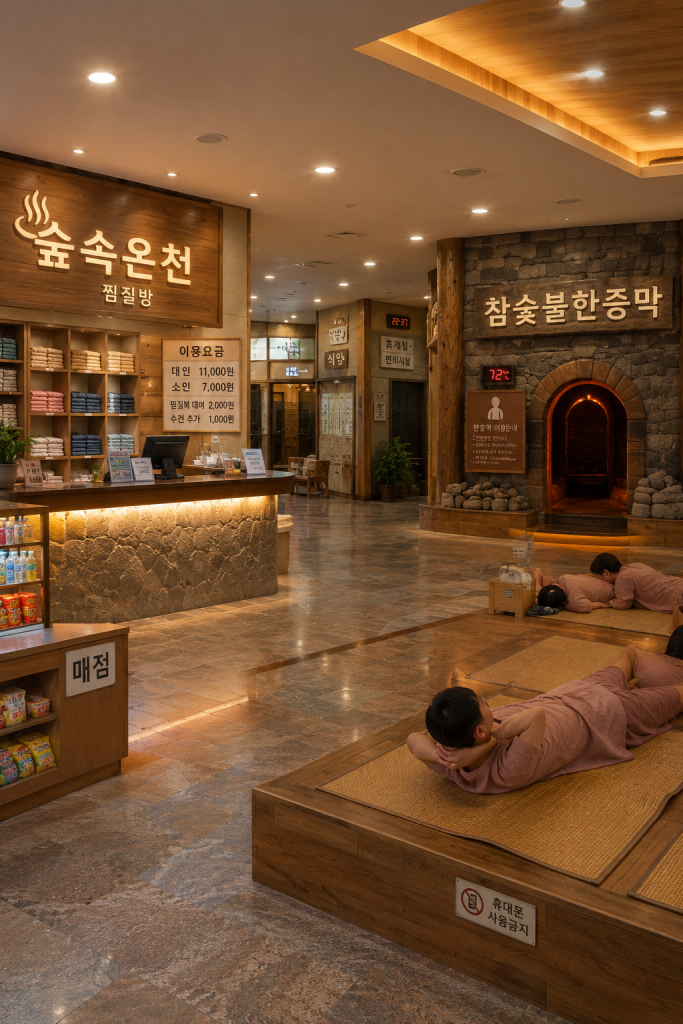
Hand over your shoe key. You will get back a wristband or a second key, plus a folded uniform: a loose T-shirt and shorts, usually color-coded by gender.
The wristband is the part nobody explains. It has a barcode. Anything you buy inside — eggs, drinks, a scrub, a massage chair — gets charged to it, and you settle the whole bill on your way out. You do not carry a wallet around. You do not need one.
3. The locker room
Find your locker number, strip completely, and take only the small towel with you into the bath. Phone stays in the locker. This is not a suggestion — most bathhouses ban phones in the wet area outright, and Korea treats illegal filming in bathhouses as a serious criminal offense. Do not bring it in even to check the time.
The Wet Bath: Rules That Are Not Negotiable
Wash before you get in the water. Sit down at one of the shower stations, and actually wash — soap, shampoo, the whole thing. A quick rinse is not enough and people will notice. The pools are shared, not chlorinated the way a swimming pool is, and this single rule is what makes the system work.
The small towel is not a modesty garment. It is for scrubbing and for wiping down afterward. You will see Koreans hold it in front of themselves while walking, which is fine, but it never goes into the water.
Keep your voice down. The wet bath is quiet. Conversation happens, but it is low. Splashing, swimming, and laughing loudly all read as childish.
Do not stare, and expect to be looked at. Adults will not stare. Children absolutely will, especially at tattoos and at anyone who looks foreign, and their parents will pull them away. It is curiosity, not hostility.
A word on tattoos
Policies vary and I will not pretend otherwise. Newer bathhouses and anything in a tourist district will not care. Older neighborhood places sometimes post signs refusing entry to guests with large visible tattoos, a rule that dates back to associations with organized crime rather than anything about you. If you have full sleeves and want to avoid an awkward conversation, ask at the counter first or choose a larger, newer facility.
The body scrub
The ttaemiri (때밀이), or body scrub, is an optional paid service performed by an attendant on a vinyl table in the corner of the wet area. It is done with a coarse Italy towel, it is far more vigorous than a spa treatment anywhere else, and the point is exactly that. Expect roughly 25,000 won and up depending on the facility, often cash only. It is unrelated to your wristband tab at some places, so ask first.
Do not tip. Tipping is not part of the transaction anywhere in Korea, and offering money afterward creates confusion rather than goodwill.
The Heated Floor: Where You Can Actually Relax
Dry off, put on the uniform, and go up or across to the common floor. This is the part most people picture when they hear the word jjimjilbang.
Around the edges are the kilns, each a small room heated a different way:
- Hwangto-bang (황토방) — ocher clay, moderate heat, the one most people can sit in the longest
- Sogeum-bang (소금방) — floor covered in coarse salt crystals
- Champsut-bang (참숯방) — charcoal-lined, dry, dim
- Bulgama (불가마) — the extreme one, often 80°C or hotter, usually with hooded mats at the entrance. Minutes, not tens of minutes
- Eoreum-bang (얼음방) — the ice room, for cooling down between kilns
- Sanso-bang (산소방) — the oxygen room, kept cooler at around 45°C, meant for sitting longer rather than sweating hard
The rhythm Koreans follow is hot room, cool down, hot room, cool down. Nobody sits in one kiln for an hour.
The towel on the head
The folded towel headpiece is called yangmeori (양머리) — literally “sheep head.” Fold the small towel into thirds lengthwise, roll both ends inward, and slip the resulting loop over your head so the rolls sit above your ears.
It is genuinely practical, since it keeps wet hair off your neck in a hot room. It is also, honestly, something Koreans do because it looks funny, and if you make one you will get approving looks rather than confused ones.
Sleeping over
Sleeping in a jjimjilbang is completely normal and not a loophole. Mats and blankets are stacked along the walls, some floors have small wooden pillows, and quiet sleeping rooms are usually separated by gender. People who miss the last subway, students during exam season, and travelers between flights all end up here. Expect an overnight surcharge, usually applied after around 10pm or midnight.
What to Eat
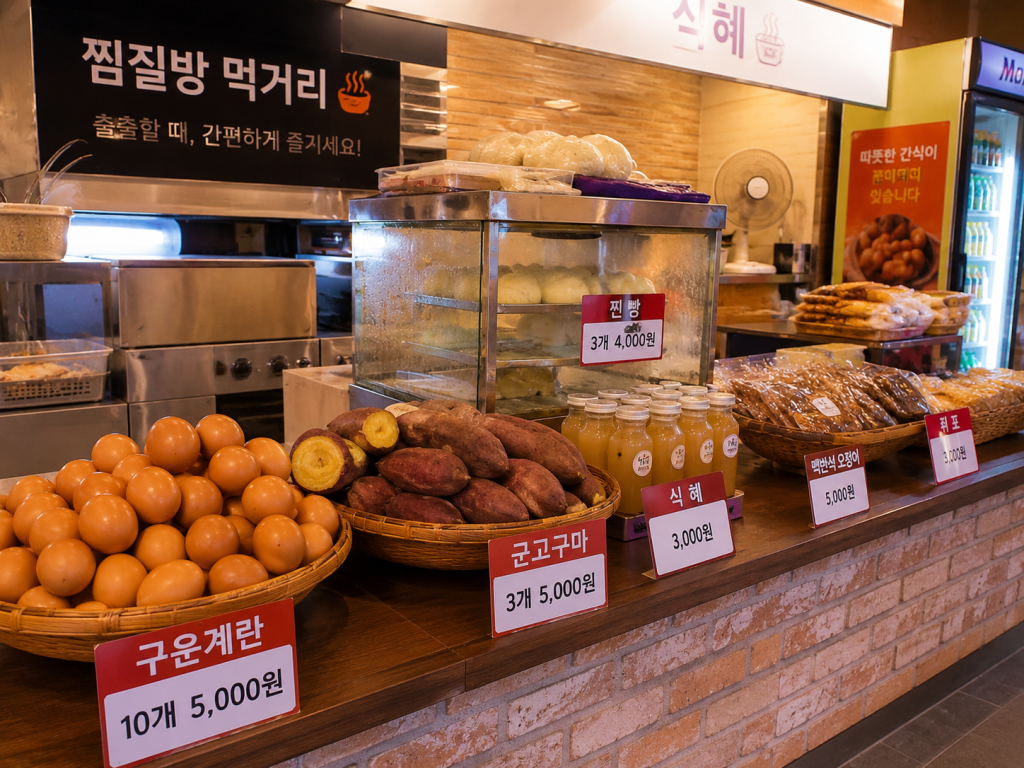
Two items are almost obligatory. Maekbanseok gyeran (맥반석 계란) are eggs slow-baked in a stone kiln until the whites turn faintly brown and nutty — nothing like a boiled egg. The traditional way to crack one is against your own forehead, which is exactly as ridiculous as it sounds and is half the reason people order them.
The other is sikhye (식혜), a chilled sweet rice drink with grains floating in it, served in a small metal cup. Cold, faintly malty, and perfect after twenty minutes in a kiln.
Beyond that: instant ramyeon, seaweed soup, patbingsu in summer. The prices are convenience-store level rather than restaurant level, and the ordering system works much like a Korean convenience store — you pay, you collect, you find your own seat.
You Can Skip the Naked Part
This is the thing almost no English-language guide says clearly, so here it is plainly: the wet bath is optional.
You can pay the entrance fee, change straight into the uniform, and spend your entire visit on the heated floor without ever entering the nude area. Nobody will stop you, nobody will ask, and the staff genuinely do not track it. The kilns, the food, the sleeping floor, and the atmosphere are all still yours.
If the nudity is the only thing keeping you from going, go anyway. You can always try the bath on a second visit, once the building is familiar.
Where This All Came From
Public bathhouses spread through Korea in the early twentieth century, and they stayed essential for a simple reason — most homes did not have a private bath. Weekly trips to the neighborhood mogyoktang were a household routine well into the 1980s, which is why so many Koreans over forty associate the smell of a bathhouse with childhood rather than with tourism.
That changed as apartment living became the standard and every unit came with its own bathroom. The bathhouses responded by adding the heated common floor, the food counter, and 24-hour operation, and the jjimjilbang as it exists now took shape in the 1990s. It was no longer somewhere you went to get clean. It was somewhere a family went for an afternoon.
Do Koreans Still Go?
Less than they used to. Many neighborhood bathhouses have closed over the past decade, squeezed by rising heating costs and the pandemic, and the ones that survive are often the larger complexes.
But the habit has not disappeared, it has narrowed. Families still go on weekends. People still go the morning after drinking — the sweat-it-out logic is close to the haejang mindset around Korean drinking culture, where recovery is treated as its own small ritual. And a jjimjilbang is still one of the cheapest legitimate places to sleep in any Korean city.
Quick Rules to Remember
| Situation | Do this |
|---|---|
| Entering the building | Shoes into the small locker before the counter |
| Wet bath | Fully nude, wash thoroughly before entering any pool |
| Phones | Never in the wet area — leave it in the locker |
| Heated floor | Uniform on, mixed gender, keep it quiet after midnight |
| Paying | Everything goes on the wristband, settled on the way out |
| Tipping | Never, including for the scrub |
Before You Go
Entrance usually runs somewhere around 10,000 to 18,000 won for a daytime visit, with Seoul at the higher end and smaller cities well below it. Overnight costs more. Soap and shampoo are normally provided at the shower stations, towels are handed out or rented for a small fee, and a toothbrush is not included — buy one at the counter or bring your own.
Bring nothing else. That is the actual pleasure of the place. You hand over your shoes at the door, you get a wristband and a cotton uniform, and for a few hours there is nothing in your hands at all.
If you are working through Korean social rules more broadly, the same underlying logic — shared space, clean space, and the quiet expectations around both — runs through Korean table manners as well.
Illustrations on this page are AI-generated and do not depict a specific facility.