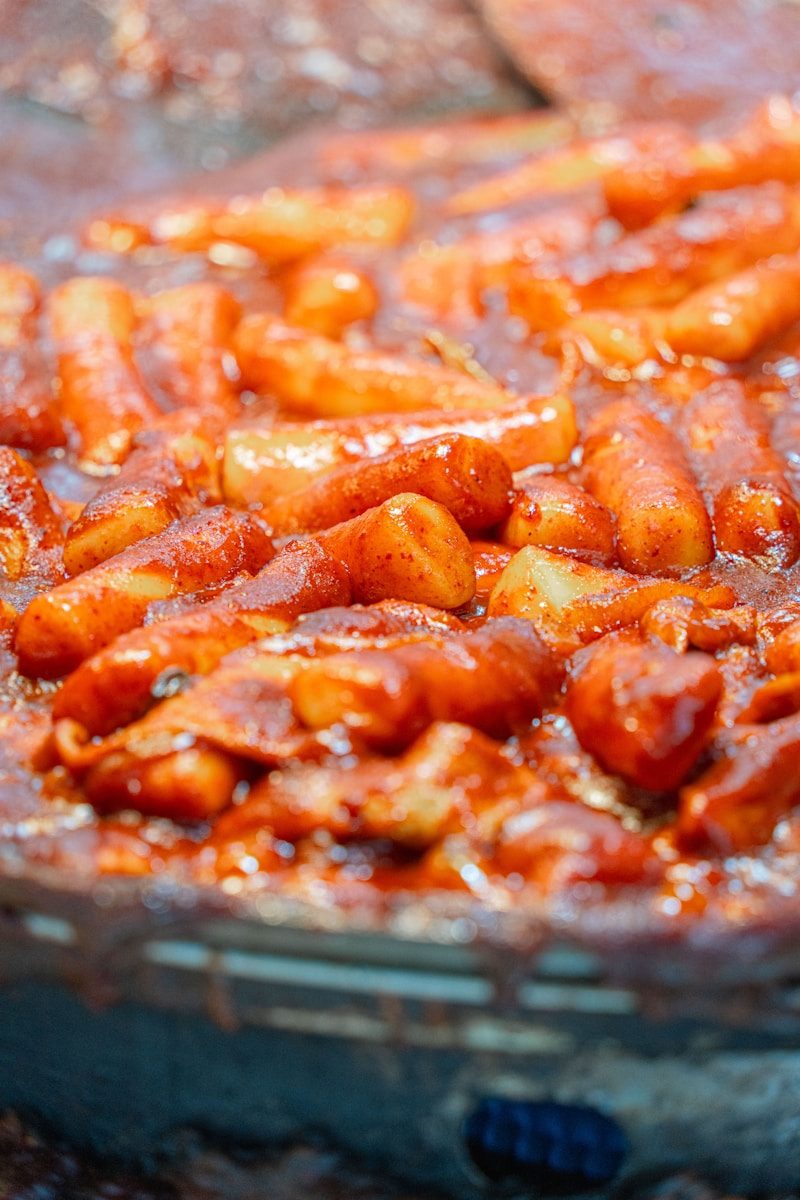
What is tteokbokki? Cylindrical rice cakes simmered in a red chili sauce, sold from small shops on nearly every commercial street in Korea. That description is accurate and tells you almost nothing.
Ask Koreans about tteokbokki and you will not get a recipe. You will get an argument about which version is the real one — and the answer depends almost entirely on when the person was in elementary school.
The version outside the school gate
In the 1980s and 90s, every school had a stationery shop and a bunsikjip (분식집) nearby — a small snack shop where children spent whatever money they had.
The tteokbokki there was wheat-based, not rice. Thin, roughly the length of a finger, soft in a way rice cakes are not. The sauce was gochujang and not much else. That was the whole dish.
It was plain by any modern standard. It is also what people from that generation describe as tasting better than anything sold today, which is a claim about memory as much as flavor — and one worth taking seriously anyway, because the market has responded to it.
The setting explains part of it. A bunsikjip was not a restaurant. It was a counter, a few stools, and a wide shallow pan kept warm all afternoon, positioned so children walking home could see it. The tteokbokki had usually been sitting in that pan for hours, which meant the rice cakes had gone soft and the sauce had thickened and reduced around them. Nobody was making it to order.
Portions were sized to what a child had in their pocket. You bought what your coins allowed, ate standing or perched on a stool, and left. The whole transaction took a few minutes and cost almost nothing, which is precisely why it belonged to children rather than to families.
There is a practical reason wheat dominated then, too. Wheat flour was cheaper than rice, and the shops selling to schoolchildren were working with margins that left no room for the more expensive ingredient. The dish that generation remembers so fondly was, in its own time, the economical version.
What replaced it
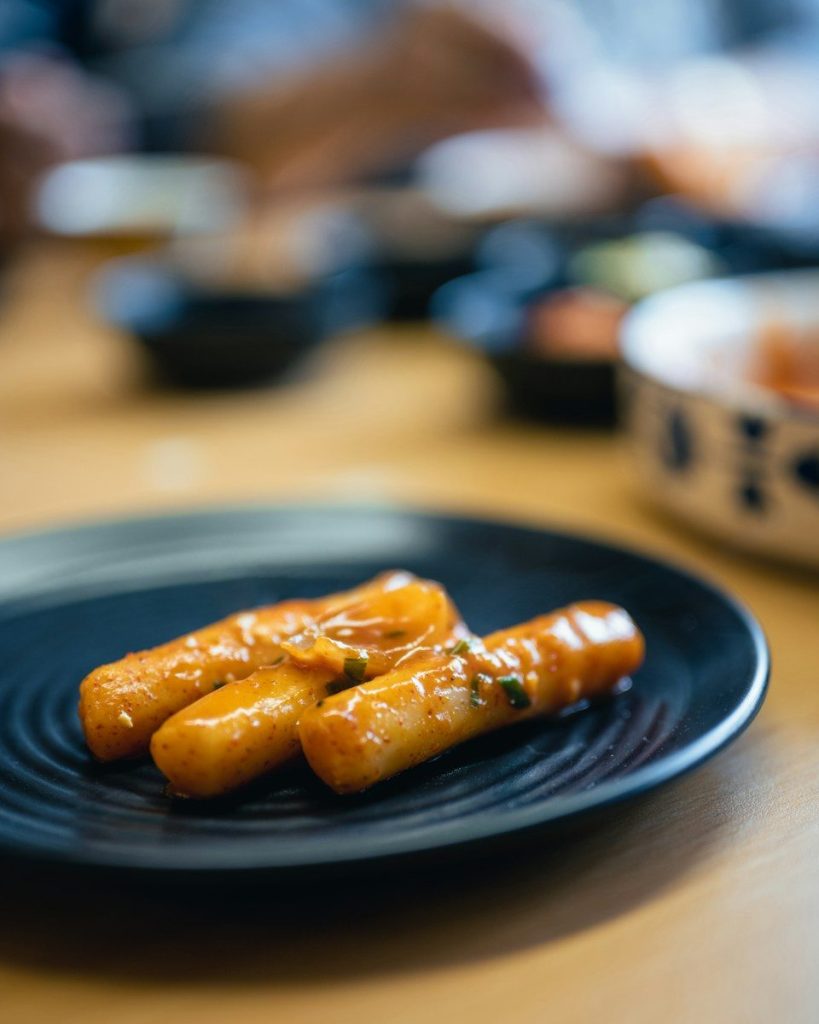
Rice cakes took over. Thicker, chewier, and often cut on the diagonal into flat ovals, the same shape used in tteokguk, the rice cake soup eaten at New Year. Some shops still serve the long finger-shaped kind, but the diagonal cut is the default at an ordinary snack shop now.
The sauce changed more than the shape did. Sugar came in. Modern tteokbokki chases what Koreans call dan-jjan-maep-jjan — sweet, salty, spicy, salty — an intensity that stacks flavors rather than balancing them. It is engineered to be a little addictive, and for younger diners that is precisely the appeal.
Not everyone came along. Some people find rice cakes texturally wrong for the dish — as though the rice is sitting in tteokbokki sauce rather than being tteokbokki. Shops know this, which is why menus carry yennal tteokbokki (옛날 떡볶이), “old-style,” or simply wheat tteokbokki as a named option. The nostalgia is a product category.
The objection is specific rather than vague. Wheat cakes absorb sauce; rice cakes resist it. A wheat cake that has sat in the pan takes the flavor into itself and turns soft all the way through. A rice cake stays chewy at the center and carries the sauce on its surface, which is why people describe the modern version as rice cakes coated in tteokbokki rather than tteokbokki itself.
Whether that is a downgrade depends entirely on what you want. Chewiness is not a defect — Korean cooking values that texture highly, and younger diners who grew up with rice cakes find the wheat version disappointingly soft. Both camps are describing the same food accurately and reaching opposite conclusions.
It is also worth noticing that the sweetness is not incidental. Sugar does not merely add flavor; it changes how the sauce behaves, thickening it into something that clings. Modern tteokbokki sauce coats every piece in a way the older, thinner gochujang sauce never did. The shift in ingredient and the shift in texture happened together.
| Old-style | Modern | |
|---|---|---|
| Rice cake | Wheat, thin, finger-length | Rice, thick, often diagonal |
| Flavor | Gochujang, restrained | Sweet, salty, spicy, layered |
| Texture | Soft | Chewy |
What to order and how it comes
Tteokbokki is rarely eaten alone. The standard pairing is kimbap, dipped straight into the sauce — not an improvisation but the expected way to eat both.
Rabokki adds instant noodles to the pan, and glass noodles turn up as an add-on too. Fish cake, boiled eggs, and fried items are all common additions.
At elementary schools today you will find cup tteokbokki, served in an ordinary paper cup for around a thousand won. Portioned and priced for children with pocket money, which is exactly what the wheat version outside the school gate was doing forty years ago.
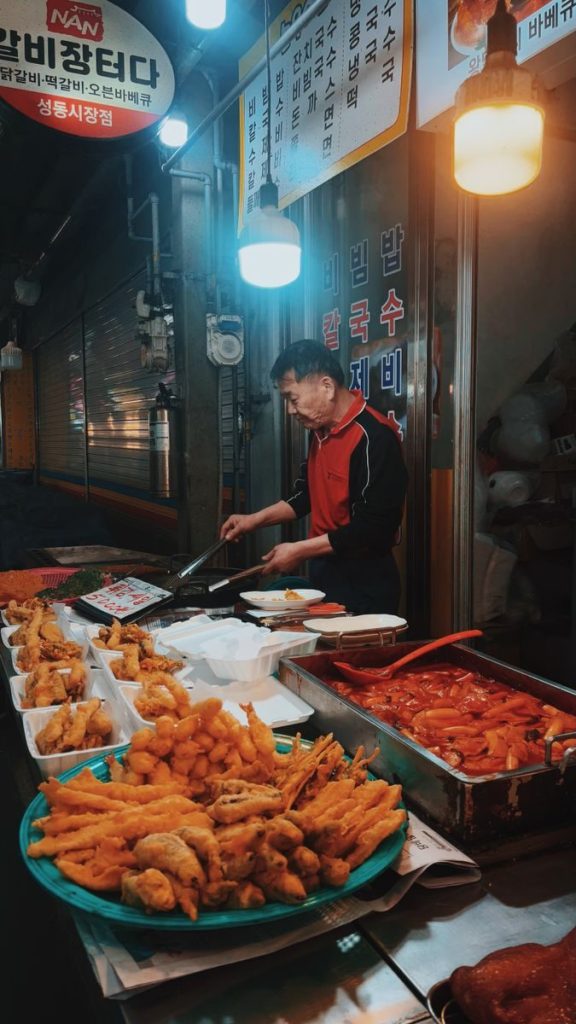
Fried items are the other standard companion. Shops selling tteokbokki almost always sell twigim — battered and fried vegetables, squid, dumplings — and the expected move is to dip them into the tteokbokki sauce rather than eat them plain. Ordering tteokbokki without something fried alongside is entirely possible and slightly unusual.
Portions are built for sharing. A standard order arrives in a shallow pan meant for two or more people picking at it with skewers or forks, not divided into individual servings. Eating alone is normal enough, but the format assumes company, and a table of four will order one pan and several additions rather than four separate dishes.
Most shops are small, fast, and cash-friendly, though card payment is standard now. You order at the counter, food arrives quickly, and nobody expects you to linger. Our guide to Korean restaurant etiquette covers the wider conventions, most of which apply loosely here at best — a bunsikjip operates by its own relaxed rules.
How spicy is it
Moderate, usually. Heat is present but sweetness carries most of the flavor, and the average shop version is approachable for someone who is not used to chili.
That said, some chains build their identity on extreme heat, and those are genuinely punishing. If you are unsure, ask — this is a normal question and shops are used to it.
If the heat does catch you out, the fix is not water. Something starchy or dairy works far better, which is one more reason kimbap and fried items sit on the same menu. Many shops also serve a cup of the water the fish cakes are simmering in, and that broth does more to settle things than a cold drink will.
Why the argument matters
Tteokbokki is the rare dish where Koreans can point to a specific decade and say the food changed. The wheat cakes, the plain sauce, the shop by the school gate — those are attached to a particular childhood, and the people who had it are now adults ordering “old-style” off a menu.
Which means there is no single correct answer to what tteokbokki tastes like. There is the version being sold to children in paper cups right now, and there is the version adults are trying to get back.
The same long rice cakes, called garaetteok, have their own day in Korea. On November 11, the government encourages people to give them as gifts, a campaign that shares the date with Pepero Day.