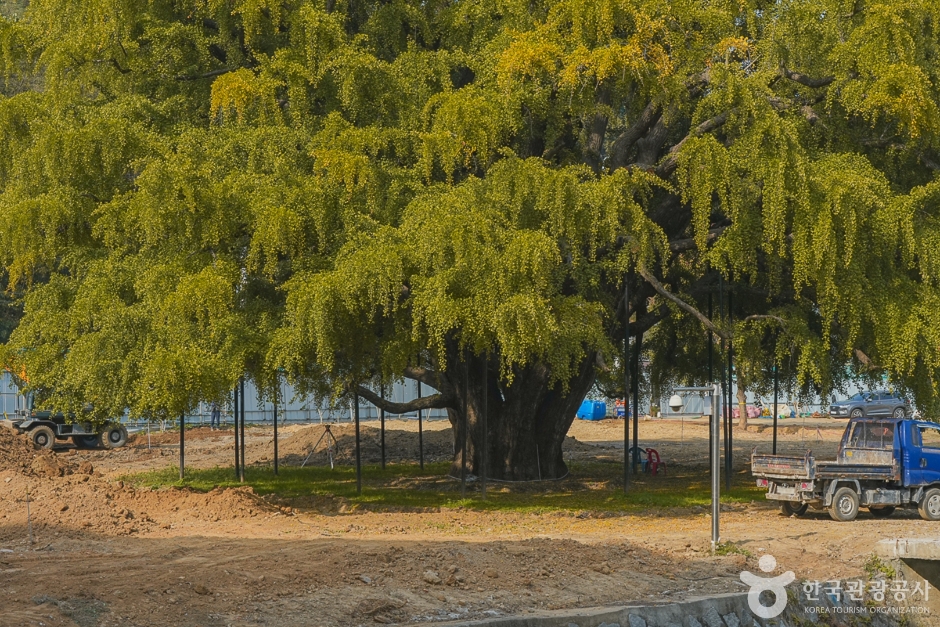
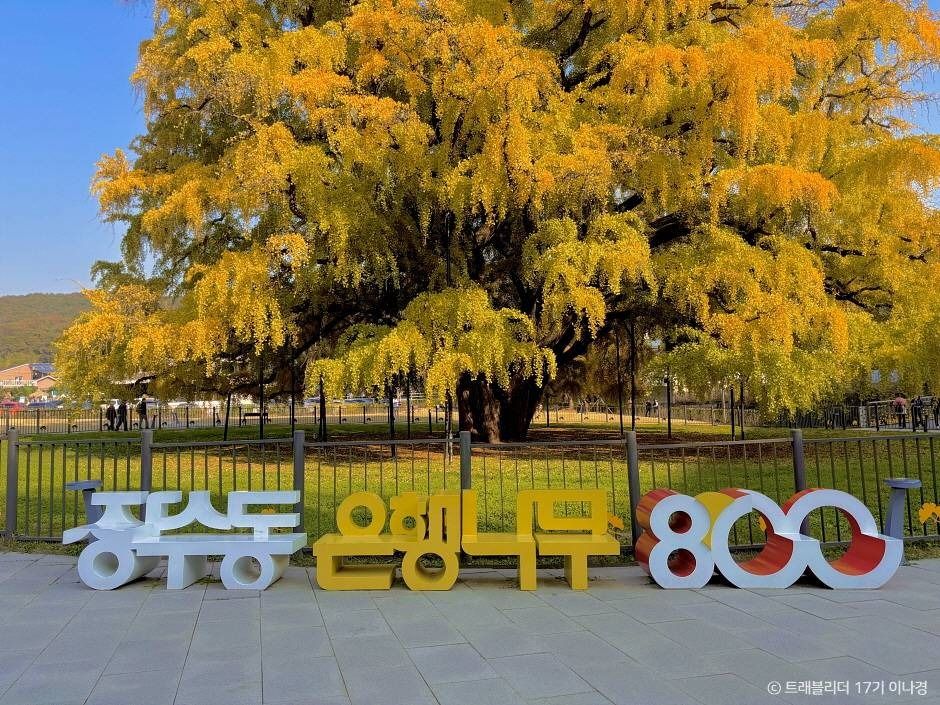
The Jangsu-dong ginkgo tree has been standing at the edge of what is now Incheon for about 800 years. It was already old when the villages around it were still farmland, and it is still here now that a highway runs past its hillside and a giant city park sits across the road. In autumn, when the whole crown turns gold at once, it is one of the most striking sights in the Seoul metropolitan area.
I will be honest from the start. Unlike Incheon Grand Park, where I spent countless school picnics, this corner of Incheon was never part of my childhood. It is the far edge of the city, right on the border with Siheung, and for most of my life it felt like the countryside. That is exactly what makes it worth writing about. This post covers the tree, the stories around it, and the quiet valley of loach soup restaurants, cafes, and mountain trails that surrounds it.
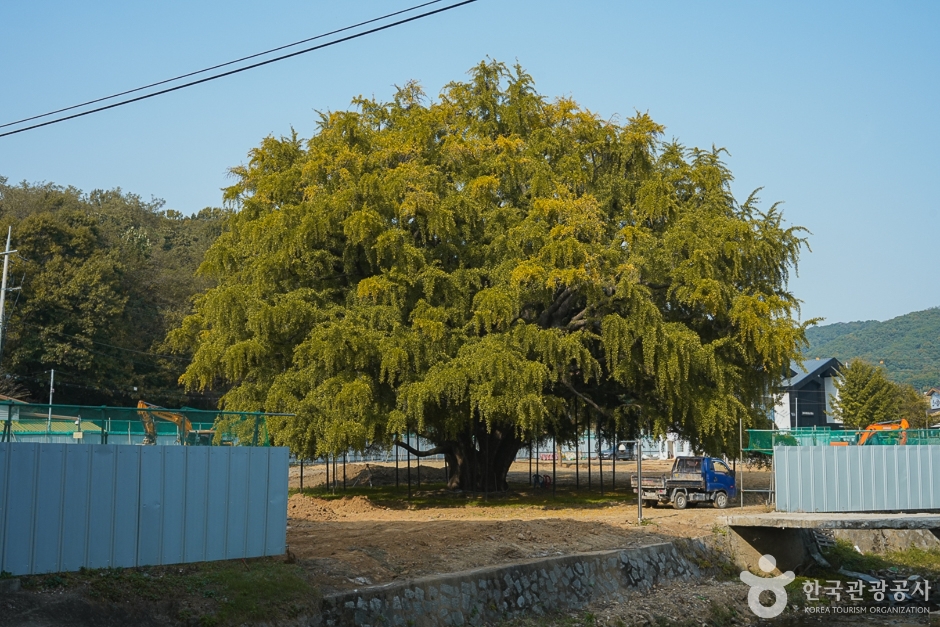
An 800-Year-Old Tree at the Edge of the City
The tree stands in Jangsu-dong (장수동), Namdong-gu, at the mouth of a small valley called Manuigol (만의골). Behind it rise the slopes of Soraesan (소래산), and directly across the road is the east side of Incheon Grand Park. If you have only seen Incheon as an airport and a port city, this place will surprise you. It feels less like a metropolitan city of three million people and more like a village road in the provinces.
The name of the neighborhood fits the tree perfectly. Jangsu (長壽) literally means “long life,” and the oldest living thing in the area is a tree that has been alive for eight centuries. Whether the name shaped the legend or the legend shaped the name, nobody can say for sure, but it fits the stories you will read about below.
What Makes This Ginkgo Special
The tree is nearly 30 meters tall, about the height of a ten-story apartment building, and its trunk is close to 9 meters around at the base. Published measurements vary slightly by source, but standing under it, the numbers stop mattering. The crown spreads roughly 30 meters across, so wide that it shades the entire plaza around it.
Two features set it apart from most old ginkgos in Korea. First, the trunk splits into five thick stems right near the roots, which rise together like fingers on an open hand. Second, the tips of its branches droop downward, almost like a weeping willow. Most ginkgo trees grow stiffly upward. This one looks soft, as if the whole tree is leaning down to listen.
There is one more detail that Korean visitors appreciate. This is a male tree. Female ginkgo trees drop seeds in autumn, and the fleshy coating around those seeds smells strongly enough that many Korean cities now prefer to plant male trees along their streets. Anyone who has walked a Korean sidewalk in October knows that smell. At the Jangsu-dong tree, you get the golden leaves without it.
From City Monument to Natural Monument
Incheon first recognized the tree in December 1992, when it was designated an Incheon Monument. In February 2021, the national government upgraded it to Natural Monument No. 562, giving it protection at the national level. In Korea, a Natural Monument (천연기념물) is a protected natural heritage, similar to how a historic building can be listed for preservation.
The heritage authorities did not grant that status only because the tree is big and old. Their evaluation also pointed to its folk value: the tree has been part of village life and ritual for generations. That folk side is what turns a large tree into a story.
The Village Guardian: Rituals, Legends, and One Strange Rule
Nobody knows exactly who planted the tree or why. What has been passed down is how villagers treated it. For a very long time, people saw it as a sacred tree with spiritual power. When bad luck struck a household or an epidemic spread through the village, families set out food offerings in front of the tree and prayed for protection.
That belief grew into an annual ritual. For roughly 200 years, villagers have held a dangje (당제), a village rite for the guardian spirit, on the first day of the seventh lunar month, which usually falls in midsummer. They pray for a good harvest and a peaceful year, and then the most important part begins: everyone shares the food. In rural Korea, rituals like this were as much about neighbors eating together as they were about the spirits.
The local legend is my favorite part. According to the story, the spirit living in the tree drew in all the energy that would normally produce great scholars and officials, so the village rarely produced famous people. In exchange, the people who lived here lived unusually long lives. It is a very Korean kind of bargain: no fame, but long life.
There is also a taboo that has been handed down. You are not supposed to take anything from the tree into your home, not a leaf and not a twig. So when you visit in autumn and the ground is covered in perfect golden leaves, take photos, but leave the leaves where they fell. Even if you do not believe in the spirit, it is a good habit at a protected heritage site.
When to Visit
The tree is open to visitors year-round with no admission fee, but autumn is the season. The leaves usually start turning yellow in late October, and the peak tends to come in early to mid November. At its best, the crown glows like a lamp, and the leaves that fall form a thick yellow carpet around the fence.
Timing changes slightly every year depending on the weather, so if you are planning around the peak, check recent photos on Korean social media before you go. Weekday mornings are the quietest. On autumn weekends, the plaza fills with families, photographers, and hikers coming down from the mountain.
Summer has its own appeal. The tree is a deep, cool green, and the shade under it is wide enough to rest in. If you happen to be in the area around the first day of the seventh lunar month, you may see signs of the village rite.
Three Ways to Get There
Public transport is the one weak point of this area. The tree sits at the edge of the city, and no subway station is right next to it. The good news is that each route has its own charm, and two of them double as a walk through nature.
Route 1: Through Incheon Grand Park
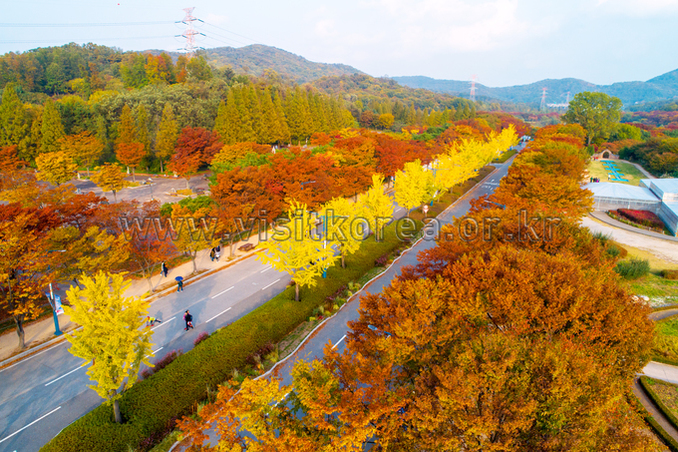
Take Incheon Subway Line 2 to Incheon Grand Park Station and leave through Exit 3. Enter the park through the nearby south gate and walk through the park toward its east side. The ginkgo stands just outside the park across from the east gate area. This is the longest route on foot, but in autumn it may be the best one, because you walk past the park’s own lakes and colored avenues on the way.
Route 2: Bus 15 or 22, Then Walk Up Manuigol
Take city bus 15 or 22 and get off at Unyeon Samgeori (운연삼거리). From there, head into the entrance of Manuigol and walk up the valley road toward the tree. Think of it as a small trail rather than a commute. The road climbs gently past restaurants, cafes, and fields, with the mountains on both sides, and it is a pleasant way to see how this edge of Incheon actually looks.
Route 3: Circular Bus 54
The easiest option is the Circular Bus 54 (순환54). It stops at Incheon Grand Park Station and then climbs the Manuigol road itself, getting you close to the tree with very little walking. If you are traveling with older family members or small children, this is the route to choose. Buses on this line run less often than main city routes, so check the arrival time in a map app such as Naver Map or KakaoMap before you head to the stop.
Manuigol: Loach Soup, Barley Rice, and Mountain Cafes
The valley road around the tree is not a tourist strip. It grew up feeding hikers, park visitors, and families on weekend drives, and it still has that easy, unpolished feel.
Yeonnakgol Chueo Village
Near the entrance to Manuigol, there is a small cluster of restaurants specializing in chueotang (추어탕), a soup made from mudfish, also called loach. Locals call this little stretch Yeonnakgol Chueo Village (연락골 추어마을). If the idea of fish soup worries you, it shouldn’t. In most chueotang, the fish is ground finely and simmered with soybean paste and greens such as napa cabbage leaves, so the soup is thick, earthy, and comforting rather than fishy.
Koreans often add a pinch of sancho (산초) powder, a tingly ground pepper that is usually set on the table, along with chopped chili and garlic. Chueotang has long been thought of as a stamina dish, the kind of bowl people want after a hike or on a tired day. Order it with a bowl of rice, and the side dishes will arrive without asking, as they do at almost every Korean restaurant. If you are not sure what those are, my guide to banchan explains them.
Barley Rice, Tofu, and Post-Hike Meals
Walking up the valley, you will also find restaurants serving boribap (보리밥), barley rice topped with a spread of seasoned vegetables. You mix it all together with chili paste and a little sesame oil, much like bibimbap, and it usually comes with a bowl of soybean paste stew. Barley rice was once the food of hard times in Korea, eaten when rice was scarce. Today it has become something people drive out to the countryside to eat on purpose.
Many places here also make their own tofu, and the menus lean toward hearty, shareable food: savory pancakes, spicy stir-fried dishes, and bowls of noodles. After a hike, a lot of Korean hikers order a pancake with a bottle of makgeolli (rice wine). My honest advice is simple. You do not need a famous name here. Walk in anywhere that looks busy, and you will eat well.
Cafes, Campsites, and Weekend Farms
Keep walking up the Manuigol road, and the restaurants give way to cafes with garden seating, a campsite, and small weekend farms where city families rent plots to grow vegetables. Further up, the valley runs under the Seoul Ring Expressway No. 1, and around that area you will find more cafes and restaurants tucked against the hills. If you keep following the road to the very end, it simply stops. Manuigol is a dead-end valley, which is part of why it stays so quiet.
Walking On: Soraesan, Sangasan, and the Namdong Trail
The tree sits right where several walking routes meet, so it is a natural starting point for a longer day outdoors.
- Soraesan (소래산): The trail entrance is right nearby. This mountain, just under 300 meters high, sits on the Incheon and Siheung border, and the climb is short enough for a half-day hike.
- Sangasan (상아산) and Gwanmosan (관모산): On the opposite side, these low hills connect directly into Incheon Grand Park. Hikers often go up one side and come down into the park.
- Namdong Dulle-gil (남동둘레길): Namdong-gu’s district walking trail network uses the ginkgo as a starting point. Course 1 runs about 11.5 kilometers, and Course 4 runs about 7 kilometers through Mansu-dong, one of the district’s older neighborhoods.
Mansu-dong has a personal connection for me. In my post about Moraenae Market, I wrote about the hillside neighborhood where a covered stream marked the boundary with Mansu-dong. It is a little strange to realize that a trail starting under an 800-year-old tree ends up passing so close to the streets of my childhood.
Why Most Visitors Never Find It
Foreign travelers rarely hear about this tree for the same reason most Koreans outside Incheon don’t: it sits at the city’s far edge, away from the subway lines, and it does not belong to any famous attraction. It is not on the way to anything. You have to come here on purpose.
That also means you see it the way local people do. On a November weekday, you might share the plaza with a few retirees on a walk, a photographer with a tripod, and hikers heading to the Soraesan trailhead. There are no ticket booths and no gift shops. It is just a very old tree, a quiet valley, and a bowl of hot soup waiting down the road.
Visiting the Jangsu-dong Ginkgo Tree
The tree is in Jangsu-dong, Namdong-gu, Incheon, at the entrance to Manuigol, across from the east side of Incheon Grand Park. For the easiest trip, take Incheon Line 2 to Incheon Grand Park Station and transfer to Circular Bus 54. For a walk, take bus 15 or 22 to Unyeon Samgeori and follow the Manuigol road uphill.
| Item | Details |
|---|---|
| Admission | Free, open year-round |
| Best time | Late October to mid November for golden leaves |
| Quietest time | Weekday mornings |
| Parking | Public lots nearby, including the Soraesan public lot and Incheon Grand Park’s east lot; fees apply |
| Combine with | Incheon Grand Park, a Soraesan hike, or a loach soup lunch |
For a full day in Namdong-gu, you can pair the tree with Incheon Grand Park in the morning and finish with seafood at Sorae Port in the evening. Heritage details are also listed on the Korea Heritage Service website.
Final Thoughts
Big cities tend to erase their own past. Incheon has grown from fishing villages into an international hub with an airport, a free economic zone, and endless new apartment towers. Yet at its eastern edge, one tree has quietly outlived all of it, still receiving offerings, still turning gold every November.
Come in autumn if you can. Take the slow route up the valley, eat whatever the busiest restaurant is serving, and stand under the branches for a while. Just remember the old rule on your way out: the leaves stay with the tree.
Photos: © 트래블리더 17기 이나경 / Korea Tourism Content Lab (KOGL Type 1); © Korea Tourism Content Lab / Korea Tourism Organization (KOGL Type 1); © Korea Tourism Content Lab / Korea Tourism Organization (KOGL Type 3).