
Korean kite flying, called yeonnalligi (연날리기), was once the sound and sight of every Korean winter. In the days around the Lunar New Year, children climbed hills, dykes, and empty rice fields with a bamboo-and-paper kite under one arm and a wooden reel in the other. The sky over villages filled with rectangular kites, each one with a round hole cut in the middle, darting and diving as their owners tried to cut each other’s strings.
Kite flying is one of the oldest games in Korea, with a story that reaches back to a general in the seventh century. It was also something more than play: on the last day of the season, people wrote a wish on their kite, sent it as high as it would go, and then cut the string on purpose to let their bad luck float away. This guide explains what makes Korean kites different, how the kite fights work, the history and customs behind them, and where you can still see kites in the winter sky today.
Korean Kite Flying at a Glance
| Korean name | Yeonnalligi (연날리기), from yeon (kite) and nalligi (flying) |
| Season | Late winter, peaking from Seollal (Lunar New Year) to Jeongwol Daeboreum, the first full moon |
| Most famous kite | Bangpae-yeon (방패연), the rectangular “shield kite” with a hole in the center |
| Easiest kite | Gaori-yeon (가오리연), a diamond-shaped “stingray kite” with a long tail |
| Main games | Flying high, performing tricks, and kite fighting (cutting an opponent’s string) |
| Key custom | Writing a wish on the kite and cutting it free to send away bad luck |
| 2027 dates | Seollal on February 7, Jeongwol Daeboreum on February 21 |
When Koreans Flew Kites
Kite flying was a winter game. In the countryside, boys often started once the autumn harvest was in and the fields were empty, and in the colder north the season began even earlier. Open, frozen rice paddies were perfect: no crops to damage, few trees to snag a string, and steady winter winds blowing across the flat land.
The real season, though, ran from Seollal, the first day of the lunar year, to Jeongwol Daeboreum, the first full moon fifteen days later. These two weeks were a time of rest in a farming society. The work of the previous year was done, the planting of the new year had not started, and families had time for games. Kite flying sat alongside other New Year games such as yutnori, the board game played with four sticks, and spinning tops on the ice, described in our guide to paengi chigi.
Once Daeboreum passed, the kites were supposed to come down for good. Spring farm work was about to begin, and a person still playing with a kite after the full moon was teased for being idle. The season had a clear beginning and a clear end, and that end was marked by one of the most memorable customs in Korean folk culture.
The Shield Kite: Korea’s Signature Design
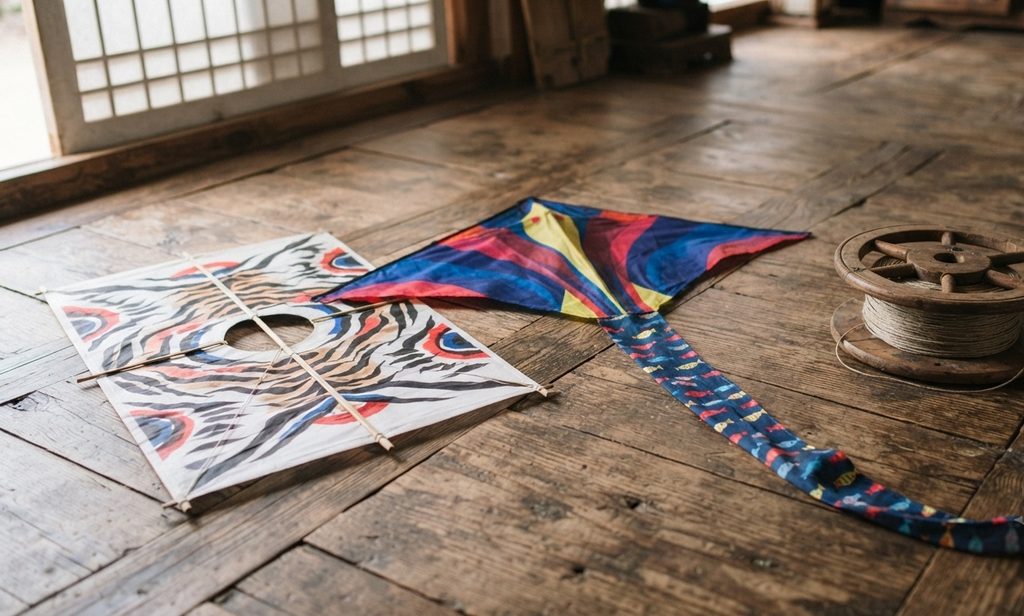
Most people around the world picture a kite as a diamond with a tail. The classic Korean kite looks nothing like that. The bangpae-yeon (방패연) is a tall rectangle, roughly the shape of a shield, which is where the name comes from. It has no tail, and in the center there is a large round hole called the banggumeong (방구멍).
That hole is the secret to the kite’s character. Wind passes through the center instead of pressing against the whole surface, which takes pressure off the frame and lets the kite respond quickly to every tug of the string. It does not float lazily in one spot. A skilled flyer can make it turn sharply, dive straight down, shoot back up, or slide sideways across the sky. That agility is exactly what made the shield kite so good for fighting.
A traditional shield kite is made from just a few materials:
- Hanji (한지), the tough Korean paper made from mulberry bark, which is light but hard to tear
- Thin bamboo strips, usually five, shaved carefully so the frame is balanced from side to side
- Several bridle strings tied to the top corners, the center, and the bottom, which control the angle of the kite in the wind
Getting the balance right is harder than it sounds. A frame that is slightly heavier on one side, or a bridle string tied a little too tight, will make the kite spin or flip. Old kite makers say that building a kite is easy compared to tuning one.
Decorations and Patterns
Shield kites are decorated with simple, bold designs. A colored circle at the top, called a kkokji (꼭지), is one of the most common. Others have colored bottoms, half-moon shapes, stripes, painted eyes, or the red-and-blue taegeuk symbol. Kite makers sort them into families by these patterns, and each pattern has its own name. A child’s homemade kite might simply have a name or a drawing scribbled on plain white paper, which was enough to tell it apart from a friend’s in the sky.
The Stingray Kite: Where Most Children Started
The shield kite takes skill. For younger children, the usual first kite was the gaori-yeon (가오리연), the “stingray kite.” It is a diamond shape with a long tail, which keeps it steady and makes it forgiving for beginners. It does not dive or dart like a shield kite, but it goes up easily and stays up, which is all a seven-year-old really wants.
Stingray kites were also the cheapest to make. A sheet of paper, two sticks, some rice-paste glue, and a strip of newspaper for a tail were enough. In later decades, plastic versions printed with cartoon characters were sold for a few hundred won at stationery shops, the same small shops covered in our story of where Korean kids got their toys.
The Eolle: Korea’s Kite Reel
Korean kites are not flown from a ball of string held in the hand. They are flown from an eolle (얼레), a wooden reel with a handle running through the middle. The flyer holds the handle and spins the frame to let string out or wind it back in.
The eolle is not just for storage. It is the steering wheel. Letting string out quickly makes the kite fall back and drop, winding fast makes it climb and charge forward, and a sharp flick sends it turning in a new direction. Watching an experienced flyer work an eolle, with quick wrist movements and constant small adjustments, shows how much of kite flying happens on the ground rather than in the air.
Three Ways to Play
Traditional kite flying is usually described as three kinds of play, from the simplest to the most competitive.
- Flying high (높이 띄우기). The basic challenge: get the kite up, keep it up, and send it higher and farther than anyone else. With your back to the wind, you let out a few meters of string, let the wind catch the kite, and then feed out more line as it climbs.
- Performing tricks (재주부리기). With a shield kite, a flyer can make the kite spin, dive, climb, and swing left and right on command. This is where the center hole and the eolle work together.
- Kite fighting (끊어먹기). The game everyone gathered to watch. Two flyers bring their kites close, cross the strings, and try to saw through the other’s line. The loser’s kite drifts away over the rooftops.
Kite Fighting: Battles in the Sky
Kite fighting is what turned a quiet hobby into a spectator sport. In the late nineteenth and early twentieth centuries, foreign visitors to Korea wrote about crowds gathering in the streets during the New Year to watch kite battles, cheering and groaning as strings crossed and one kite finally broke free.
The idea is simple. Two flyers maneuver their kites until the strings cross, then use the motion of the kites and the reels to rub one line against the other. Friction does the cutting. Whoever’s string survives wins, and by tradition, a kite that was cut loose belonged to whoever found it.
Winning depends partly on the string itself. Kite fighters treated their lines to make them stronger and sharper. A common method was to coat the string with glue mixed with finely crushed porcelain or glass, so that it worked like a saw. Some flyers used other powders, and old accounts mention string dyed with gardenia seeds as well. Every kite fighter had a recipe, and many kept it to themselves.
Technique matters even more than the string. The flyer must decide when to let line out and when to pull it in, how to approach from above or below, and how to keep tension on the line at the moment of contact. A quick reel-in at the right time can slice through an opponent’s line in a second. Experienced fighters say it is tiring work, demanding strength in the arms and constant attention to the wind.
Sending Away Bad Luck: The Final Kite
The most beautiful custom in Korean kite flying happens at the end of the season. Around Jeongwol Daeboreum, people wrote characters on their kite, often 송액영복 (送厄迎福, song-aek yeong-bok), which means “send away misfortune, welcome good fortune.” Some wrote the single character for misfortune, aek (厄). Others wrote their own name and date of birth, or even their address.
Then the kite was flown as high as it could go, usually toward evening, and the string was deliberately cut or let out to the very end. As the kite disappeared over the hills, it carried the year’s bad luck away with it. A kite used this way was called an aengmagi-yeon (액막이연), a kite for warding off misfortune.
Because the kite was meant to take bad luck with it, picking up someone else’s cut-loose New Year kite was considered unlucky. After all, you would be bringing their misfortune home. The custom also explains why kite flying stopped after Daeboreum: once your bad luck had been sent away, there was no reason to fly again until next winter.
Daeboreum night had other rituals of its own, including spinning cans of fire in the fields. Our guide to jwibulnori describes that custom, which happened on the very same night.
When I was a child, my friends and I flew kites whenever we got together, whatever the season. The stationery shop sold shield kites and simple triangle kites, and kits were easy to find, but we often made our own at home. We cut up an old wall calendar or a sheet of window paper, glued on thin strips of bamboo for the frame, and attached a long paper tail with paste. For string, we simply borrowed a ball of thread from the house.
Getting the tail right mattered. If it was the wrong length, the kite lost its balance and spun in circles instead of climbing. Some of our kites ended up tangled in power lines and had to be left behind, and others snapped free and drifted off out of sight. On the best days, I let out so much string that my kite became a tiny speck high up in the sky.
A History That Starts With a General
No one knows exactly when Koreans first flew kites, but the earliest written story comes from the Samguk Sagi, the history of the Three Kingdoms compiled in 1145. In its biography of the Silla general Kim Yu-sin, it describes a rebellion in 647, led by the high officials Bidam and Yeomjong.
During the conflict, a large star was seen falling near the royal army’s camp one night. The rebels took it as a sign that the queen’s side would lose, and the royal troops were shaken. Kim Yu-sin’s answer was clever: he had a straw figure set alight, tied it to a large kite, and sent it up into the night sky. To anyone watching, it looked as though the fallen star had risen back into the heavens. Morale returned, and the rebellion was put down.
Later stories added more famous names. One tradition says the Goryeo general Choe Yeong used kites in the fourteenth century during a campaign on Jeju Island. Another holds that Admiral Yi Sun-sin used kites with different patterns to send signals during the Imjin War in the 1590s. These accounts are part of popular tradition rather than detailed historical records, but they show how strongly Koreans connected kites with cleverness and strategy.
By the Joseon dynasty, kite flying was firmly a New Year game for ordinary people as well as nobles. Records from the eighteenth century note that King Yeongjo enjoyed watching people fly kites, and descriptions of seasonal customs from the period list kite flying as one of the standard pleasures of the first lunar month.
Kite Flying in Modern Korea
Through much of the twentieth century, kite flying remained a normal part of a Korean childhood. Children in the 1970s and 1980s remember making kites with fathers or grandfathers, buying cheap ones at the stationery shop, and losing more than a few to power lines and tree branches. It belonged with ddakji, spinning tops, and gomujul nori in the long list of games played outdoors with whatever was on hand.
As cities grew and apartment blocks replaced open fields, there were fewer places to fly a kite. Overhead wires, traffic, and crowded streets made it impractical in most neighborhoods, and indoor entertainment took over. Today, most Korean children fly a kite only on special occasions.
The tradition has not disappeared, though. Kite associations and master craftsmen keep the art of making and fighting with shield kites alive, and kite festivals and competitions are held in various parts of the country. Around Seollal and Daeboreum, folk museums, folk villages, and riverside parks often hold traditional game events where families can try flying a kite, and some offer kite-making workshops. The wide open riverbanks along the Han River in Seoul are a popular spot when the wind is good.
If you are in Korea during the Lunar New Year, check the event listings of national and city folk museums, palaces, and local district offices. Kite flying usually appears on the program alongside yutnori, jegichagi, and other traditional games.
How to Fly a Korean Kite: Beginner Tips
If you get a chance to try, a few basic tips will help you get your kite into the air.
- Start with a stingray kite. A diamond kite with a tail is much easier to launch and keep steady than a shield kite.
- Find open space. Choose a wide field or riverbank away from trees, buildings, roads, and especially power lines.
- Stand with the wind at your back. Let the wind lift the kite out in front of you rather than running and dragging it.
- Let out a little string first. Release a few meters, wait for the kite to catch the wind, then feed out more line as it climbs.
- Keep the line tight. A slack string means the kite loses control. Small pulls on the line help it rise.
- Never fly near power lines. If a kite gets caught on a wire, leave it. Do not try to pull it down.
With a shield kite, expect a learning curve. The same agility that makes it a great fighting kite makes it twitchy for beginners. Give the bridle strings a careful check before launch, and do not be discouraged if it spins on the first few tries.
Useful Korean Words
| 연 (yeon) | Kite |
| 연날리기 (yeonnalligi) | Kite flying |
| 방패연 (bangpae-yeon) | Shield kite, the rectangular kite with a center hole |
| 가오리연 (gaori-yeon) | Stingray kite, the diamond kite with a tail |
| 얼레 (eolle) | Wooden kite reel |
| 연줄 (yeonjul) | Kite string |
| 연싸움 (yeon-ssaum) | Kite fighting |
| 송액영복 (song-aek yeong-bok) | “Send away misfortune, welcome good fortune” |
Why Kite Flying Still Matters
On the surface, yeonnalligi is a children’s game. Underneath, it carries a whole way of thinking about the year. The winter rest after the harvest, the fresh start of the New Year, the hope of leaving bad luck behind, and the return to work in spring are all built into the short season of the kite.
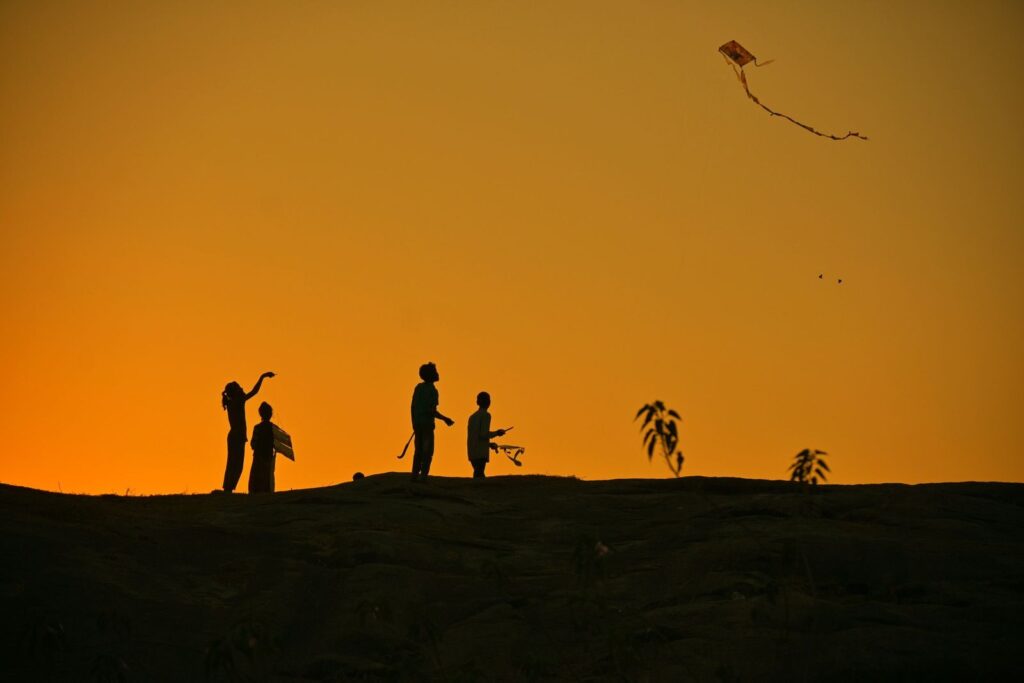
The image of a kite with a wish written on it, drifting away over a frozen field at sunset, is one many older Koreans still hold onto. It is a quiet, hopeful way to begin a year, and one worth knowing about the next time you see a rectangular kite with a hole in its middle dancing over a Korean riverbank.
For more about the games Korean children played, start with our overview of traditional Korean games.
Note: Some images in this post are AI-generated illustrations of traditional Korean kites.