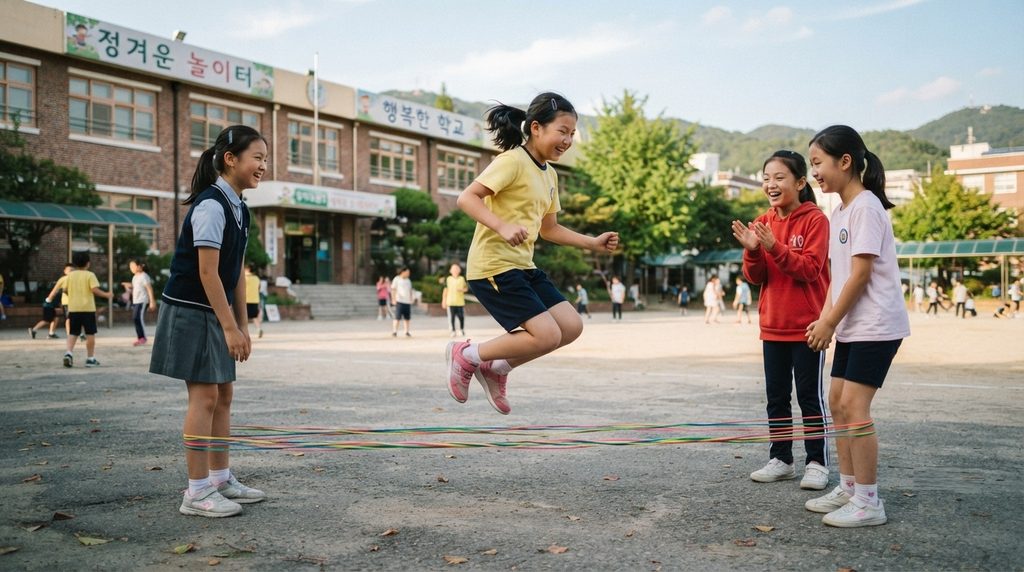
Gomujul nori is the Korean rubber band jumping game that filled school playgrounds and narrow alleys for decades. Two children stretch a long black rubber cord around their ankles, and a third hops, twists, and steps over it in time with a song. With every round the cord climbs higher, from ankles to knees, to waists, to shoulders, until only the most daring jumpers can still reach it. Ask almost any Korean woman who grew up before the 2000s, and she will remember the songs, the rhythm, and the boys who sneaked up to cut the rope.
Known in Korean as gomujul nori (고무줄놀이), literally “rubber cord play,” the game needs nothing but a few meters of elastic and two friends willing to hold it. This guide explains how it is played, the height levels and moves, the songs children chanted, the famous rope-cutting pranks, and why the game has almost disappeared from Korean playgrounds today.
Gomujul Nori at a Glance
| Korean name | Gomujul nori (고무줄놀이), “rubber cord play” |
| Players | Three or more: two holders and one or more jumpers, or two teams |
| Equipment | A long rubber cord, about 2 to 4 meters, usually tied into a loop |
| Where | School playgrounds, alleys, apartment courtyards |
| Golden age | From the 1950s through the early 1990s |
| Played mostly by | Girls of elementary school age |
| Cousins abroad | Chinese jump rope, “elastics” in Britain, Gummitwist in Germany |
What You Need: A Few Meters of Rubber
The game’s only piece of equipment was the gomujul itself. In the past, it was a thin, black, round rubber cord that children bought cheaply at the neighborhood stationery shop. Many people describe it as looking like a long strand of black noodles. Girls tied several pieces together until the loop was long enough, and the knots became part of the cord’s history. When it snapped, it was simply tied again.
Some children used flat white elastic, the kind sewn into the waistbands of clothes and underwear, which their mothers kept in the sewing box. Either way, the cord cost almost nothing, fit into a pocket, and could turn any open space into a playground in a few seconds. That simplicity is a big reason the game spread so widely. Like many games in our guide to where Korean kids got their toys, it depended on what a child could buy for a coin or two at the shop by the school gate.
How to Play: The Basic Rules
There is no single official rulebook, and every school and neighborhood had its own version. But the core of the game looks much the same everywhere.
- Set up the cord. Two players, the holders, stand facing each other a few meters apart with the loop stretched around their ankles, so two parallel lines of rubber stretch from one holder to the other. In a simpler version, the holders stretch just one line.
- Start the song. The jumper steps into the middle and begins singing, often with the holders and waiting players joining in.
- Follow the pattern. On each beat, the jumper hops in, out, over, and onto the cords in a set sequence, sometimes landing with one foot on each line, sometimes crossing the lines or twisting them around her ankles.
- Finish without a mistake. If she completes the whole song without missing a step, tangling the wrong way, or failing to touch the cord when she should, she moves on to the next level.
- Raise the cord. The holders lift the rubber to the next height, and the pattern begins again.
- Switch roles. When a jumper makes a mistake, she is out and becomes a holder, and someone else takes a turn.
In team versions, two sides took turns, and a skilled player could “save” a teammate who had been knocked out by successfully completing the level for her. These rescue moments were some of the most exciting parts of the game, and the best jumpers in a class enjoyed real playground fame.
The Height Levels
The thing everyone remembers is the cord climbing higher and higher. The exact steps varied, but a typical sequence went like this:
| 1. Ankles | The warm-up level. Anyone can do it. |
| 2. Knees | Still easy for most players. |
| 3. Thighs | Jumps start to need real spring. |
| 4. Waist | Where the game becomes a contest. |
| 5. Armpits or chest | Only good jumpers reach this level. |
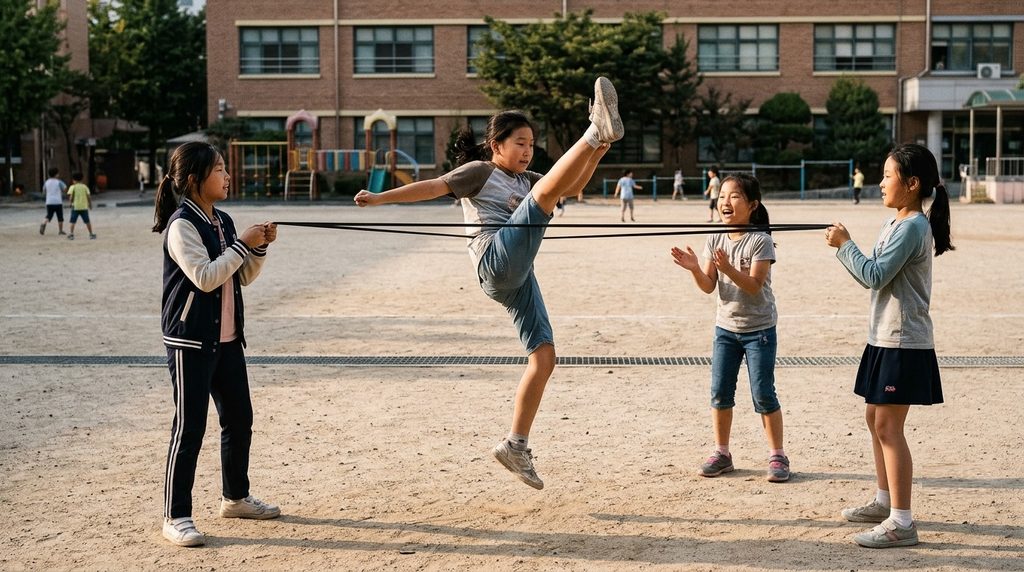
| 6. Shoulders or head | Players hook the cord with a high kick to pull it down. |
| 7. Hands raised | The holders lift the cord over their heads, sometimes standing on tiptoe. Called “manse,” like raising your arms in a cheer. |
At the higher levels, jumpers could not simply hop over the rubber. Instead, they used a high kick, a cartwheel-like swing, or even a handstand to catch the cord with a foot and pull it down to a reachable height before continuing the pattern. Watching a skilled girl hook a cord stretched above her own head was one of the most impressive sights on a Korean playground.
Lines, Triangles, and Other Shapes
The basic game used two parallel lines held by two players, but children found ways to make it harder and more social.
- Single line: A simpler version for younger children, with one stretch of rubber to jump over and step on.
- Double line: The classic version, with the loop around two pairs of ankles, allowing more complex footwork.
- Triangle: Three holders stand at the corners of a triangle, and jumpers move along all three sides, so more children can play at once.
- Tied to objects: When there were not enough friends to hold the cord, children tied one end to a tree, a pole, or a gatepost.
The Songs: Singing While You Jump
Gomujul nori was never played in silence. Every jump followed the beat of a song, and the song set the number and timing of the steps. If you knew the song, you knew the pattern.
The choice of songs tells an interesting piece of Korean history. In the decades after the Korean War, many of the most popular rubber band songs were military and patriotic songs that children heard all around them, including marching tunes about soldiers and the war. Girls who had no idea what the lyrics really meant sang them cheerfully while hopping over the cord. Looking back as adults, many Koreans are surprised by how serious those songs were.
Over time the soundtrack changed. Children’s songs from school, folk tunes, simple counting rhymes, TV commercial jingles, and cartoon theme songs gradually took over. Each generation sang what was popular in its own childhood, which is why people of different ages remember completely different rubber band songs, even though the game itself looks the same.
The rhythm mattered more than the words. A song with a steady, bouncy beat made the best rubber band song, and regional versions often changed the lyrics while keeping the tune.
“Cutting the Rope”: The Boys’ Favorite Prank
No memory of gomujul nori is complete without the boys who ruined it. A classic playground scene went like this: a few girls are deep in a game, singing and jumping, when a mischievous boy runs past with scissors, a small knife, or just a quick grab, cuts or snaps the cord, and runs off laughing. The girls shriek, chase him across the playground, and then patiently tie the cord back together.
This prank, called gomujul kkeunki (고무줄 끊기), became so famous that it turned into a symbol of childhood mischief in Korea. In comedy shows, cartoons, and dramas set in the 1970s and 1980s, a boy cutting a rubber cord is an instant shorthand for “elementary school.” Many adult Korean men will admit, with a guilty laugh, that they were once the culprit.
Older Koreans often say the prank was really a clumsy way for boys to get the attention of girls they liked. Whatever the reason, it made the game a little more dramatic, and it gave every knot in the cord a story.
Gomujul Nori Around the World
Korea is not the only country where children jump over elastic. The same basic game is known in English as Chinese jump rope, in Britain and Australia as elastics, in Germany as Gummitwist, and in the Philippines as Chinese garter. Its roots are often traced to China, and versions spread across Asia and later to Europe and the Americas, where it became a playground craze in the 1960s and 1970s.
What makes the Korean version distinct is mostly its soundtrack and setting: the black rubber cords from the stationery shop, the songs that changed with each decade, the alleys of crowded neighborhoods, and of course the rope-cutting boys. Many foreign visitors who played elastics as children are delighted to find that Korean women of their generation remember almost exactly the same game.
What the Game Taught
Adults who grew up with gomujul nori often say it taught more than jumping. The game asked for a surprising mix of skills.
- Rhythm and memory. Players had to remember long step patterns and match them exactly to the beat of a song, a little like learning a dance routine.
- Strength and flexibility. The higher levels demanded powerful jumps, high kicks, and the kind of balance that gymnasts train for.
- Fairness and negotiation. Because the rules changed from place to place, every game began with a short debate about which version to play, how many lives each player had, and what counted as a mistake.
- Teamwork. Holders had to keep the cord steady and at the right height, and in team games, rescuing a friend who had been knocked out built real loyalty.
It also gave girls a space that was clearly their own on the playground, while boys played rougher games like marbles and ddakji nearby. That division is less sharp today, but it shaped how a whole generation remembers recess.
Why the Game Disappeared
Walk past a Korean elementary school at recess today, and you are unlikely to see a rubber cord. Several changes pushed the game aside.
- Less free time. Many Korean children spend after-school hours at private academies, leaving little time for long, unstructured outdoor games.
- Fewer alleys. As neighborhoods of low houses were replaced by apartment complexes and busy roads, the narrow alleys where children gathered largely disappeared.
- New entertainment. Video games, smartphones, and organized sports gave children other ways to play.
- Smaller playgroups. Fewer children per family and per neighborhood made it harder to gather the three or more players the game needs.
Still, the game has not vanished entirely. Some schools and museums teach it during traditional game days, and you will see it at folk villages and cultural festivals. Interest in old playground games also rose after the series Squid Game introduced global audiences to Korean childhood games, which we explore in our guide to the Korean games in Squid Game.
How to Play It Yourself
You can try gomujul nori anywhere with a bit of space.
- Get a cord. A loop of elastic about 3 to 4 meters long works well. Strong sewing elastic or a store-bought Chinese jump rope is perfect.
- Find two holders. If you only have one friend, tie one end around a chair leg or a pole.
- Start low. Begin at the ankles with a simple in-and-out pattern before trying more complex moves.
- Pick a song with a strong beat. Any rhythmic children’s song works. The song keeps everyone on the same count.
- Raise the stakes slowly. Move up one height at a time, and save the high kicks for the brave.
More Korean Childhood Games
Gomujul nori sits alongside many other games Korean children once played in the streets. Our guide to traditional Korean games gives the big picture, and you can learn the rough-and-tumble boys’ game of malttukbakgi, the paper-folding battle of ddakji, or the playground classic mugunghwa kkochi pieotseumnida, Korea’s version of red light, green light.
Illustrations in this post were created with AI.