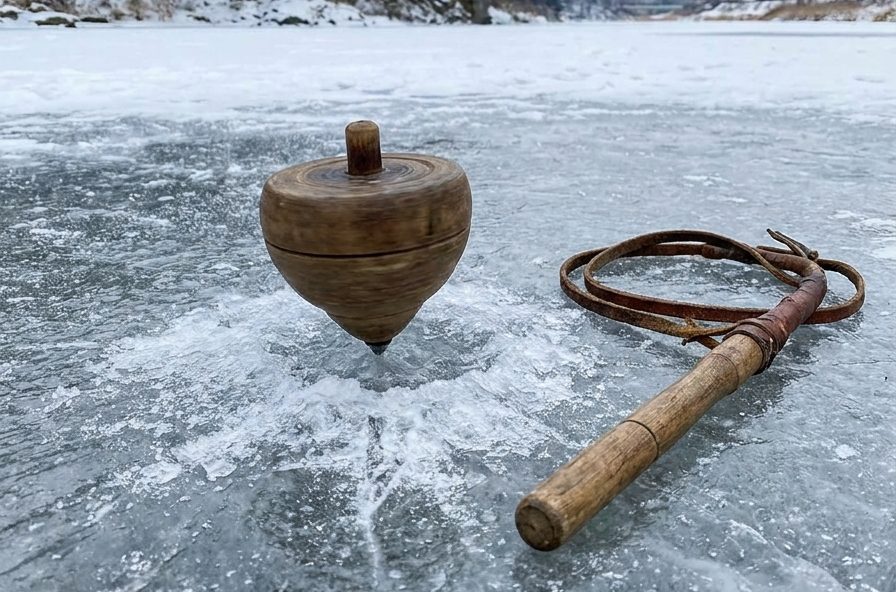
If you search for how to play paengi chigi, almost every guide shows you the same scene: a child on frozen ground in winter, striking a wooden top with a small whip to keep it spinning. That version is real, and it is old. It is also not the game I played.
I grew up in Incheon in the 1980s and 1990s. In my neighborhood, paengi chigi (팽이치기) meant something much more specific — a top bought at the corner stationery shop, a length of string wound around its stem like the thread of a screw, and a hard overhand throw that either landed clean or embarrassed you in front of six other kids standing in a circle.
Both are called paengi chigi. English articles almost always describe the first one and skip the second, which means they describe the museum version and miss the street version. This article is the street version, written by someone who was standing in that circle.

Two Different Games Share One Name
The confusion is worth clearing up first, because it changes everything about how the game is played.
The older form uses a whip. You spin a wooden top by hand or with a cord, and then you keep it alive by repeatedly striking its side with a stick that has a short strap attached. The top never stops on its own because you never stop hitting it. This is the form recorded in Korean folk tradition, and the form you will see demonstrated at cultural centers and school heritage days.
The form I grew up with uses a string and a single throw. There is no whip. You wind the string, you throw once, and after that the top is on its own. Everything that happens next — how long it spins, whether it survives a collision — was decided in the two seconds when the string left your hand.
That difference is not a small technical detail. The whip version rewards persistence. The throw version rewards a single moment of precision. They produce completely different kinds of players, and completely different playground arguments.
How to Play Paengi Chigi the Way We Played It
Here is the actual sequence, step by step, as I learned it around age eight or nine.
1. The top and the string come as a set
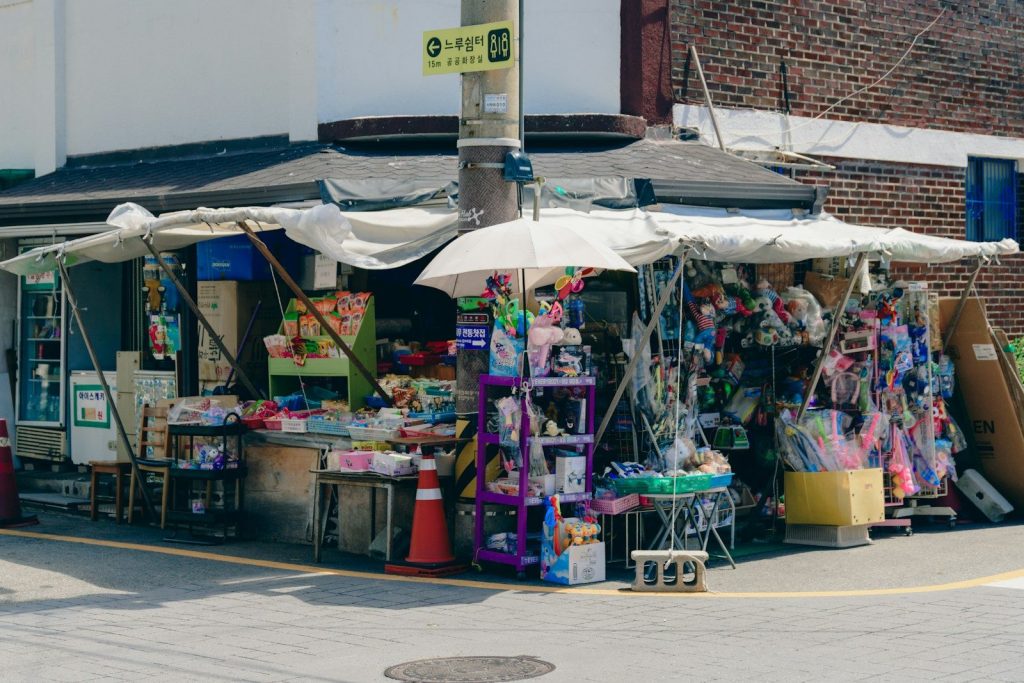
Nobody in my neighborhood carved their own. You walked to the mun-bang-gu (문방구), the small stationery shop that sat near every elementary school, and you bought a top with its string already included. The string mattered as much as the top — too short and you could not get enough wraps, too thin and it cut into your fingers.
2. Fix the string at the head
The top has a knob or a small lip at the top of its stem. You anchor the end of the string there first. If this anchor slips, the whole wind unravels the moment you throw, and the top drops straight to the ground like a dead weight.
3. Wind downward, then back up like a screw thread
From the head, you bring the string down to the metal tip at the bottom — the point the top actually spins on — and hook it near there. Then you wind upward in a tight spiral, each wrap sitting snugly against the last. This is the part that separated kids who could play from kids who were still learning. Loose wraps mean the string slips instead of gripping, and the top comes off the throw barely turning.
4. Hold the string and the top together, and throw
You do not throw the top and then pull the string as two separate motions. You grip the wound top and the free end of the string in the same hand, and you throw the whole thing forward and down. The string stays with your hand, unwinds against the top’s stem, and that unwinding is what spins it. The top flies out, meets the ground already turning, and settles.
When it works, there is a very particular sound — a short, dry snap as the string pulls free, then a low hum as the top finds its balance. When it fails, the top hits the dirt on its side and rolls, and you pick it up and wind again while someone says something about your technique.
The Two Ways We Competed
Once you could land a throw reliably, there were two contests, and every group of kids ran both.
Longest spin. Everyone throws at roughly the same moment, and the top still turning when the others have fallen wins. This sounds passive, but it is not — it rewards a clean, vertical landing and a well-balanced top, and it is the contest where a cheap top gets found out. A top with a slightly bent tip wobbles from the first second and dies early no matter how well you throw.
Top fighting. This was the real game. Two tops are spinning on the ground. Each player takes the two ends of a string in their hands, loops it behind their own spinning top, and uses that string to push their top across the ground into the opponent’s. The goal is to break the other top’s balance. A direct hit on a top that is already wobbling ends it immediately. A hit on a top spinning perfectly can bounce off and cost you your own balance instead.
Because the pushing is done with a string held in two hands, there is real skill in the approach — you can come in slow and controlled, or you can send your top across fast and gamble everything on one impact. Kids developed clear personalities here. Some players never lost a top and never won a fight.
Dokki-jjigi: The Move That Separated the Good Players
There was one throw that everybody knew about and almost nobody could do. We called it dokki-jjigi (도끼찍기), which means “axe chop.”
Instead of throwing the top forward at a shallow angle, you throw it straight down, hard and vertical, like swinging an axe into a log. Done correctly, the top drops onto its tip already spinning at full speed and stands up instantly, no roll, no settling. It looks like the top simply appeared on the ground spinning.
The success rate was low. Most attempts ended with the top bouncing off the dirt and skittering away, which is why most kids threw it forward and safe. But the payoff was enormous, because a vertical throw can be aimed. The best players in my neighborhood could dokki-jjigi directly onto an opponent’s spinning top and kill it on landing — no string pushing, no slow approach, just one drop from above that ended the round.
I want to be honest about one thing: I do not know whether dokki-jjigi was the national term or just what kids in my part of Incheon called it. Korean children’s games were full of local vocabulary that never made it into any book, and the name for a move could change between two neighborhoods a bus stop apart.
The Older Version: A Whip, a Wooden Top, and Ice
The traditional form deserves its own explanation, because it is genuinely old and genuinely different.
In that version, the top is wood, usually shaped by hand into a cone, and it is played on ice — a frozen paddy, a frozen stream, a frozen stretch of anything flat. Ice matters because it has almost no friction, so a top that would die in twenty seconds on dirt keeps going far longer. The player carries a short stick with a strap and keeps striking the top’s flank, adding energy every few seconds. A skilled player could keep one alive for as long as their arm held out.
Korean records of top spinning go back a long way. A seventeenth-century Korean language reference work records the activity under a word describing something whirling rapidly, and an eighth-century Japanese chronicle notes the top reaching Japan by way of Korea — which suggests the game was already established here well over a thousand years ago.
The traditional contests were similar in spirit to ours: keep yours spinning longest, or crash yours into your opponent’s and knock it over. Some regions also ran a distance version, driving the top forward along the ice to see whose traveled farthest while still turning.
I never played this version as a child. By my generation the ice-and-whip form had already moved out of everyday play and into demonstrations — something you saw an adult do at an event, not something waiting in your friend’s bag.
Why the Stationery Shop Mattered
If you want to understand Korean children’s play in the 1980s and 90s, you have to understand the mun-bang-gu.
These shops sat within a two-minute walk of almost every elementary school, and they sold school supplies at the front and the entire apparatus of childhood at the back — tops, strings, jegi shuttlecocks, sets of five gonggi stones, snacks, cheap toys. What a generation of Korean children played was, to a real extent, decided by what the local stationery shop chose to stock.
I should be careful here: I am describing the city I grew up in. It is entirely possible that in smaller towns and rural areas, homemade wooden tops were still normal into my childhood. I never saw one in my neighborhood, but a neighborhood is not a country.
Where We Actually Played
We played in the alleys.
Incheon in the 1980s was not yet a city of apartment towers. It was dense low-rise housing — detached houses and small multi-unit buildings packed along narrow lanes, with flat patches of ground between them where nobody parked and nothing was built. Those gaps were the playground. Not a designated playground with equipment, just the flat spot everyone agreed was the flat spot. The same empty lots are where we lit cans of fire for jwibulnori on winter evenings.
That ground shaped the game. Packed dirt is slower than ice, so spins were shorter and the fighting version dominated. It was also uneven, which meant a top could die from hitting a pebble rather than from anything either player did — and that was accepted as part of the game, the way a bad bounce is accepted in street football.
Those spaces are mostly gone now. The same lanes are apartment complexes with managed grounds and designated parking, and there is no longer a flat patch of nobody’s land where seven kids can stand in a circle for two hours. The game did not disappear because children stopped liking it. The ground it needed disappeared first.
Is Paengi Chigi Still Played in Korea?
Honestly, no. Not the way it was.
If you walk through a Korean neighborhood today, you will not find children spinning tops. I cannot remember the last time I saw it happen outside of an organized event. The game has not been banned or forgotten — it has simply stopped being one of the things a child would think to do on a free afternoon.
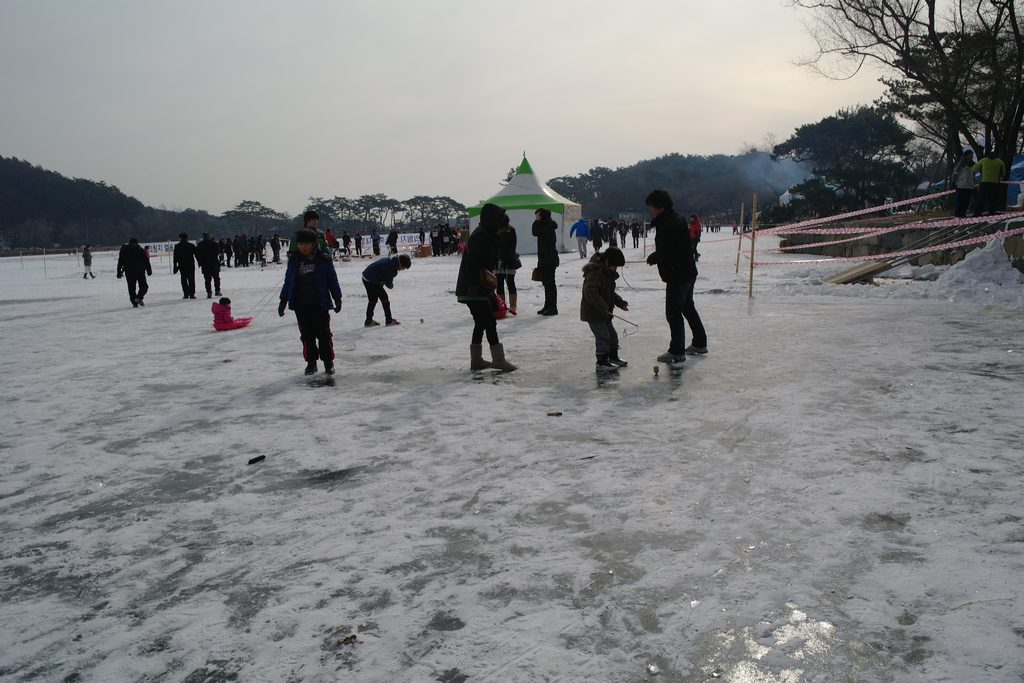
Where it does appear, it appears on a schedule. Winter festivals on frozen reservoirs set up a roped-off area and hand out wooden tops and whips. Schools run traditional play days. Folk villages keep a demonstration going for visitors. In all of these, an adult explains the game first, which tells you everything about its current status: it is now something that has to be taught, not something absorbed from older kids in an alley.
The competitive impulse behind it did survive, but under different names and different brands — battling tops with plastic launchers, sold as modern toys, following almost exactly the same logic of wind, launch, collide, last one turning wins. Children still do this. They just do not call it paengi chigi, and nobody thinks of it as Korean.
What disappeared was the middle layer: a top bought for pocket change at a shop near the school, thrown on packed dirt, with rules negotiated on the spot by whoever showed up. That layer needed three things at once — cheap equipment, unsupervised time, and a flat patch of ground nobody owned. Korea still has the first. The other two are gone. This is a different path from the games that reached global audiences through television, like the ones in Squid Game, which are now better known abroad than they are practiced at home.
Try It Yourself
If you want to try the version described here, it is not hard to set up.
- What you need: a string-launch spinning top and about two meters of cord. Korean folk-toy sets are sold online and in traditional market souvenir shops.
- Surface: flat and hard. Packed dirt, concrete, or a smooth board. Carpet and grass will not work at all.
- Difficulty: landing a clean throw takes most people twenty or thirty attempts. Winding tightly is the part beginners get wrong, not the throw itself.
- Start with: longest-spin, one player at a time. The fighting version needs two people who can already land throws consistently, or it becomes ten minutes of picking tops up off the ground.
If you would rather see the traditional whip version, look for a folk village or a municipal cultural center running a seasonal program — these usually appear around the winter holidays, and staff will hand you the whip and let you try.
One Last Thing
When people write about traditional Korean games, they tend to write about them as artifacts — fixed rules, fixed equipment, a fixed date of origin. That is not how any of this felt from the inside.
What I remember is that the rules were argued about constantly, the equipment came from a shop that also sold erasers, and the best player on our lane was famous for one throw he landed maybe one time in five. That is the part worth passing on. A game is not a set of rules. It is whoever was standing in the alley that afternoon.
The games that survived were the ones that worked indoors with a crowd, like yutnori at the holidays.