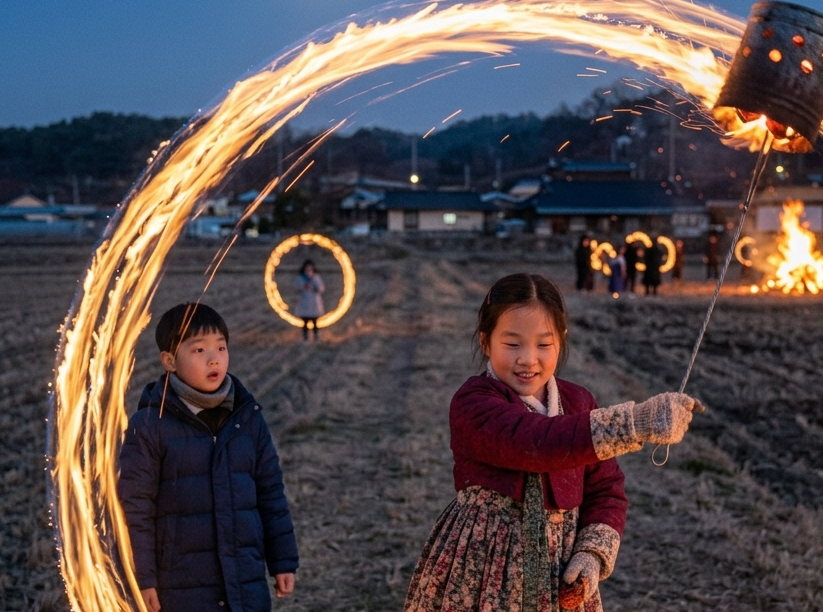
Every English guide to jwibulnori (쥐불놀이) files it in the same drawer: a folk ritual performed on the first full moon of the lunar year, when farmers burned the edges of their rice paddies to drive out rats and pests. That is where the game comes from. It is not what it was when I did it.
I did it as an elementary school kid in Incheon in the 1980s. Nobody checked the lunar calendar. Nobody was thinking about rats. A few of us would get the idea on a cold evening, somebody would find a can, and we would walk out to the edge of the neighborhood where the houses stopped and the empty ground began.
This is what that looked like — and why no Korean child does it anymore.
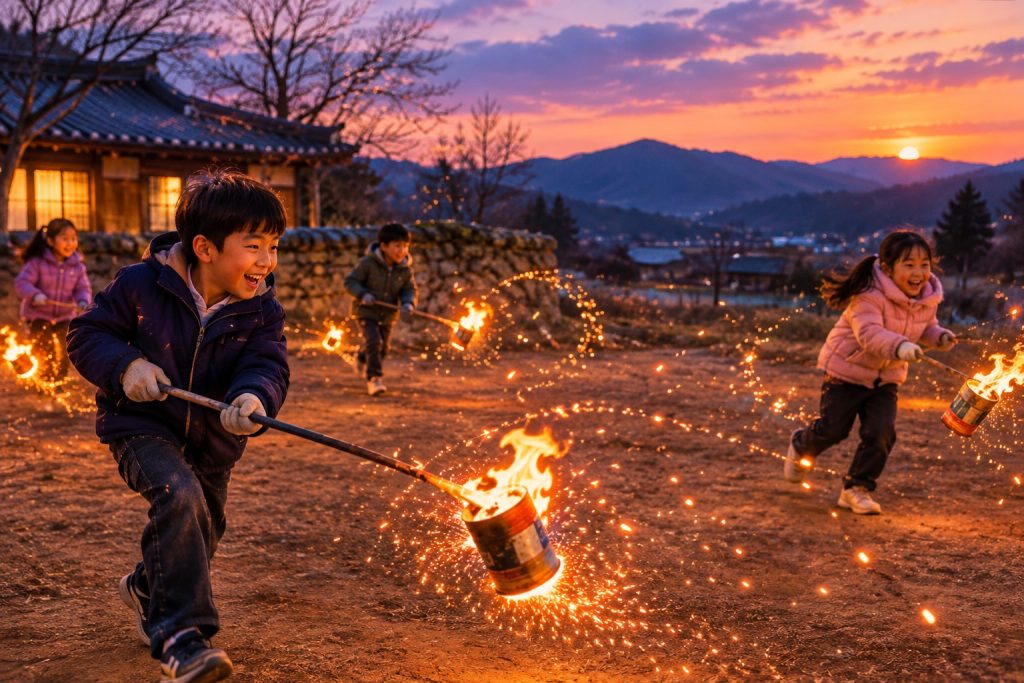
What Jwibulnori Actually Is
The name breaks down simply. Jwi (쥐) means rat, bul (불) means fire, and nori (놀이) means play. “Rat-fire play.”
In its oldest form it was not a children’s game at all. It was agricultural work with a festive edge: on a set day in the first lunar month, villagers set fire to the dry grass along the raised earth banks between rice paddies. The burning was meant to kill rats nesting in the banks and insect eggs overwintering in the weeds, and the ash went back into the soil.
The part people remember, though, is the fire can. At some point children started carrying the fire around in punctured tins swung on a wire, whipping them in wide circles until the embers inside roared. From a distance, a field full of kids doing this looks like dozens of orange rings hanging in the dark. That image — not the grass burning — is what most Koreans over forty picture when they hear the word.
How We Made the Can
There was no shop selling these. Every can was homemade, and making it was half the fun.
1. Find a can
You needed a metal tin roughly the size of a large coffee can. I think most of ours were powdered-milk tins, because those were the big sturdy cans every household with young children had lying around. Anything thin enough to crush in your hand was useless — it would buckle once it got hot.
2. Punch the holes
You took a nail and a stone or hammer and punched holes all over the sides and bottom. More holes meant more air, and air is the whole mechanism. A can with too few holes just smokes. A can with plenty of holes becomes a small forge once it is moving.
3. Attach the handle
A length of wire went through two holes near the rim and made a loop long enough to swing the can at arm’s length. The wire had to be metal. Anything else burned through.
4. Load it
Pieces of wood charcoal went in first, lit. On top went whatever would catch — torn paper, dry grass pulled from the field around you. Then you started swinging.
5. Swing until it wakes up
This is the moment everyone who did it remembers. At first nothing much happens, just a glow and some smoke. But as the can speeds up, air is forced through every hole at once, and the charcoal suddenly flares — you can hear it change from a hiss to a low rushing sound. Sparks start trailing out in a ring behind the can. That is when you know it is working.
Where We Did It: Guwol-dong Before It Was a City
Here is the detail that I have never seen in any English article, because it only makes sense if you were there.
Today Guwol-dong (구월동) is the administrative center of Incheon. City Hall is there. The main intercity bus terminal is there. It is dense, busy, and entirely paved.
When I was a child, as I remember it, the ground in front of what is now City Hall was farmland, and rice paddies ran most of the way to where the bus terminal stands now. City Hall moved to Guwol-dong in the mid-1980s, and the area around it was being built out through those years. I remember the construction clearly: paddies being filled in with truckloads of earth, flat stretches of raw dirt where there had been water the season before.
Those construction lots and the dry paddies at their edges were where we swung our cans. They were perfect for it — wide, open, nothing flammable nearby except grass, and far enough from houses that nobody complained. When the paddies were gone, we used whatever empty lot was farthest from the houses — the same kind of flat, ownerless ground where we threw paengi chigi tops in the daytime.
So the jwibulnori I knew was, quite literally, played on the last remaining rice fields of a city that was paving them over. I did not understand that at the time. I understand it now.
It Was Not About the Full Moon
This is where my experience parts ways with the textbook.
Written sources place jwibulnori firmly on a calendar: the first rat day of the first lunar month, and the days around Jeongwol Daeboreum (정월대보름), the first full moon. In farming villages, that timing mattered, because the burning had an agricultural purpose tied to the start of the season.
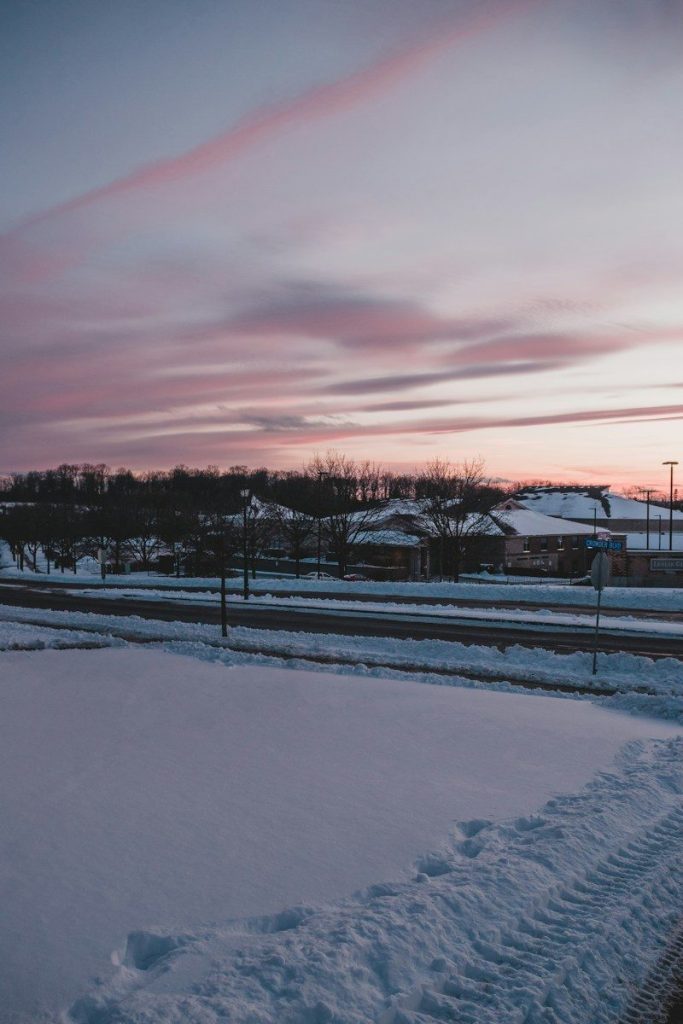
In a city neighborhood in the 1980s, none of that applied. There were no paddies of ours to protect. We did it in winter because winter is when the grass was dry and the evenings were long and dark enough for the fire rings to look good. But we did not wait for the full moon. If a few kids got together and someone had a can, that was the occasion.
I suspect this was common in cities. The game had detached from its purpose and survived purely as something fun to do with fire. The calendar date was the first thing to go.
The Old Tradition Behind It
The farming version is worth understanding properly, because it explains why adults tolerated what we did.
In the villages, the size of the fire was read as an omen. A big, vigorous burn meant a good harvest; a weak one was a bad sign. Neighboring villages would compete to burn more ground than the next village over, and there was a folk belief that the losing village would inherit the rats the winner had driven out.
Remarkably, this was not just folklore tolerated by the state — for a while it was encouraged. Korean newspaper accounts note that in the 1970s the national agricultural agency was still urging farmers to burn their paddy banks thoroughly, even as the forest service was complaining that roughly half of all winter forest fires were starting from jwibulnori. The two agencies were effectively giving opposite instructions to the same farmers.
That contradiction tells you where public feeling was. Jwibulnori was tradition, and tradition had goodwill. When a group of kids walked past with a can of charcoal, adults did not see a fire hazard. They saw something they had done themselves.
The Danger Nobody Talked About
I never started a fire. Nobody in our group ever did. But it would not have taken much.
The flat lots were safe enough. The real risk was the small wooded hills — low, scrubby rises scattered across Incheon neighborhoods back then. A can swung too close to one of those in a dry winter, one spark in dead leaves, and a whole hillside could have caught within minutes. We understood that the vague way children understand things, so we mostly kept to open ground.
What strikes me now is that no adult ever told us to quit. We were not scolded. Nobody chased us off. Ten-year-olds walking through a residential street with burning charcoal simply did not alarm anyone back then. That may be the clearest measure of how much has changed.
Why It Disappeared
Several things ended jwibulnori as a children’s pastime, all around the same time.
The land went. Regional cultural records in Korea describe the practice fading in the 1980s as urbanization accelerated. That matches exactly what I saw. The game needed open dry ground away from buildings, and the cities no longer had any.
Childhood changed. Korean children today spend their evenings on phones, games, study, and private academies, with family outings on the weekend. Kids gathering on their own after dark to build something out of a tin can and light it up simply does not fit into that schedule. It is not that they would not enjoy it. There is no unstructured time left in which it could happen. The traditional games that survived are the ones that fit indoors with family, like yutnori at the holidays.
It became illegal. This is the part foreign readers are usually surprised by.
Is Jwibulnori Legal in Korea Today?
In most of the places it used to happen, no.
Korea’s forest protection law was amended in late 2022 to ban burning of any kind within 100 meters of forested land, with fines of up to one million won. Burning paddy banks or farm waste near hills — the literal definition of traditional jwibulnori — now falls under that ban. If the fire spreads into forest, the consequences move from fines to criminal charges; even an accidental forest fire can bring a prison sentence or a heavy fine.
Burning in town is restricted too, for a different reason. Korean waste law prohibits burning household waste, so even an elderly resident burning trash in their own yard can be reported and fined. That rule is an environmental one, about smoke and pollution, while the forest rule is about fire risk. With both rules in place, there is very little legal ground left for a group of kids to light a can of charcoal and swing it around.
In practice, anyone lighting an unsupervised fire in an empty lot today should expect a neighbor to call it in. The same act that adults shrugged at in the 1980s would now be treated as a report-worthy incident.
Where You Can Still See It
Jwibulnori survives the same way many traditional Korean games do now: as an organized event.
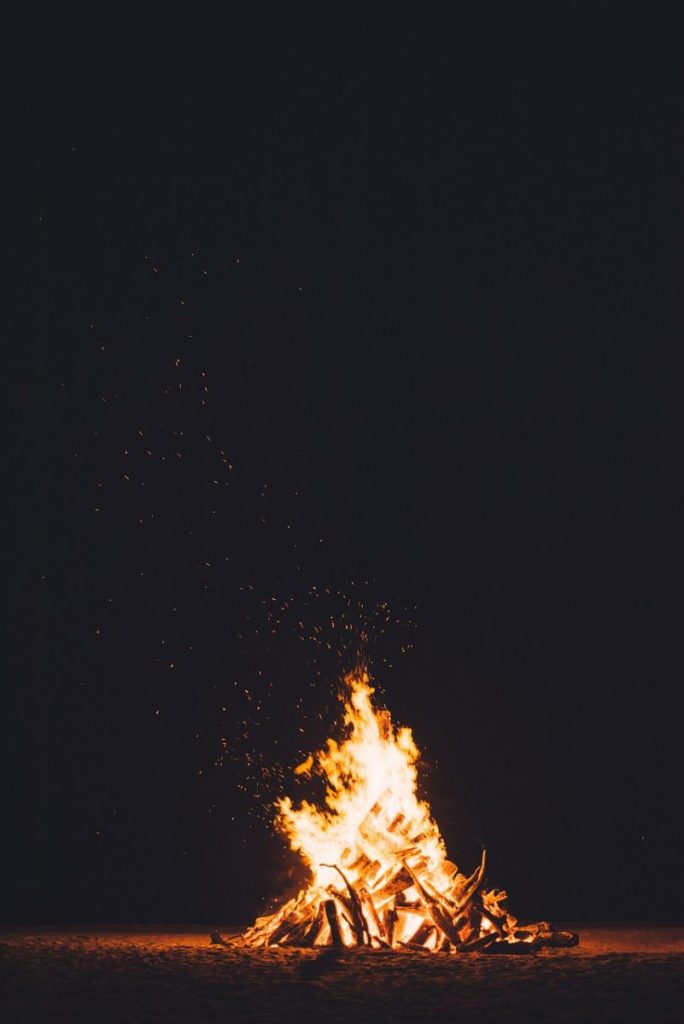
Around Jeongwol Daeboreum, local governments and village associations in various regions host full-moon festivals, usually with a large bonfire called a daljip (달집), a cone-shaped stack of straw and branches burned to welcome the moon. Some of these festivals include supervised fire-can swinging, in a designated area with fire crews standing by.
There is something a little ironic about that. The only way to do jwibulnori legally now is on the lunar calendar date the textbooks describe — the one date we never paid attention to. The game has been returned to its official origin, precisely because it can no longer exist anywhere else.
If you are in Korea in late winter, search for local Daeboreum festival listings a few weeks ahead; they are announced by individual city and county offices, and dates follow the lunar calendar, so they shift every year.
One Last Thing
When I think about jwibulnori now, what I see is not the fire. It is the ground: dark flat earth where rice had grown the year before, the lights of new buildings at the edge of it, and a few kids swinging orange circles in the cold between the two.
We thought we were just playing. We were actually standing at the exact moment a farming landscape turned into a city — the last generation for whom the fields were close enough to walk to after dinner.
Those fields are long gone. The neighborhood that grew up on them still has one place that feels the way it did then: Moraenae Market, where I tagged along on my mother’s grocery runs as a kid.