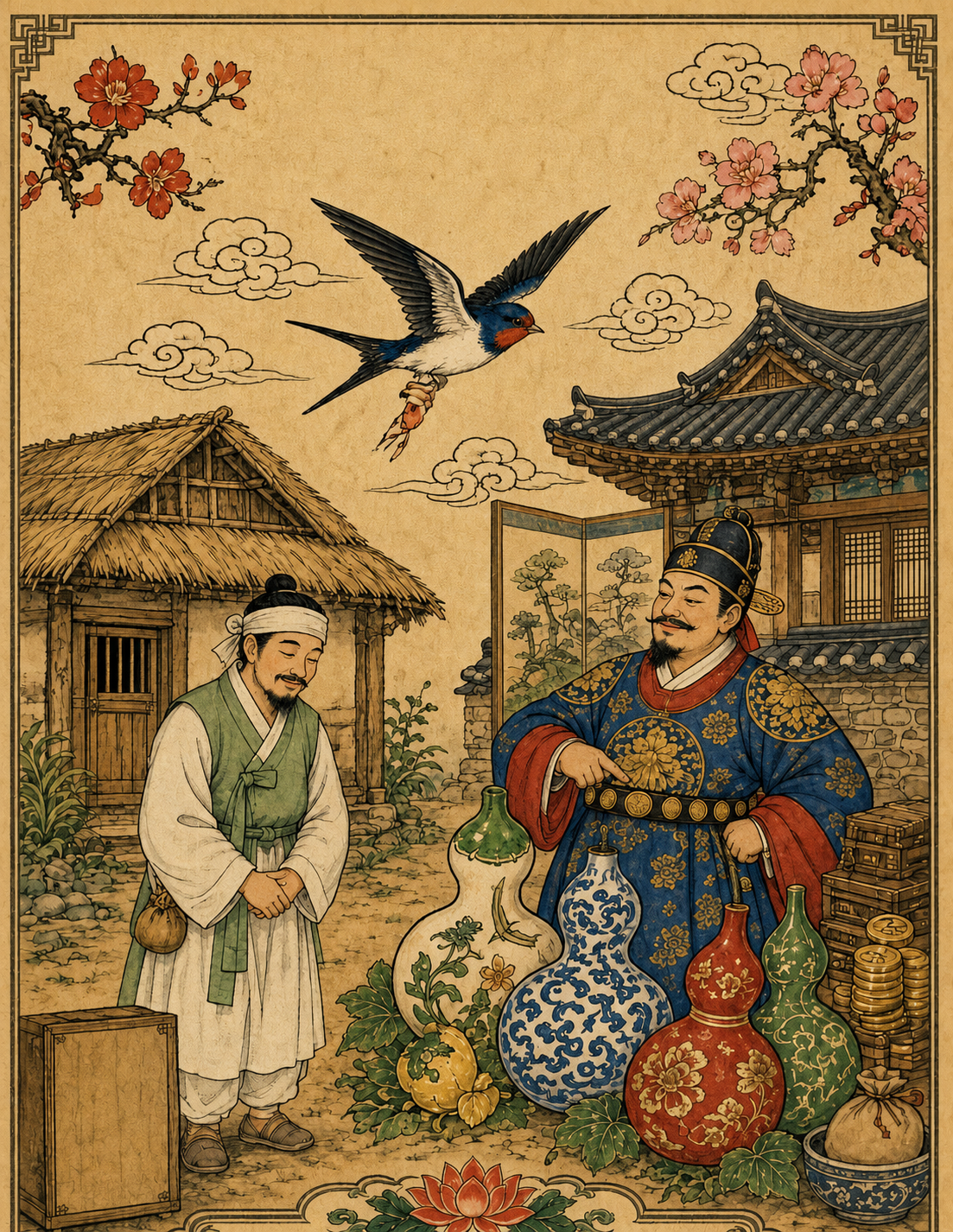
Heungbu and Nolbu is the story of two brothers. The elder is rich and cruel, the younger is poor and kind. A bird gets hurt, someone helps it, and gourds full of treasure follow. Most people can predict where this story is going within thirty seconds.
What almost no English summary tells you is how it ends — and the ending is where the story stops being a simple fable about kindness and becomes something specifically Korean.
The Story
Their father dies. Nolbu, the elder brother, takes the entire inheritance — which was his legal right under Joseon-era custom — and throws Heungbu, his wife, and their many children out of the house with nothing.
Heungbu tries everything. He builds a shack. He begs his brother for rice and gets beaten with a rice paddle for asking. In one of the story’s bleakest and funniest passages, he takes a job accepting a flogging on a wealthy man’s behalf, because corporal punishment could be served by proxy for a fee — and even that falls through.
The swallow
One spring a snake attacks a swallow’s nest under Heungbu’s eaves. A fledgling falls and breaks its leg. Heungbu splints it with cloth and nurses the bird until it can fly, and it leaves with the other swallows in autumn.
The following spring it returns and drops a gourd seed at his feet. He plants it. The gourds grow enormous, and when the family saws the first one open — they are hoping for something to eat — it is full of rice. The second holds silk and treasure. The third contains carpenters who build him a house.
The imitation
Nolbu hears about it and immediately understands the mechanism. He catches a swallow, breaks its leg himself, then splints it. The bird leaves and returns with a seed.
His gourds are where the story lets loose. Out of the first comes a debt collector demanding money. Out of the next, a troupe of travelling performers who eat everything and demand payment. Then acrobats, then a shaman demanding a ritual fee, then a strongman who wrecks the place. Each gourd strips more of his wealth. In the standard version he opens gourd after gourd anyway, unable to stop, until he has nothing.
The Ending Nobody Translates
Here is where English retellings of Heungbu and Nolbu usually stop: Nolbu is ruined, justice is served, the end.
The Korean version continues. Ruined and humiliated, Nolbu goes to his brother. And Heungbu — who was beaten with a rice paddle for asking for food, who watched his children starve — takes him in and shares his wealth. Nolbu repents. The brothers live together.
The Korean term for this is gaegwa-cheonseon (개과천선), roughly “correcting one’s faults and turning toward good.” It is not the same as forgiveness in the Christian sense, and it is not quite redemption either. The point is that the family is restored to its proper order.
This matters because it tells you what the story actually values. Punishing the wicked is not the goal — it is the mechanism. The goal is brotherhood intact. In a Confucian moral universe the bond between brothers is one of the fundamental relationships, and a story that ended with one brother destroyed and the other comfortable would be a story that ended in failure.
Not Just Korean
The rewarded-animal plot appears across East Asia. Mongolia has a tale of a girl and a gourd; China has a story of a yellow bird repaying kindness; Japan has “The Sparrow with the Cut Tongue,” in which a cruel old woman cuts out a sparrow’s tongue and the kind neighbours who care for it are rewarded, while she chooses the larger of two offered baskets and receives demons.
The Japanese parallel is close enough that the two stories were almost certainly not invented independently. What differs is the emphasis. The Japanese version turns on greed at a moment of choice — the wrong basket. The Korean version turns on the deliberate injury of the bird, which is to say on the corruption of a kind act into a calculated one. Nolbu does not fail because he wants too much. He fails because he heals a wound he made himself.
The Pansori Version
Before it was a book it was a song. Heungbuga (흥보가), also called Baktaryeong — “the gourd song” — is one of the five surviving works of pansori, the Korean tradition in which a single vocalist performs an entire narrative accompanied by one drummer. A full performance runs for hours.
Of the five, Heungbuga is the funniest and the most plebeian. Its language is closer to ordinary speech than the others, and the gourd-opening scenes are structured as extended comic set pieces — each new figure emerging from a gourd is an excuse for jokes, mimicry, and improvised business between singer and drummer. It was for exactly this reason looked down on by some singers as beneath serious performance, and parts of it fell out of the repertoire for a while.
The work first appears in written record in 1843, in a text by the scholar Song Man-jae describing the performances of his day. Pansori as a whole was designated an Important Intangible Cultural Property of Korea in 1964 and inscribed by UNESCO in 2003.
If you want to hear it, look for the Baktaryeong section specifically rather than a full performance — it is the most accessible entry point, and the audience’s shouted encouragements, called chuimsae, are part of the music rather than an interruption of it.

Where It Shows Up Today
The names are ordinary Korean vocabulary now. Calling someone a Nolbu needs no explanation. There is a large Korean restaurant chain called Nolboo, named for exactly this association — the joke being that the greedy brother’s name has been attached to somewhere that feeds you generously.
The plot structure is everywhere in Korean television. The virtuous poor sibling and the grasping wealthy one, with the wealthy one eventually humbled and reconciled rather than simply destroyed, is one of the most durable shapes in Korean drama. Once you have read this tale you will recognise it constantly.
Swallows still matter. A swallow nesting under your eaves is traditionally good luck, and the birds’ spring return is a seasonal marker in a way that has no exact English equivalent.
Reading It in English
The tale appears in most general collections of Korean folklore. Zong In-sob’s Folk Tales from Korea, first published by Routledge in 1952 and reprinted since, includes it among ninety-nine tales and gives it without softening — worth noting, because illustrated children’s editions almost always cut the flogging-for-hire episode and shorten Nolbu’s gourds to two or three.
If you read a version where Nolbu simply loses everything and disappears, you have an abridgement. Look for one that keeps the reconciliation.
This is one of five tales covered in our guide to Korean folk tales, alongside Sim Cheong, Kongjwi and Patjwi, and the siblings who became the sun and moon. For Korea’s written classical literature, The Tale of Chunhyang also began as a pansori song, and The Story of Hong Gildong takes the same theme of an unjustly excluded younger son somewhere considerably angrier.
More translated Korean works are collected in the Korean Books section.