If you discovered games like “Red Light, Green Light” or the paper-flipping ddakji through Netflix’s Squid Game, you’re in good company — the show introduced millions of people worldwide to Korean childhood games. But for those of us who grew up in 1980s Korea, these weren’t exotic curiosities. They were simply how we spent every afternoon, out in the alleys until our mothers called us home for dinner. As someone who played every one of these games as a kid, let me walk you through the real traditional Korean games behind the global phenomenon — how they work, and why they still matter.
Red Light, Green Light — Mugunghwa Kkochi Pieotseumnida
The chilling first game in Squid Game is a real children’s classic, though ours had no killer robot. In Korean it’s called mugunghwa kkochi pieotseumnida (무궁화 꽃이 피었습니다), which means “the rose of Sharon has bloomed” — the rose of Sharon being Korea’s national flower.
One child faces the wall and chants the phrase, then spins around. Everyone else creeps forward while the chanter isn’t looking and must freeze the instant they turn. Anyone caught moving is out. The magic is in the rhythm: the caller can rush the phrase or drag it out to trip you up. We played this on any open patch of ground, shrieking with laughter — a world away from the show’s tension, but the same simple, brilliant rules.
The Games You Made or Found
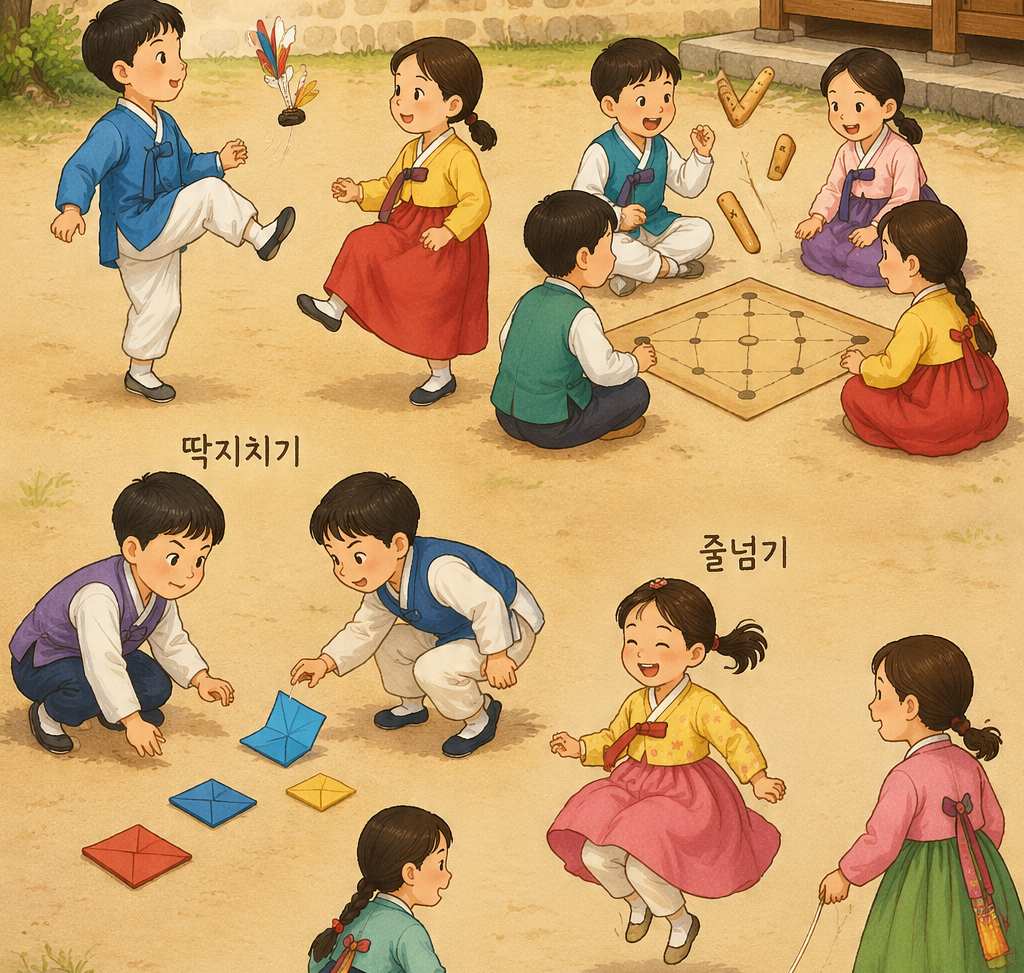
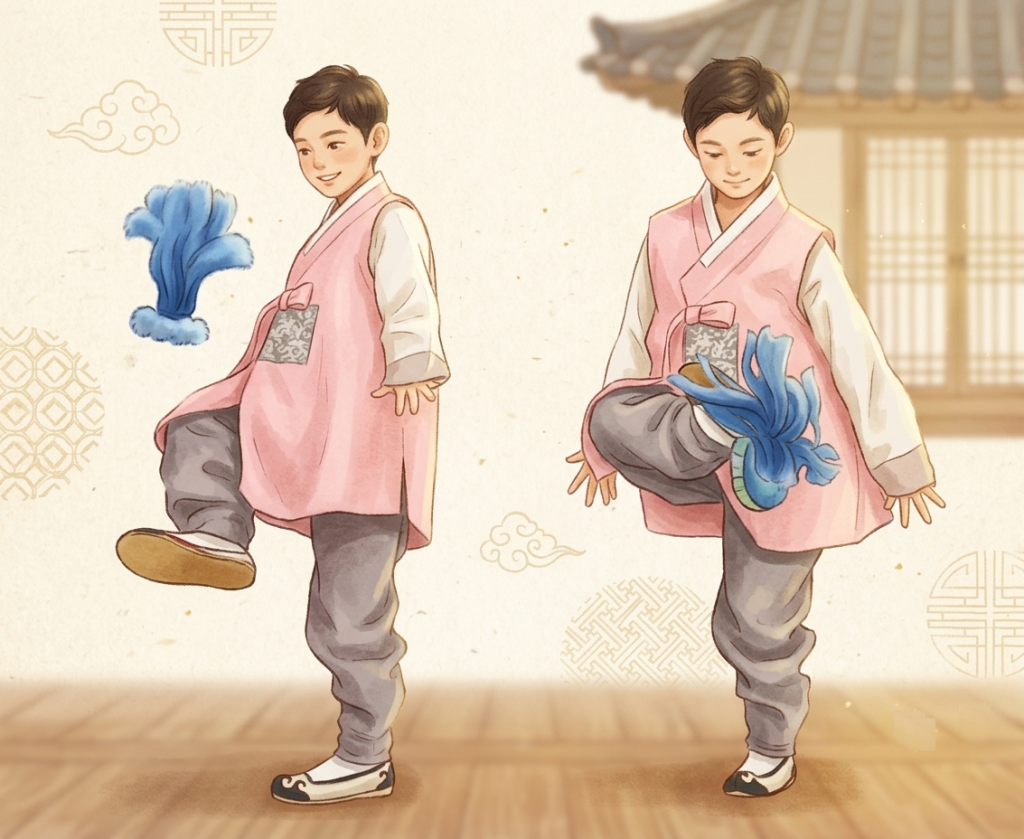
Three of the best-known games needed no real equipment. Ddakji (딱지) is the paper-flipping duel from Squid Game’s opening — two folded tiles, and you slam yours down beside your opponent’s to flip it over. Jegichagi (제기차기) is keeping a weighted shuttlecock in the air with the inside of your foot, counting consecutive kicks. Gonggi (공기) is the five-stone game of scattering, tossing and scooping, ending with all five caught on the back of your hand.
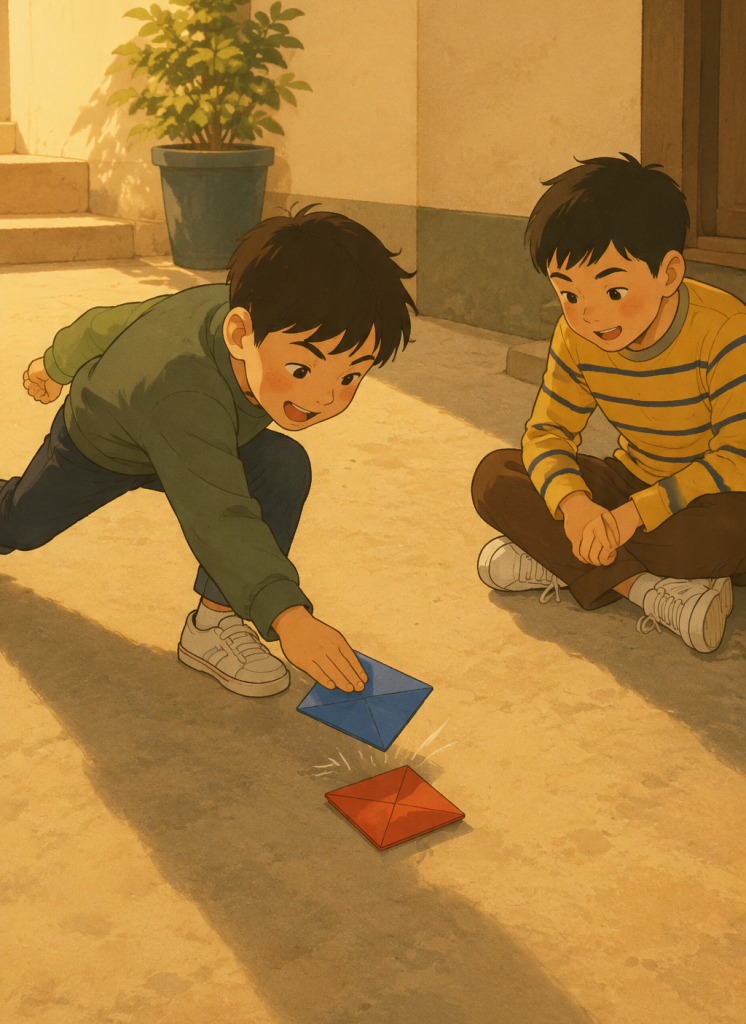
What the standard descriptions leave out is where the equipment actually came from, and in the 1980s that varied more than you would expect. Ddakji tiles were folded at home, and what you folded them from decided whether you won. Jegi and gonggi sets were usually bought at the stationery shop near the school, not improvised from coins and pebbles. I’ve written about that in detail in where Korean kids got their toys in the 1980s, because the supply line turns out to explain which games survived and which ones quietly stopped.
Yutnori — The Lunar New Year Board Game
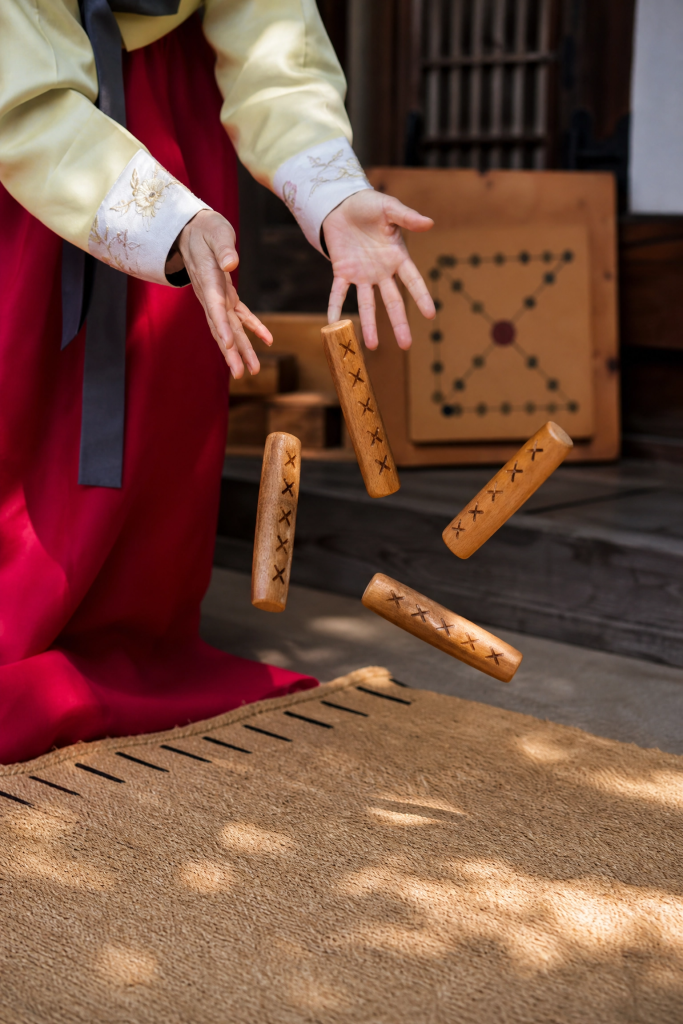
Not every game was played in the street. Yutnori (윷놀이) is the board game that still brings Korean families together every Lunar New Year (Seollal). Instead of dice, you throw four flat wooden sticks; how they land — flat or round side up — decides how many spaces your token moves, from one up to five.
With roots reaching back to Korea’s Three Kingdoms period, yutnori is genuinely ancient, yet it’s the liveliest thing at a family gathering. Teams shout, tokens leapfrog and send each other back to start, and grandparents beat grandchildren. If you want one traditional Korean game to actually play with friends, this is the one to learn.
The Rougher Neighborhood Games
Some of our favorites were pure physical chaos. In malttukbakki (말뚝박기), one team bent over in a long human “horse,” each player gripping the waist of the one ahead, while the other team took running leaps onto their backs, trying to pile on without the horse collapsing. It was rowdy, occasionally painful, and endlessly fun.
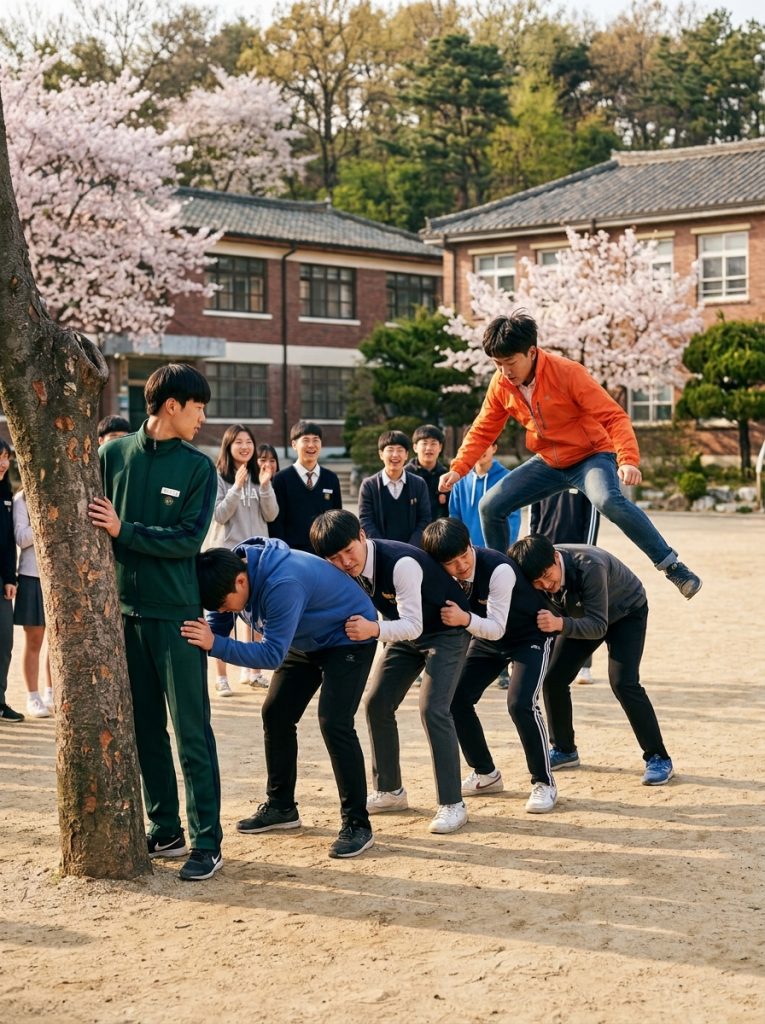
Then there was paengichigi (팽이치기), spinning wooden tops we whipped with a string to keep alive, and the universal favorite, sumbakkokjil (숨바꼭질) — hide and seek — which in a maze of narrow alleys could stretch on until the streetlights came on. These are the games that defined an entire generation’s childhood, long before anyone dreamed they’d go global.
For the string-launch version city kids played in the 1980s, see how to play paengi chigi.
Beyond Games: Seasonal Traditions
Beyond Games: Seasonal Traditions
Korea’s play culture extends past children’s games into the calendar itself, and two traditions are worth knowing about.
The first is jwibulnori (쥐불놀이), the fire game. In farming villages, on a set day in the first lunar month, people burned the dry grass along the banks between rice paddies to kill rats and overwintering insects, and children carried the fire around in punctured tin cans swung on a wire until the embers roared. The size of the burn was read as an omen for the year’s harvest, and neighboring villages competed to scorch more ground than each other.
What the standard account leaves out is what it became in the cities. We did it in Incheon in the 1980s on construction lots and drained paddies at the edge of the neighborhood, and we paid no attention whatsoever to the lunar calendar — we did it in winter because the grass was dry and the evenings were dark enough for the fire rings to look good. It has since become largely illegal, which is a story in itself.
The second is ganggangsullae (강강술래), the circle dance performed under the harvest moon, in which women join hands and move in a ring, the tempo building as the night goes on. It is old, it is regional, and UNESCO recognizes it as Intangible Cultural Heritage. Unlike the children’s games here, it survives through formal preservation rather than through anyone playing it casually — which is its own kind of answer to the question of what happens to a tradition when daily life no longer has room for it.
Where to Start If You Want to Try One
If you would like to actually play something rather than read about it, the options are not equal.
- Easiest to try anywhere: yutnori. Inexpensive sets are sold online and in Korean grocery stores, especially before the lunar new year, and the rules take four minutes to learn. It works with two players and comes alive with eight or more split into teams.
- Easiest to improvise: ddakji and gonggi. Ddakji needs nothing but paper and about a minute of folding. Gonggi needs five small objects of roughly equal size.
- Hardest to get right alone: top spinning. Landing a clean throw takes most beginners twenty or thirty attempts, and winding the string tightly is the part people get wrong, not the throw itself.
- Do not attempt: the rough physical games. Among adults these carry real risk of back and neck injury, and unlike the others there is no lighter version that keeps what made them fun.
Whichever you pick, the thing that made these games work was never the equipment. It was a group of people with an unplanned hour and no referee.
What These Games Actually Needed
Look at the whole list and a pattern shows up that no rulebook mentions. Every one of these games depended on three conditions, and none of the three is about the game itself.
Open ground that belonged to nobody. Incheon in the 1980s was low-rise housing along narrow lanes, with flat patches of dirt scattered among the buildings where nothing was built and nobody parked. Those gaps were the playground — not a designated one with equipment, just the flat spot everyone agreed was the flat spot. Tops, paper tiles, stones, hide and seek: all of it happened there.
Unsupervised hours. Every game here assumed a loose group of children with an unplanned afternoon and no adult organizing anything. That is the condition people underestimate most. You cannot schedule these games into a forty-minute slot; half the value was in the arguing, the rebuilding, the version of the rules you worked out with whoever turned up.
A cheap supply line. Whether that meant paper from the house or a small purchase at the shop near the school, the equipment had to be within reach of a child with no money or almost none. The moment a game required something a kid could not obtain on their own, it dropped out.
When these games disappeared, it was not because children lost interest. It was because all three conditions went at roughly the same time.
The Rules Were Never Fixed
Every guide to traditional Korean games presents them as settled systems with correct rules. That is what a reference work has to do, but it is not what existed on the ground.
Gonggi had a different finishing rule two streets over. The stone-throwing game I knew as malbangkkagi appears in the books under an entirely different name. Ddakji had house rules about re-folding a damaged tile mid-game. When a child arrived from another neighborhood, the first few minutes went to working out whose version applied, and the answer was usually whoever had more people on their side.
This flexibility is also why the games worked so well across mixed ages. A group with a six-year-old and a twelve-year-old would quietly adjust the difficulty without calling it a handicap. Nobody was reading from a rulebook, so nobody had to announce a departure from one.
It is the hardest part to revive. You can teach a class the standardized rules of any of these in ten minutes. What you cannot hand over is a group of children with enough unsupervised time to argue their own version into existence.
Which Ones Are Still Played
The outcomes were not equal, and the differences are worth knowing before you go looking for any of this in Korea today.
Still genuinely alive: yutnori. Ordinary families still play it at the holidays, not as a demonstration. It survives because it needs no open ground, no shop and no unsupervised time — only a holiday and a full room.
Alive as heritage education: top spinning, jegichagi, gonggi. You will see these at folk villages, school culture days and municipal programs, usually with an adult explaining the rules first. That framing tells you their current status precisely: they now have to be taught rather than absorbed.
Effectively gone: the fire-can game, the rougher neighborhood games, and most street play. Some of these are now restricted by law, and some simply lost the ground they required.
So if you are visiting Korea hoping to see children playing these in the street, you will not find it. What you can find is the organized version, and that is worth seeing on its own terms — as long as you know which one you are looking at.
Why These Games Still Matter
Squid Game turned these humble pastimes into a worldwide talking point, and there’s a lovely irony in that. Beneath the show’s brutal competition, the real games were built on the opposite value: community. They cost nothing, needed no batteries, and pulled whole neighborhoods of kids outside together. Cultural experts often point out that games like tug-of-war and yutnori are fundamentally about cooperation and shared fun.
The best part? You can play almost all of them yourself. Fold a ddakji, find five smooth stones, or gather friends for a round of yutnori. It’s the most hands-on way to touch a piece of everyday Korean culture — no Netflix subscription required.
Keep Exploring Korean Culture
Curious about the modern side of the Korean Wave? Our K-pop terminology glossary decodes the fandom words every new fan should know. And if you’d like to see everyday Korea for yourself, take a look at our local’s guide to Juan Station in Incheon.
For a first-hand account of the fire-can game on the last rice paddies of 1980s Incheon, see jwibulnori.
The one game that never needed reviving is yutnori, still played by families every Seollal.
For the game that schools quietly retired, see malttukbakgi.